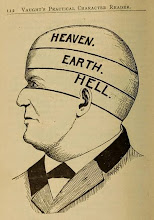
Clerical magic in D&D - pre-memorized, predictable, healing-heavy - strikes a lot of people as not quite right. I've covered this ground before, but in thinking how the final 52 Page Prophet class should work, a few things are still not clear to me.
What is clear: a need to move from a standardized list of "miracles" to a list of choices, so that players can be druid (or Franciscan) nature priests, healers, abjurers, diviners at will: the same kind of choice that wizards get.
What is also clear: having a separate module for hit point restoration, as I do currently, is good. It means miracles aren't short-changed for healing, and because it's presented as confidence rebuilding rather than actual physical healing, it can be farmed out to composite classes like bards or commanders.
What is less clear: how clerical magic should be different from wizard magic.
Some follow an intuition that clerical magic should work less predictably: basing it on a turning roll (Talysman's way) or some other random roll (Brendan's way). Currently in my 52 Pages, for prophets, one miracle is free and you keep getting miracles as long as you make a Mind save.
Others go farther and insist the clerical magic should involve developing a relationship with a divine agency. The first edition AD&D Players Handbook started this trend, basing clerical spells of high level on good behavior, and being even more harsh toward the paladin. Dungeon Crawl Classics has not only the cleric, but the wizard, dependent on the favor or disfavor of a supernatural entity. Under these rules, the cleric-type should behave in ways approved by the god. For following these strictures they get rewards and for ignoring them they get punished.
So, when I last turned my thoughts to this, I came out on the side that clerical magic should not just be random, but should reflect a relationship between cleric and a free-willed deity- much like the one between any other character type and their trainer or mentor.
There are three problems with this, though, as I've realized lately:
1. As with my old observations on alignment, I never had the urge to turn that observation into an actual system, or to play that way - which should be telling me something. The shocking things that you'd think might happen if you just let cleric-type players do their thing, don't actually happen in my experience. Mostly, they either act up to the pious standard, or present a cheerfully helpful healing service to a venal expedition. Letting them be wild and erratic-seeming "prophets" rather than staid "priests" helps, somewhat.
2. I have no desire as DM to be treated as a god - yet that is exactly what happens when you start acting out the relationship between deity and worshiper. I suppose for a player who wants to take on that challenge, I could oblige, just as I take all the myriad roles of the world. But to make it a mechanical requirement of the basic functioning of a character just seems wrong. Although social relationships may be important to some individual characters, I want to give players the freedom, always, to take or leave those relationships.
3. Finally, subjecting the divine relationship to rules, even random ones or player-skill ones, is a kind of theology that leads to bad, ultimately unsatisfying consequences. Let me explain ... but next time, where I'll also consider what would happen if you did have a cleric-player who took their character very much off the rails.
Showing posts with label church. Show all posts
Monday, 15 April 2013
Sunday, 24 March 2013
Holy World
You know what this is? Number eighteen in the series of thirty-six of these pocket genre worlds. Halfway there! Hallelujah!
Sunday, 5 December 2010
Church World Triumphant
Of the three settings for D&D I proposed - the clericless Sorcery World, the polytheist Pantheon World, and the monotheist Church World - I chose the latter for my ongoing campaign. And I'm not regretting that choice.
Running off the D&D grid, with an old rule set, gives many freedoms. One that keeps getting spotlighted is the freedom to use all the red-blooded trappings of 1970's fantasy that were expunged in reaction to parental and Christian pressure groups. Demons, devils, half-orc assassin PCs, human sacrifices, naked lady pictures, naked lady human sacrifices ... Both Third Edition official content and Old School revivalism have produced intentionally notorious products, as returns of the repressed.
But ironically, another historical element purged from the game has never made such a loud comeback: the backdrop of medieval Christianity that gives us clerics, paladins, relics, and a spell list ripped straight from the Bible. In part, this is because the repression was self-imposed and subtle. No atheist or Jewish groups sought to expel D&D from schools because it promoted Christianity, even if the case that it promoted Satanism was equally ludicrous. The shift from a Church World of OD&D to a Pantheon World of 2nd Edition was gradual, and in keeping with the adoption of standard campaign settings, Greyhawk (especially the 1983 version) and Forgotten Realms. Those products, unlike the more open-ended 1980 Greyhawk, forced TSR's cards on the table regarding details of religion.
With the Satanic panic stinging, it's easy to see why TSR skirted monotheism by the length of a ten-foot pole. Ever since Giordano Bruno was burned at the stake for daring to suggest that God had created other worlds than ours, the relationship of speculative fiction to Christianity has been questionable. Any fictional or counterfactual treatment risks offending a religion whose truths are deterministic and rooted in historical time (see here, Experiment 5).
The Catholic Tolkien and Anglican Lewis famously finessed this point by placing their tales, respectively, in a world of virtuous pagans, and a world where Christ was represented in a plain allegory. But presenting an alternate monotheistic Church was not a path easily followed as TSR got bigger and more accountable. The typical North American paralytic reaction then set in, as seen elsewhere when handling issues of sexuality and race: better to burn out and bowdlerize, than to discuss, risking offense and dissension. The "cleric" took on a life of its own as an ahistorical pagan-Christian hybrid who wasn't sacrificing animals and casting auguries so much as healing, healing, turning and healing, all in the name of, uh, Odin or someone like that.
With freedom restored through the return of powers to the gamer, I see no reason to observe the taboo any longer. A monotheistic world has certain advantages. The cleric class gets a lot simpler - no more domain spells, or god-weapon lists. Clerics stick together rather than worrying about whether they should fight each other. The competing concerns of Church and State, moral and temporal, add variety to power struggles without the need to factor in 18 Churches.
Working in folk beliefs that take the Church "halfway to paganism" in some places also add variety, and a further moral question of toleration versus orthodoxy. In fact, I'll be showing off some of the folk-saints of Mittellus in the next series of posts, who are very much inspired by popular beliefs in Europe that represent a syncretism of ancient gods and Christian saints - Voudoun for white folks, if you will.
What's more, I think a fantasy-historical version of the Church can be presented without offending either believers or nonbelievers. The nature and origin of miracles, salvation, and reality can be debated in-world, without the GM needing to pronounce ex cathedra, and the historical Christian church offers enough examples from saints to simoniacs that both the good and the bad can be explored.
But, as with everything from rulings improvisation to in-game romance, this approach requires a knowledgeable GM with a mature and balanced attitude. And that's not something that can be easily extracted from a supplement.
Running off the D&D grid, with an old rule set, gives many freedoms. One that keeps getting spotlighted is the freedom to use all the red-blooded trappings of 1970's fantasy that were expunged in reaction to parental and Christian pressure groups. Demons, devils, half-orc assassin PCs, human sacrifices, naked lady pictures, naked lady human sacrifices ... Both Third Edition official content and Old School revivalism have produced intentionally notorious products, as returns of the repressed.
But ironically, another historical element purged from the game has never made such a loud comeback: the backdrop of medieval Christianity that gives us clerics, paladins, relics, and a spell list ripped straight from the Bible. In part, this is because the repression was self-imposed and subtle. No atheist or Jewish groups sought to expel D&D from schools because it promoted Christianity, even if the case that it promoted Satanism was equally ludicrous. The shift from a Church World of OD&D to a Pantheon World of 2nd Edition was gradual, and in keeping with the adoption of standard campaign settings, Greyhawk (especially the 1983 version) and Forgotten Realms. Those products, unlike the more open-ended 1980 Greyhawk, forced TSR's cards on the table regarding details of religion.
![]() |
| Uncensored knights from Valdemar Miniatures |
The Catholic Tolkien and Anglican Lewis famously finessed this point by placing their tales, respectively, in a world of virtuous pagans, and a world where Christ was represented in a plain allegory. But presenting an alternate monotheistic Church was not a path easily followed as TSR got bigger and more accountable. The typical North American paralytic reaction then set in, as seen elsewhere when handling issues of sexuality and race: better to burn out and bowdlerize, than to discuss, risking offense and dissension. The "cleric" took on a life of its own as an ahistorical pagan-Christian hybrid who wasn't sacrificing animals and casting auguries so much as healing, healing, turning and healing, all in the name of, uh, Odin or someone like that.
With freedom restored through the return of powers to the gamer, I see no reason to observe the taboo any longer. A monotheistic world has certain advantages. The cleric class gets a lot simpler - no more domain spells, or god-weapon lists. Clerics stick together rather than worrying about whether they should fight each other. The competing concerns of Church and State, moral and temporal, add variety to power struggles without the need to factor in 18 Churches.
Working in folk beliefs that take the Church "halfway to paganism" in some places also add variety, and a further moral question of toleration versus orthodoxy. In fact, I'll be showing off some of the folk-saints of Mittellus in the next series of posts, who are very much inspired by popular beliefs in Europe that represent a syncretism of ancient gods and Christian saints - Voudoun for white folks, if you will.
What's more, I think a fantasy-historical version of the Church can be presented without offending either believers or nonbelievers. The nature and origin of miracles, salvation, and reality can be debated in-world, without the GM needing to pronounce ex cathedra, and the historical Christian church offers enough examples from saints to simoniacs that both the good and the bad can be explored.
But, as with everything from rulings improvisation to in-game romance, this approach requires a knowledgeable GM with a mature and balanced attitude. And that's not something that can be easily extracted from a supplement.
Tuesday, 16 November 2010
Mittellus: Religion
Some notes on the religious history of the world, Mittellus, that houses the Trossley campaign.
The Old Way has always been the way of man: gods that were their domains, harvest and springing stag, rills and mountain peaks, served by shamans, Druach votaries, goat-leapers and wind-witches. Cut down time and again by the empires of men, the ancient rites find accommodation, and spring back when empires fall. But this time, they have competition: the Church.
In the dark years after the breaking of the Millennial Empire, it was commanded that three prophets receive the Revelation that there is but one God: Odaus, the sage of the East; Invictus, the young soldier of the West; and Amalthea, aristocrat of the ravaged Millennial homelands. Spreading the word and the blessings of holy miracles, the three found each other within a decade, and the Church was formed. Then, on a mission to convert a King of the North, Odaus betrayed the Lady Amalthea to the barbarians to save his own skin, a despicable act for which his followers in the East blamed Invictus. So was born the schism of the churches, West against East, with Amalthea as martyr.
It has been five hundred years since then. Kings and pontifices of the West have waged near-constant war, against priest-emperors of the East and eruptions of barbarians and worse from the edges of the world. Trossley sits in a landlocked area of the Northern Continent Alatoria, within the sphere of the Western Church, but here the reach of the Sacred Seat is tenuous. Mitras, Hermas, Froellia, Uncumber, Eracle and other folk-saints are much honored hereabouts. Priests are trained and knowledge concentrated in fortified phalansteries, and it seems every town of some standing is trying to build a church to rival its neighbors.
Enemies of the Church are many. The benighted Eastern followers of Odaus, even more infuriating for their claim to the true Revelation; the Anti-God or Devil known from the Revelation, a subtle fellow with many secret worshippers and guises; the Powers of Beyond, demons of utmost Chaos who enter the world through the gates of human desire; and those who cling to the Old Way, although these are the least of the Church's worries and are even somewhat tolerated in the Alatorian hinterland.
Against these stand the Church hierarchy and the holy Orders. The unforgiving black-robed followers of St. Hieracon are charged with maintaining doctrinal purity and order among the Church and her faithful. The brown-robed hermits and peaceful wanderers of St. Silvain are popular with the common folk but suspected to be soft on the Old Way. The main Militant orders are three: the Order of Valentia, the Order of the Tower, and the wandering Peregrines. Holy Sequina, the Divine Wisdom, shelters mystics and intellectuals alike in her white-robed Order.
Raise, then, the equal-armed Cross and let the banners of the Church advance! But make sure that the Cross you raise has the horizontal bar over the vertical - the Western church's Hilt of Invictus - and not the vertical over the horizontal - sign of the Devil's own heresy, the Staff of Odaus, sacred to the Anti-Church of the East.
The Old Way has always been the way of man: gods that were their domains, harvest and springing stag, rills and mountain peaks, served by shamans, Druach votaries, goat-leapers and wind-witches. Cut down time and again by the empires of men, the ancient rites find accommodation, and spring back when empires fall. But this time, they have competition: the Church.
In the dark years after the breaking of the Millennial Empire, it was commanded that three prophets receive the Revelation that there is but one God: Odaus, the sage of the East; Invictus, the young soldier of the West; and Amalthea, aristocrat of the ravaged Millennial homelands. Spreading the word and the blessings of holy miracles, the three found each other within a decade, and the Church was formed. Then, on a mission to convert a King of the North, Odaus betrayed the Lady Amalthea to the barbarians to save his own skin, a despicable act for which his followers in the East blamed Invictus. So was born the schism of the churches, West against East, with Amalthea as martyr.
![]() | ||
| Folk-saints Phoebe and Mitras counsel King Thonar |
Enemies of the Church are many. The benighted Eastern followers of Odaus, even more infuriating for their claim to the true Revelation; the Anti-God or Devil known from the Revelation, a subtle fellow with many secret worshippers and guises; the Powers of Beyond, demons of utmost Chaos who enter the world through the gates of human desire; and those who cling to the Old Way, although these are the least of the Church's worries and are even somewhat tolerated in the Alatorian hinterland.
![]() |
| Silvanian mendicant friars |
Raise, then, the equal-armed Cross and let the banners of the Church advance! But make sure that the Cross you raise has the horizontal bar over the vertical - the Western church's Hilt of Invictus - and not the vertical over the horizontal - sign of the Devil's own heresy, the Staff of Odaus, sacred to the Anti-Church of the East.
Tuesday, 19 October 2010
Church World: Priest Spell Lists
Standard Priests and Militants of the Church
All White and Gold spells at each level
Additional spells available, from the magic lists:
Level 1: Blinding Light, Temptation/Fortitude, Translate/Obfuscate, Detect Magic
Level 2: Augury, Find Dangers, Multiply Matter, Tonguetie/Tongueloose
Level 3: Dispel Magic, Hold Persons, Magic Circle, Create Material
Level 4: Anti-Magic, Divination, Confusion, Mastery of Weather
Level 5: Hold Monsters, Greater Summoning, Mastery of Earth, Mastery of Water
Level 6: Legend Lore, Planar Travel, Power Word, Earthquake
Special Orders of the Church
Order of St. Hieracon (Inquisitors): All White, Orange and Green spells
Order of St. Silvain (Hermits): All Brown, Gold and Orange spells
Order of St. Sequina (Mystics): All White, Silver and Orange spells
Druids of the Old Way
All Brown spells at each level; all Gold spells to level 4
Additional spells available, from the magic lists:
Level 1: Animate Small Object, Charm Person, Translate/Obfuscate, Detect Magic
Level 2: Augury, Find Dangers, Fear, Levitate/Root
Level 3: Dispel Magic, Speak with Object, Breathe/Choke, Damage Ward
Level 4: Anti-Magic, Change Form, Divination, Confusion
Level 5: Hold Monsters, Greater Summoning, Polymorph Other, Wall of Stone
Level 6: Legend Lore, Planar Travel, Power Word, Earthquake
Diabolic and Demonic Cults
Typically: All Black spells, and all spells of two schools from this list: Red, Yellow, Green, Purple, Orange, Silver
All White and Gold spells at each level
Additional spells available, from the magic lists:
Level 1: Blinding Light, Temptation/Fortitude, Translate/Obfuscate, Detect Magic
Level 2: Augury, Find Dangers, Multiply Matter, Tonguetie/Tongueloose
Level 3: Dispel Magic, Hold Persons, Magic Circle, Create Material
Level 4: Anti-Magic, Divination, Confusion, Mastery of Weather
Level 5: Hold Monsters, Greater Summoning, Mastery of Earth, Mastery of Water
Level 6: Legend Lore, Planar Travel, Power Word, Earthquake
Special Orders of the Church
Order of St. Hieracon (Inquisitors): All White, Orange and Green spells
Order of St. Silvain (Hermits): All Brown, Gold and Orange spells
Order of St. Sequina (Mystics): All White, Silver and Orange spells
Druids of the Old Way
All Brown spells at each level; all Gold spells to level 4
Additional spells available, from the magic lists:
Level 1: Animate Small Object, Charm Person, Translate/Obfuscate, Detect Magic
Level 2: Augury, Find Dangers, Fear, Levitate/Root
Level 3: Dispel Magic, Speak with Object, Breathe/Choke, Damage Ward
Level 4: Anti-Magic, Change Form, Divination, Confusion
Level 5: Hold Monsters, Greater Summoning, Polymorph Other, Wall of Stone
Level 6: Legend Lore, Planar Travel, Power Word, Earthquake
Diabolic and Demonic Cults
Typically: All Black spells, and all spells of two schools from this list: Red, Yellow, Green, Purple, Orange, Silver
Saturday, 16 October 2010
Church World
The Universe
Between Heaven and Hell lies this Middle World, suspended in the Formless Void. The Lord of Heaven made the World, but suffered the Devil to rebel and keep the fires of Hell for all who make the Devil's choice. While the Devil and his infernal court form part of the Lord's plan, the free will of men is no less dangerous for spawning Demons, who lurk in the Void, awaiting the chanting of their names in ritual. There are other worlds and powers - Faerie, the Halls of Heroes, the ancient gods of the fallen Empire - their influence fading as the Revelation of the Church spreads.
The World
In the centuries since the Revelation and the fall of the Empire, the Church of the Lord has become the religion of nearly all civilized kingdoms and most of their inhabitants. Vast and sprawling, the Church has a complex hierarchy and a system of devotional Orders. Within the Church all tendencies can be found: the tolerant, the fanatical, the merciful, the severe, and sometimes the decadent and corrupt. At its best, the Church acts as the arm of the Lord on earth to fight the Devil and other dark forces. Among those forces, some would include those dwellers of remote and inhospitable regions who still follow the pagan Old Way, or who worship the old hero-gods.
Alignment
Beings can be either Good, Evil or unaligned. Beings from Hell, the Void and undead beings are unholy, and Evil if intelligent; beings from Heaven are holy, and Good if intelligent. The Church promotes Good but contains many who have fallen from that standard.
To maintain a Good alignment, a being must uphold five principles by avoiding certain actions:
Life: Don't kill or torture a helpless sentient being.
Kindness: Don't harm, disrespect, or steal from a peaceful sentient being.
Courage: Don't back away from a fight against Evil that you can win.
Justice: Don't let crimes against Life and Kindness go unpunished.
Generosity: Don't hoard wealth; do what you can for your own security, then give to others.
A being is allowed a "flaw" - ignoring one of these five precepts at will - without losing Good alignment; such is the mercy of the Lord. If the being then breaks an additional precept, his Good alignment is in doubt.
To be unaligned rather than Evil, a being must refrain from two less restrictive actions:
Life: Only kill or torture a sentient being who would have killed or tortured you if it could.
Kindness: Don't harm, disrespect, or steal from someone you have a social tie to (adventuring party, village, guild, however defined)
Breaking these precepts puts unaligned status in doubt.
The rules about being in doubt about one's alignment are the same as in Pantheon World. For members of the Church, Atonement can come only through a high ranking priest of the Church, who may additionally impose a penance of wealth, pilgrimage or service.
Spellcaster Classes
To certain of His servants the Lord gives miraculous powers. These are priests; robed spellcasters, not trained to fight in armor. They observe the ancient sacerdotal taboo of never using a blade to cut or pierce. Evil priests serve the Devil and demonic forces, but some may have also infiltrated the Church. The Devil in particular sometimes gives his servants powers in imitation of the Lord's miracles. These can be told apart only by the uses to which the wicked priest puts them.
Priests of the Old Gods and Druids of the Old Way also gain powers from the spirits of the earth, and are less restricted by weapon taboos.
Militants are demi-priests of the Church trained to arms. Thus they are better at fighting, and train using armor and edged weapons (though their code of valor requires they not use missile weapons). They cast spells as a priest one less than their own level, but still get a bonus 1st level spell at level 1 if they have high Wisdom.
Priests and militants follow the spell rules from Pantheon World priests, but with different lists of spells. These spells and restrictions on the various Orders of priests and militants of the Church, as well as the followers of evil and the Old Ways, are detailed in the following table (next post).All priests of the Church must maintain a Good alignment, or be denied their spells and powers until they atone (or turn to the Devil for replacements).
Between Heaven and Hell lies this Middle World, suspended in the Formless Void. The Lord of Heaven made the World, but suffered the Devil to rebel and keep the fires of Hell for all who make the Devil's choice. While the Devil and his infernal court form part of the Lord's plan, the free will of men is no less dangerous for spawning Demons, who lurk in the Void, awaiting the chanting of their names in ritual. There are other worlds and powers - Faerie, the Halls of Heroes, the ancient gods of the fallen Empire - their influence fading as the Revelation of the Church spreads.
The World
In the centuries since the Revelation and the fall of the Empire, the Church of the Lord has become the religion of nearly all civilized kingdoms and most of their inhabitants. Vast and sprawling, the Church has a complex hierarchy and a system of devotional Orders. Within the Church all tendencies can be found: the tolerant, the fanatical, the merciful, the severe, and sometimes the decadent and corrupt. At its best, the Church acts as the arm of the Lord on earth to fight the Devil and other dark forces. Among those forces, some would include those dwellers of remote and inhospitable regions who still follow the pagan Old Way, or who worship the old hero-gods.
Alignment
Beings can be either Good, Evil or unaligned. Beings from Hell, the Void and undead beings are unholy, and Evil if intelligent; beings from Heaven are holy, and Good if intelligent. The Church promotes Good but contains many who have fallen from that standard.
To maintain a Good alignment, a being must uphold five principles by avoiding certain actions:
Life: Don't kill or torture a helpless sentient being.
Kindness: Don't harm, disrespect, or steal from a peaceful sentient being.
Courage: Don't back away from a fight against Evil that you can win.
Justice: Don't let crimes against Life and Kindness go unpunished.
Generosity: Don't hoard wealth; do what you can for your own security, then give to others.
A being is allowed a "flaw" - ignoring one of these five precepts at will - without losing Good alignment; such is the mercy of the Lord. If the being then breaks an additional precept, his Good alignment is in doubt.
To be unaligned rather than Evil, a being must refrain from two less restrictive actions:
Life: Only kill or torture a sentient being who would have killed or tortured you if it could.
Kindness: Don't harm, disrespect, or steal from someone you have a social tie to (adventuring party, village, guild, however defined)
Breaking these precepts puts unaligned status in doubt.
The rules about being in doubt about one's alignment are the same as in Pantheon World. For members of the Church, Atonement can come only through a high ranking priest of the Church, who may additionally impose a penance of wealth, pilgrimage or service.
Spellcaster Classes
To certain of His servants the Lord gives miraculous powers. These are priests; robed spellcasters, not trained to fight in armor. They observe the ancient sacerdotal taboo of never using a blade to cut or pierce. Evil priests serve the Devil and demonic forces, but some may have also infiltrated the Church. The Devil in particular sometimes gives his servants powers in imitation of the Lord's miracles. These can be told apart only by the uses to which the wicked priest puts them.
Priests of the Old Gods and Druids of the Old Way also gain powers from the spirits of the earth, and are less restricted by weapon taboos.
Militants are demi-priests of the Church trained to arms. Thus they are better at fighting, and train using armor and edged weapons (though their code of valor requires they not use missile weapons). They cast spells as a priest one less than their own level, but still get a bonus 1st level spell at level 1 if they have high Wisdom.
Priests and militants follow the spell rules from Pantheon World priests, but with different lists of spells. These spells and restrictions on the various Orders of priests and militants of the Church, as well as the followers of evil and the Old Ways, are detailed in the following table (next post).All priests of the Church must maintain a Good alignment, or be denied their spells and powers until they atone (or turn to the Devil for replacements).
Thursday, 14 October 2010
The Village of Trossley
Good news. We've found a very local couple two minutes' walk away who are willing to play in a campaign using my "Old School Players" rules. He's a gaming veteran we've known for some time here, and she's never RP'd before but is Very Enthusiastic. My wife, of course, brings her old school savvy to the campaign as well.
In my one-off games I dispensed with the town, preferring to start off all equipped, henched up and at the dungeon entrance. For the campaign I sketched out a place that can serve as the base for a number of adventures.
Trossley is a village on the edge of the Tulgey Wood and the Durrn Hills, somewhere in Church World. It was formerly an adventurers' stronghold. The locals still speak with reverence of the "Most Magnificent Adventuring Party of All Time" or words to that effect. These legendary figures built the Sealed House and the glorious Temple to St. Hermas, folk-saint patron of adventurers. Their largesse enriched the local economy as much as their departure impoverished it. One of their former henchmen is now the Mayor, thirty years later. Would-be parties still make pilgrimage to Trossley and swear binding oaths of solidarity on the altar in the Temple.
Old School Players once again proved its worth in the short session; the party was generated in an hour between bites of pizza (my wife's a bookish wizard, Mademoiselle's a clumsy and indignant dwarf maiden and Messieur's a zealous Militant of the Church) . This left the remaining hour to roleplay through interviews with the necessary hirelings and henchmen for this low-numbering but charismatic party, get set up in Trossley at the old Duck and Whistle, and ruminate about any number of interesting hints and rumors picked up along the way.
This is going to be fun!
In my one-off games I dispensed with the town, preferring to start off all equipped, henched up and at the dungeon entrance. For the campaign I sketched out a place that can serve as the base for a number of adventures.
![]() |
| Profiteer Street, a prestigious address behind the Keep |
Trossley is a village on the edge of the Tulgey Wood and the Durrn Hills, somewhere in Church World. It was formerly an adventurers' stronghold. The locals still speak with reverence of the "Most Magnificent Adventuring Party of All Time" or words to that effect. These legendary figures built the Sealed House and the glorious Temple to St. Hermas, folk-saint patron of adventurers. Their largesse enriched the local economy as much as their departure impoverished it. One of their former henchmen is now the Mayor, thirty years later. Would-be parties still make pilgrimage to Trossley and swear binding oaths of solidarity on the altar in the Temple.
Old School Players once again proved its worth in the short session; the party was generated in an hour between bites of pizza (my wife's a bookish wizard, Mademoiselle's a clumsy and indignant dwarf maiden and Messieur's a zealous Militant of the Church) . This left the remaining hour to roleplay through interviews with the necessary hirelings and henchmen for this low-numbering but charismatic party, get set up in Trossley at the old Duck and Whistle, and ruminate about any number of interesting hints and rumors picked up along the way.
This is going to be fun!
Subscribe to:
Posts (Atom)