Showing posts with label campaign. Show all posts

Saturday, 27 June 2020

One Page Dungeon Contest 2020: Stela Obliterata

In these pandemic times, I have summoned seven redoubtable players from my previous one-shot games and campaigns to join in a weekly online game, following the path of least resistance to Roll20 and the well-supported, and still world's most popular, 5th edition D&D. For this year's One Page contest I thought I'd work-up an area based on the campaign.

Here I must ask my current players to look no further!


The campaign is set in a region of Mittellus, far away from where eight years ago the Game of Iron campaign began. It is a desert-ringed land, culturally combining ancient Egypt and Mesopotamia, the ruling empire a torpid and death-obsessed metropolis amid concentric canals that divert its life-giving river. There is more promise in the vassal kingdoms. The campaign began at the edge of one of these, Wahattu, which had recently seen its neighbor Dulsharna fall to incursions of gnolls.

My principal goal was to make this campaign last longer in game time than previous ones, which had compressed three or more years of real-time play into less than a game-year. To this end, characters would spend months between levels training up. I also wanted to give the players more of a stake in the land by having them sponsor and economically improve the last bordering village, Alakran.

After about 12 sessions they have had some outdoor and social adventures, and run through two adapted scenarios I placed in the map (Jason Morningstar's Khas Fara from Fight on! #2, their introduction to Alarkan; and following a newly dry streambed to relieve a family of flying camels from drought, they found it had been diverted to feed the fell doings of the Sinister Shroom, whose Pod Caverns lay below).

I might have more to say about this low-level economic game, and about 5th edition in general. later on. But right now, here's the entry ... wherein the players have only ventured to, and been soundly thrashed in, the bronze cedar tomb.


Saturday, 19 September 2015

Stupid Good: The Case For Custom Alignments

It so happens that in my campaign that the party:

* contains a priest of Ygg, God of Knowledge At Any Price;
* has been fighting demons sprung from a painted canvas, who claim fealty to Lord Fraz, Princeof Deception;
* has also antagonized a hierarch of Pholtus, lawful God of Blinding Light,a narrow-minded and fanatic sect familiar to Greyhawk canon.

Yes, these could be summed up in basic D&D alignment terms as Neutral, Chaotic and Lawful respectively. Or in AD&D terms as Neutral, Evil and Good.

But a different, um, alignment of forces occurred to me. Ygg stands for knowledge, the two other cosmic adversaries obfuscate and deny it. Once this "second axis of alignment" has been sketched in, other possibilities fall into place- the holy mystical force that stands for Knowledge Good, the merciful and cruel Oblivion personifying Stupid Neutral, and the Luciferian figure who brings humanity Knowledge Evil.

This kind of thinking is much more satisfactory to me than the usual second axis of Lawful/Chaotic tagging on after Good/Evil. I mean, it's really not clear whether Law/Chaos is supposed to be about:

* a cosmic force for the organization of matter and energy?
* a political philosophy of social organization?
* a matter of personal style separating staid bankers from wackadoo Malkavians?

Best Lawful buds for life!
This makes it the weak axis, more suitable for explaining why elves and dwarves, or demons and devils, distrust each other. I mean, since when does Jehovah team with Asmodeus to fight elves, Zeus, and Demogorgon?

It's far more interesting to cast out the Lawful-Chaotic axis and create your own cosmic alignment struggle, for a campaign, region, or episode.

HOW TO CREATE YOUR OWN COSMIC ALIGNMENT STRUGGLE

Step 1: Fill in the blank with some THING interesting: "_________ is a good or bad thing, depending on how you look at it."
Step 2: Think of ways you can be for and against this THING.
Step 3: Now personify "good" (morally upright)and "evil" (morally corrupt) variants on both the pro-THING and anti-THING forces.

Example: THE SEA is a good or bad thing, depending on how you look at it.

You can be for the Sea by celebrating its life. You can be against it by celebrating ... dryness, the creation of new lands, ice ages ... so ...

The Good defender of the sea is the mermaid goddess SHAI, who tends the dolphins and whales and bargains with land-creatures for fish using a great random wheel of coral.

The Good opponent of the sea is SAINT COURVAL, who represents the dominion of wood over water. Ship hulls, docks, stilt houses are her domain, she blesses the salt-thirsty mangrove's roots, and her exorbitant ambition is to plank over the whole surface of the sea.

The Evil defender of the sea is the predator DAGON, half squid, half shark, bringer of the tsunami, begetter of the hurricane.

The Evil opponent of the sea is THULIS, Ice Demon, Wind of the Arctic Pole and Presence of the Ice whose lust is to roll forward the glacier, gather up the seas in piles of ice, and lock up the tides forever.

See, players like to think in terms of good and evil - the bright knight versus dark demon is a fantasy cliche. This cuts good and evil down to size - while the distinction looms large in players' minds still, it's just a lifestyle choice within a larger and more clearly defined struggle over the way the world should be. So, strange bedfellows and moral dilemmas are more compelling and believable than if you have your second axis based around, "Say, I rather admire the way you carry out completely unacceptable actions in an orderly and predictable manner."

Really interesting things happen when you insist on treating these alignments on a par with good and evil. Players have the option to cast their lot with one side or the other or remain neutral. Spells can detect friends of the sea, items can only be wielded by friends of the land, But if you don't want to give alignment such powers (anyway, I don't in my own campaign), the system can still be a structure for the world and its struggles.

Wednesday, 6 May 2015

Six Alternatives to the Exposition Dump

At some point a campaign of sufficient gravitas will demand that certain hard facts be discovered in the course of adventuring -- insight into the history and cosmology of the world, more precious to the players' voyage of discovery than a stash of rubies or +2 arrows would be to their characters.

Well, that was easy.
The standard way to impart this mind-shaking knowledge is through an Ancient Book or Eternal Sage holed away in some corner of the world. Here are six alternatives that leave more room for player input, misinterpretation, or overinterpretation.

1. Reliefs or Murals. Lovecraft presented horrible, unbearable facts about the history of the planet this way in At The Mountain of Madness. Rather than shout "HEY YOU KNOW HUMANITY IS A FAILED SCIENCE FAIR PROJECT" far better to describe or sketch cryptic scenes and give the players wiggle room to misinterpret them. Also keep in mind that images are a common way to present propaganda - that narrative may very well be unreliable, although its visual reality will tend to fool people seeing it more so than words would.

2. Exam Questions. I did this recently for my Game of Iron campaign- they found a suite of rooms with a bunch of unmarked exam papers dealing with the Big Questions of the dwarven past, sans question, scattered around (these being ancient dwarves the answers were graven in runes on copper foil strips). I used four different fonts to create four different students with different styles of writing and degrees of knowledge, and pulled the resulting strips of paper out of a bag.This is one of the best ways I know to impart information while creating doubt and variously reliable narrators.

3. Rosetta Cryptogram. The players have to figure out a text that's written in a known language but unknown script, with just a few clues (known places on a map, captioned pictures of known gods or monsters). This is an actual puzzle,in English or whatever language they know, for the players. Make sure to leave a few letters that can be figured out only by context ("... and he shall be freed from the ...cage? cake? cave?")

4. Shadow Play. The shadows, ghosts, or bones of persons past still enact a dumb-show of the terrible events that went on in this place. Most suited to local history but, to convey cosmic truths, you can set up a whole stage where the spectral troupe enacts a mystery play.

5. Degenerate Chant. As done well in Riddley Walker, awfully in the old Star Trek episode The Omega Glory, and with ample historical precedent ... the clue to history lies in the correct interpretation of a children's rhyme, folk song, or ritual chant, which has become corrupted, streamlined, or sanitized over time.

6. Pop Quiz. Here, it's the sage or oracle who asks the players what they think happened. In the straight-up version, all they get is a "yes", "no" or "kind of"reply to their guess, with no follow-up questions. In the postmodern version, if you're OK with the players helping create the world, their answer becomes canonical truth, perhaps with one deviation ("the sage says, 'That's almost right...'") The important thing when running the postmodern version is notto let the players know this ahead of time.

Monday, 1 December 2014

Mad Archmage Campaign: Village Invasion

I realize these play reports may  not be the most exciting reading, but hell with it, I do need to document my campaigns like this, and it helps the players if this kind of collective memory is preserved.

In the meantime, I do have about three more meaty posts on the slow, slow go.

And still bummed I have to miss Dragonmeet this year.

Session, Nov 30, 2014

Fingauble, the wizard who had been paying the Lightning's Hand party to grant access to the library of the Mad Archmage, opened negotiations with the Muleteers for a cheaper deal if they could find out the secret to opening the doors, which he thought was a password. After reviewing their analysis of the 25 puzzle rooms he opined that they must have made an error somewhere, and that there should be a way to determine in what order the path adds letters of rooms to the word. The Muleteers inadvertently gave away their guesses about the password to the final interior door of the library, which Fingauble "charitably" repaid by casting a Detect Magic spell for free. Fingauble further agreed to give the party 50 pieces of gold and a scroll and holy robe that would help in fighting the demons in the upper castle cellars if they gave him the secret to entering the library.

The next day, Grimnir wandered off and the remaining Muleteers headed to the Castle to study the puzzle rooms. On the way, they were approached by a pack of five beak dogs, which their tame beak dog seemed all too eager to meet. As the beak dogs loped toward them, they staked down the tame dog and opened up with missiles. The pack charged and managed to seriously injure Erasmo's head and arm, also giving Titus a good scare with a near-miss beak to the throat, so that against such odds there was no such choice but to flee. The beak dogs soon freed their fellow beast and after a short test of dominance accepted him into the pack. With what remained of the day the Muleteers decided to make haste to the Grey City, leaving the still-injured Nixington and Erasmo in Garyburgh to heal more.

On arriving at the Silver Eel Inn these travellers found a large beer cart parked outside and a drinking contest about to begin courtesy of the Fickle Firkin brewery. The contest was eventually won by a dwarf (of course) but for a while Winmore held him neck and neck, and got a forty ounce bottle of beer as a runner-up prize. The members of the party were wheeled into their rooms afterward.

Back in Garyburgh, in the common room of the Wizard's Wench, as the end of the evening drew into sight, a peasant ran in shouting "Orcs in the fields!" The initial order of battle of the defenders of the village consisted of the barkeep and a following of drunkards; Captain Rurik and a detachment of six Grey City-State guards; the novice adventuring party Free Roamers, down to four active members after taking injuries in a fight with kobolds; the five-strong Lightning's Hand, their lightning wand, alas, depleted; and the weakened, leg-maimed Muleteer wizard Nixington.

The night was wracked by strong-gusting winds and rain. The defenders saw torch lights behind a line of trees and charged there, only to find the lights were an illusion, and came back to find the village green surging with Bloody Axe orcs, the same tribe seen and fought in the dungeons. Nixington, exposed, almost took an arrow. Spellcast and sound fighting held off the central thrust of the attack, but not before another Free Roamer went down injured. Fingauble came down the stair of the inn, grumbling about roisterers outside disturbing his sleep, opened a window and casually lobbed a ten die fireball into the midst of a cluster of orcs before heading back upstairs.

But on the flank, fighting between the houses, orcs slaughtered the barkeep and drunks, then outflanked and slew all but one of the guards. An old man was spotted at the back of their ranks, consorting with a baboon and two young, strong fellows - the same group the party had heard tell of before, travelling to Garyburgh and then vanishing. This old man was a spell caster, incapacitating foes with stinking vapors and placing a charm on Rurik. When the flanking group emerged into the square and saw charred bodies and smoldering grass, they beat a retreat into the night, Rurik among them.


In the morning after the slaughter, it became clear that no law or government would be left in Garyburgh, as Pennypacker the tax collector loaded a cart with worldly goods and family and set off back to safer places. For now, it was enough to bury the dead: 10 humans and more than 20 orcs. One captive orc commander remained to tell the tale.

Monday, 28 April 2014

Next 52 Introduction

I have been letting out a few of the new pages from the "Next 52"-a rules expansion for my 52 Pages system covering new classes and options. As may be apparent, the structure of the two documents mirrors the Basic and Expert sets of TSR D&D. Just as the first 52 gave a simple structure and goal for adventuring, so do the next 52 structure the next set of challenges - from a town to a realm.


Essentially, each adventure completed from player levels 4-6 should usually be set up to have consequences for the party's reputation in the eyes of one or more leaders (from 3-7 individuals who influence a realm). Have more of the leaders on your side than against you, and you can be named agents of the realm, setting you up for the level 7-9 adventures that will end with your own rulership. It's a slightly different twist on the ACKS middle and end game - you're not sent on missions per se, but you are aware - usually - of what your activities mean for those in power.

In a fit of disclosure, I'll say that neither of my ongoing campaigns are based on this template. The more story-intense one has the players bouncing long distances across the world with the vague structure of a couple of mysterious prophecies and conspiratorial organizations, while the looser one is based around the tentpole of the Castle of the Mad Archmage. So certainly 52 Pages "as written" would be a viable idea for the next campaign ...

Meanwhile, I've set myself the fun challenge of coming up with mechanics for politics, trade and domains that are as modular and simple as the 52 Pages aim to be.

Sunday, 13 October 2013

The Mississippi Sea

As Joe Bloch has observed, the Greyhawk map has a lot of interesting coastline, unlike boring maps like Middle Earth. This is, perhaps, just a conscious design decision made by Gary Gygax as he transitioned his Greyhawk campaign from the map of North America to an actual commercial product. In place of a big chunk of land in the Flanaess' equivalent of the US South and Midwest, we have a great two-armed sea.

Great maps by Anne B Meyer.
Could be this a homage to the great inland sea that spread over the Midwest in Cretaceous times? Perhaps, but only indirectly. In fact, the sea was far to the west of the present-day Great Lakes. Still, the idea of a North American inland sea would have been known in the 60's from archeology. Its receding phase as the Pierre Sea, shown below in a map by Ron Blakeley, presents an intriguing profile in the spirit of the Greyhawk map.


A geographically closer influence, perhaps, is the idea that the Mississippi Plain which stretches up to southern Illinois, surrounded by hills and bluffs on every side, is in danger of becoming submerged. Although mass media often focus on the possibility that California might drown or become an island from the activity of the San Andreas Fault, another equally severe seismic zone is located along the Mississippi. The New Madrid earthquakes in 1811-1812 were the strongest and most extensive recorded in North America.

Perhaps on the basis of this anxiety, a series of psychics since at least 1983 have produced remarkably similar-looking visionary maps of the future North America with huge inundations of California and the Mississippi Valley, often connecting the Great Lakes with the Gulf of Mexico. A risen Atlantis, accounting for sea level rises elsewhere, is optional. A handy compilation of these is provided by a diligent poster on the David Icke forums, although the bloom somewhat goes off these prophecies when you notice that they were all predicted for different dates ranging from 1994 to 2012. Although a little late to have influenced Greyhawk, Gygax had avowedly read up on Theosophy and may have come across the 1940's cataclysmic geographical prophecies of the psychic Edgar Cayce, who attributed his "future map" with a marine Mississippi to a coming pole shift:


Of course, geological facts make the Mississippi and Ohio river valleys the most low-lying parts of the Midwest, so it is no great stretch to imagine them as the basis for a more watery continent. Indeed, extreme global warming scenarios also put Chicago - the location for Greyhawk in the early campaign - in a position to trade between lakes and sea, with the Ozarks standing in for the Pomarj peninsula:


Conspiracy believers, however, generally reject global warming and see the coming Mississippi Sea as the plot of a purposefully evil government, with levee demolitions, sinkholes and FEMA preparations all pointing to the cataclysm, in which a polar shift may or may not be involved. Thus we stand in the 21st Century.

Anyway! All of this suggests a slightly different look to the North American Greyhawk map. Greyhawk and Dyvers reclaim their positions as Chicago and Milwaukee, respectively, and some combination of seismic activity and sea level rise produces this geography, on a scale of 125 miles to the hex:


The three cities of the Greyhawk campaign, here, are a buffer between the proud kingdom of Acrondy and the plains realms to the west, while also profiting from north-south trade in raw materials from the woods and mines of the Lakes region. Ashland, from the etymology of Nashville, is a secretive realm ruled by druids and bards, where something real bad happened to blast the mountains in the east. The Four Winds kingdom is a nod to the etymology of Kansas, while Acrondy is a breakaway state from the declining Great Kingdom over the mountains. And somewhere in Manitoba, Iuz weaves his plots ...

Friday, 11 October 2013

North American Greyhawk

The clearest sign that Gary Gygax's World of Greyhawk was based on an earlier campaign that used a map of North America is the Lake Superior/Nyr Dyv resemblance.


Recently, I decided to develop a little more the small campaign world that had grown up around the university gaming society's forays into the Castle of the Mad Archmage. Player-named, a village named Linton and a town named Burwell coexisted with the "Grey City" (Greyhawk with numbers filed off). I wanted the world to have the same feel, looking like a slightly different derivation of Gygax's North America campaign with an homage as transparent as the "Mad Archmage" dungeon itself.


Southern Wisconsin, then, is the new location of the Grey City, and it sits in the hills at the confluence of the Wisconsin and Mississippi. Except that, using the same translation gimmick as the Atlas of True Names, it is now at the Great Grand River and the Redley (red-lay). It benefits from brisk river trade between the realms of Blackmoor up the river, the lands of Ernst to the east, and the cities downriver.

Lake Superior: Lake of Unknown depths
Lake Michigan: Lake of Fog (undoubtedly sorcerous)
Site of Chicago: Ruins of the Stinking City
Lake Geneva: Shrine of St. Cuthbert and the location of many pilgrimages and conclaves.

But what about points south? Well, that is where the real craziness comes in. Get ready for psychic visions, conspiratoids, and Cretaceous hijinks as ... the Bay gets Woolly, next time on Roles, Rules and Rolls!

Wednesday, 27 February 2013

Sketches From Faerie

And now, a few pages from our player Lui's sketchbook (creator of the wonderful Tomb of the Iron God maps). These illustrate sights and marvels seen by the Band of Iron in connection with the faerie realms.

 
The mind-altering faerie fruit doesn't actually have the Goofy Grape and Loudmouth Lime faces, but it is very addictive. Lui's character has been lucky to survive this far, considering that the high-concept is "an elf who wants to taste everything." 

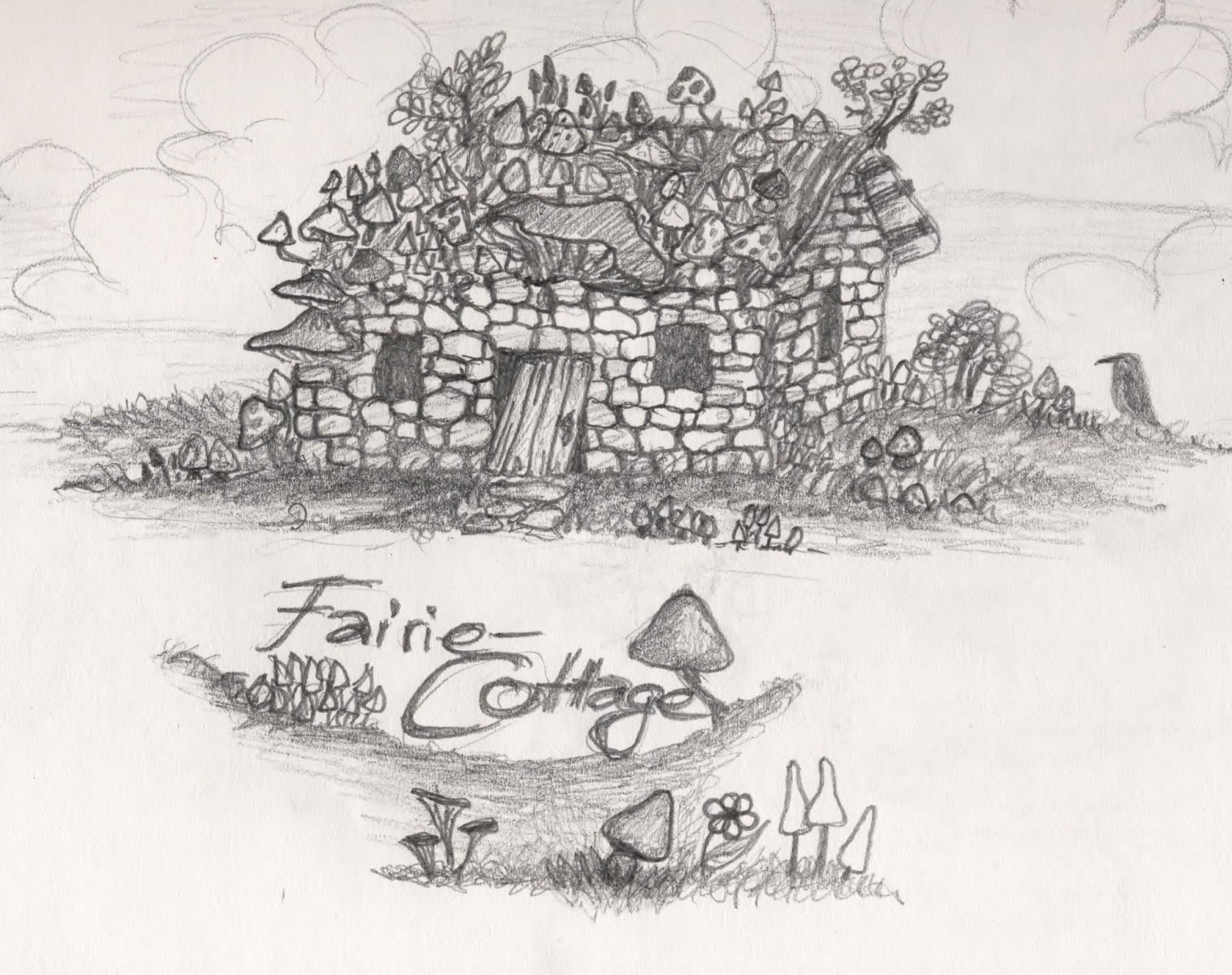
This is a stop on one of the Faerie Roads - an overgrown cottage where dwells a little fungus-man, skilled at healing with moss and honey-slugs.

On the road, the Band had to step aside and avert their eyes as a faerie army marched by on the way to war. The elf must have peeked because this is a pretty good likeness of the scene.

The two guards I placed at the gate of Leslie Furlong's One Page Dungeon Contest winning scenario, the Faerie Market.

Say hello to the bad guy: Anton the Mountain, retail faerie fruit greengrocer.

Monday, 11 February 2013

The B Team Can Relieve Your Campaign

A couple of recent gaming developments have made me really appreciate the practice of keeping up more than one set of characters in any long-term gaming group.

Part of my recent travels involved returning to the Cafe 28 on New York's 5th Avenue where some of the Red Box NYC games take place. Investigating, I found that a Glantri game was taking place the night before I took off back home, so I showed up to a table packed full of Erics (no, seriously, there were 4 Erics out of 7 guys at table).

One of these Erics was blogger "the Mule," who'd been present at my previous foray, and another was the GM. He ran a B/X game mostly by rules as written with some nice touches - no duplicate spell memorizing, declaring only spells and withdrawal from combat before the initiative roll. The players had maps of Eric's megadungeon from three years of continuous play, spanning five levels and hundreds of rooms. This "Chateau D'Amberville" is based on Castle Amber in the sense that The Lord of the Rings is based on the Elder Edda. It was truly a great glimpse into the potential of the format.


As it turned out, my newly rolled wizard character - Raz, son of Taz - was adventuring that evening with a B-list party consisting of players' secondary characters, mostly level 5 and 6. This explained the nonchalance when two of them got double-level drained, in merciless old school style, by some unexpected spectres, which we quickly fled from. I admired the good spirits of these players, who were evidently playing in a very free-wheeling table with drop-in party composition and multiple characters.

On returning home I unleashed the lead-in to an episode I'd been brooding over all January - a climax adventure that could take place in one session, and would cap off the plot of the "Faerie war" arc they'd been following since the summer. Today I learned the limits of plot-heavy climax adventures ... when one of the players called in sick and we realized that we just couldn't play on in this adventure without her.

So we decided to form a B-Team with the existing group, rolling up new characters and embarking ad-hoc on an adventure. The A team (Band of Iron) had started in the Valley of Milk and Cheese where I had also placed Jeff Sparks' Labyrinth Lord adventure Wheel of Evil, purchased but never engaged with, an appropriately cheese-themed adventure. And so, the new group started in the uneasy town of Renneton, got a good way into the cheese caves, and everyone seemed to enjoy the change of perspective and freedom from the burdensome importance of actions in the by now year-long main campaign.

Perhaps this is what most campaigns need past a certain point - a way to deal with missing or guest players, to blow off steam, and get the kind of fast-and-loose play that comes with an adventure rather than story focus.

Saturday, 15 September 2012

Player Wilderness Map and Doodle

 Here's another awesome player map from my campaign - an overland journey from Kaserolle (in the south) to Goran's Anvil (unmarked, in the north). Along the way, the players met with owls of doom, a goblin head on a stick, an archaeopteryx flying out of a misty chasm, and much more.

Click to enlarge ...


The same player sketched this scene of a shepherdess' reaction to a group of six armed strangers emerging from the woods, led by a dwarf, near the start of the "Faerie" episode they are currently in. This is the moment before she screamed and ran for the village.


We all agree that she should remember to bring her sketch book to the game more often ...

Wednesday, 12 September 2012

D&D's Modular Bounty

Last night the players met the Three Fine Gentlemen, who in the Dragonsfoot module "Red Tam's Bones" are set to bedevil the players as they go about the quest of recovering the bones for the good of the Holy Church and the erotically haunted Duke's daughter.


In the course of conversing with these foes, my players realized they liked them and the roguish, departed Tam better than they did the sourpusses of the Church and State, their ostensible employers. Avoiding a donnybrook, they still got experience from the encounter, and a new tip - perhaps the spirit of Red Tam could be found elsewhere, placated by other means?

"Yes, but ..."

So off the railroad and on to  the Faerie Road to a certain Market, from where it should be possible to find the Winter Court wherein Red Tam's spirit might be found ...

Oh YEAH. The thing about D&D is that, over nearly 40 years of this game, there is an insane amount of material that is more or less compatible with whatever version you're playing. Need a Faerie Court? There's Ravenloft stuff and 3rd edition stuff  and even a tasty-looking module from the renowned Wolfgang Baur which comes wrapped in a 4th edition crust ...

Well, despite the wrong turn in later editions, D&D's basic simplicity makes it ideal for improvised, free-running campaigns like the one I run. And sure, there are plenty of other simple systems. But what I appreciate about D&D is the ready availability of material - to be modified and hacked and hijacked to be sure, like my players hijacked "Red Tam's Bones," but that's part of the fun, and having the D&D corpus at my beck and call means I only have to put in a fraction of the work.

Wednesday, 20 April 2011

Reminiscences 2: 11th Grade Campaign Failure

Isle Of The who? A 10th grade creation ...
11th grade and I was ready to go. No more D&D in the science wing lounge under the prying, mocking eyes of the uninitiated. My house was open after school, and the gang was gathering for my campaign twice a week.

I cooked up a new dungeon, a serious dungeon, a ruined castle with a moat and undercrypts and under-undercrypts. Now I had the Fiend Folio, so the place was swarming with annoying jermlaine, bouncing with gorbels, coffer corpses and death dogs, or was it devil dogs? There was a Christian chapel - just one of many religions in the World of Atalona!

I made a punk-style collage homemade DM screen, cut dungeon tiles from manila folders. We'd never had a tactical display last year, but I had my players buy minis for their characters, and used my own small collection augmented with counters from Squad Leader and Citadel of Blood. Every hit in combat I rolled a quick d6 for hit location, just for flavor mind you (that's one habit that's stood the test of time...). I resolved to heed the sage advice of the Great Gygax and play almost entirely by the book. I think my players even rolled chances to have psionics, to no avail, and weapon vs. AC modifiers were definitely a part of play.

Well, eight months later, my players were in revolt, one going so far as to intone the name of Asmodeus repeatedly to see if I would kill the wretched party by rolling the chance for the Devil Lord to appear "by the book." The whole experience left a sour taste on AD&D that explains my current appreciation of the looser spirit of the Basic game I never played.

Who's to blame? Me ... and him. Please turn to page 86 of the Dungeon Master's Guide. There you will find a rule whereby even the character who has played completely true to class and alignment must fork over 1500 gp in training fees to reach second level. Those who are merely "superior" in their adherence must pay 3000 gp and it gets worse from there.

WTF, Gygax? An exemplary thief who has reached 2nd level by earning nothing but treasure has not earned enough treasure to pay the advancement fees. Nor has any merely superior character of whatever class. I think I enforced a flat 1500/level and it still was extremely unpleasant for characters having to take out loans from each other.

It's one thing if you put toxic rules that have clearly not seen playtest, conceived in a fit of hate for "Monty Haul" campaigns, in a book that bills itself as mere guidelines. Another thing entirely if you start and continue the book in the high spirit of ex cathedra pronouncement - this is the One True Ruleset!

Ah, no, I'm not bitter. But I'm also not nostalgic. Good educators eventually come to know that students take everything you say literally and seriously. Yes, the stride made in gaming in the 90's promoted a few cliches that don't necessarily guarantee good fun (see under: heavy-handed board game catch-up mechanisms). But they also brought a huge increase in professionalism to the field, helped along by Magic and its multi-thousand dollar purses resting on arcane interpretations of wording.

Then again, DMG let me roll up this bitchin' random demon.
And my own overenthusiasm and inexperience also doomed the campaign. My dungeon, all three levels, was still a damn monster hotel, with random details obscuring rather than clarifying the sense of discovery. And uh, I think I also bogged down every town visit with random encounters and disease rolls, so help me, and who knows what other foolishness I inflicted on the players. My vague attempt at plotting, involving a Chaotic Neutral conspiracy and a female wizard named Warith Ban who flew around in a cube of force, came too little and too late. Basically, I didn't see that fun was the goal and The Book was not always going to take you there.

I'm just wondering if any of you gentle readers had similarly lousy experiences with by-the-book AD&D. Was I the only insecure 16-year-old with more book larnin' than horse sense out there? And more generally, what have you learned from failed campaigns?

Monday, 20 December 2010

Death and Aftermath

Knights, samurai and other warrior elites know that the point of life is not just to live well, but to die well. Adventure games, though, typically give no rewards in themselves for a good death. Nevertheless, the recent heroic self-sacrifice of one of my campaign's characters gives room to illustrate how death may be given its consolations, both through mechanics and gameplay.

The game referee has to project a difficult illusion. On the one hand, the adventure must be seen to be gripping. Death and serious consequences must be seen to lurk around every corner, or the delve becomes little more than a parody of work, dungeoneers clocking in, clocking out, and collecting their haul.

On the other hand, character death really sucks. I'll leave it to Trollsmyth to spell out some reasons why, but it's no fluke that it's essentially vanished from commercial online gaming, and my Niecely Informant doesn't see much call for it in her own freeform online endeavors, either. For people who don't have a lot of time to spend playing, the grind back up to reasonable power levels can be very demoralizing. "Old school hardcore" is all very well and good, but it's a philosophy devised in an age when people gamed two weekday nights and all weekend.

One way I cushion the sting of death is to award half the old character's experience points to any new character the player rolls up. In fact, if I'd set out thinking from the start, I'd use this rule to separate good deaths from bad - a heroic or selfless death would allow a respawn at 2/3 xp instead of 1/2 xp. Interestingly enough, Ephemera's player (my wife) has rolled up another wizard, even down to the same main Sleep spell, so it's not too much trouble to pass the new character off as a student from the same school ...

Another way is the aforementioned negative HP tables, that dole out the threat of maiming or incapacitation as a less serious gradation of death. Sometimes the threat of consequences is enough. This goes even for systems like 2nd edition with its highly generous death's door rules - if the GM is plotting the campaign world well enough, failure in a mission will feel like the loss of a limb, as the consequences on the PC's allies and acquaintances make themselves clear.

Barring any further mechanical tweaks, this kind of social GMing can go some ways to showing the consequences of a good death. Ephemera's sacrifice has so impressed the man she saved, Fergus, that he has foresworn his bandit ways and with a few of his fellows has been sworn into the Trossley Village Guard and given domain over the newly opened east gate (facing the Castle). The bandits slept by her spell were trussed by the survivors and taken to justice - all are due to be hanged, even the Young Fergus, after a scene in which he rebuffed his older self. And Ephemera's mentor in Utherton, Joya, has been profoundly affected and is showing the party survivors a level of help she would have only given her student.

Ephemera has been given burial in the tomb-wall that lies in the garden in the back of the Temple of St. Hermas. Who knows? It may be that her name and legend will be enough to secure the party a more favored status in the town, as everyone awaits the tide of hungry treasure seekers ....

So how do you handle character death? Are the adventurers just leaves on the wind, rootless treasure seekers to be cut down and spring up again? Or does their death carry some meaning ... and in what way?

Sunday, 19 December 2010

Trossley: End of Innocence

Last week's session was a tense, hard and brutal slog with one of the three PCs dead at the end and the others unconscious, saved only by NPC allies.

With the bullying behavior of the Skull Stackers bandits dominating the Gray Courtyard rampart overlooking the dungeon entrance, a shadow was cast over the prospect of dungeoneering. But now is a good time to mention the NPC Fergus, a bandit from the rival Invisibles gang and veteran of the old days of the Castle, who had been hiding his cohorts in the illusion-concealed and empty Castle ruins.

What are the consequences of an empty dungeon that suddenly restocks itself for mysterious reasons?

Well, Fergus was disconcerted by the appearance of his dead comrades - and, amazingly, even his younger self - when the Skull Stackers gang "respawned." One session prior, he had turned up in town, having fled the Castle in the night after it reappeared and ... came alive.

This session Fergus pulled himself together and, urged on by the priest and Mayor, proposed that the party join the Invisibles in immediate hostile action against the Stackers. Fortuitously - as it turned out - one of my frequent "wouldn't it be cool if this happened" die rolls worked out and the woodland warrior NPC Burnsteen was back in town and eager to join the fight.

Approaching the redoubt of the Invisibles, Fergus was hailed by the small garrison left behind, as his rival for leadership, Brom, had gone foraging in secret with the main strength of the band. The two sides were facing each other on opposite sides of a tower with two doors and adjacent wall, neither side daring to step in the tower or make for the top. Now with the numbers and magic, the party decided to rush into the breach. The other tower door was open, the Skulls nowhere to be seen. Most of the force quickly gained the top floors of the tower, with two Invisibles bandits stationed at ground level - just in time to be swept forth by the charge of the fearsome half-orc fighter Grainne leading the Skull Stackers band.

The ground floor friendlies panicked and ran, Grainne chasing them out into the further court but then retreating after being peppered by missile fire from tower and battlement. The dwarf Grumpka held the stairs against the assault of the axe-wielding foeman lieutenant, while shooters behind and to the side took their angles as best they could, screened by Fergus. Once again, Grumpka's bad luck was good luck as she got downed to exactly zero, earning only a concussion rather than any roll for lasting effects. Fergus and shooters downed the axeman, and then Grainne took to the stairs, swinging her mighty two-handed sword, her armor of strong viridescent goblin-metal protecting her to an exemplary extent.

Fergus took a wound, quickly healed by the holy militant Boniface, and then counterstruck for a critical that faced Grainne with the option between maximum damage and falling from the stair. I chose the fall for her, and then Fergus made an exceptional morale roll that had him leaping on the hulking amazon, sword blade choked in gloved hand for an up-close brawl!

It was then, as Grainne's followers crowded around and tried to pull Fergus off, that the wizard Ephemera made her brave and selfless choice to try to save Fergus. Descending the perilous stair, she won initative and cast her sleep spell. All but Grainne, even Fergus, fell asleep... and getting to her feet, the half-orc won initiative, overtook the frail spellcaster, and dealt out instant death.

Grainne then leapt up the stairs. There fell Boniface - left arm out of commission for a week, by my new negative hits table. There fell the dull-witted Balm - loss of left hand, by the same table. Cordoon, Callow and Burnsteen finally faced her, and Burnsteen finished her with a well-placed sword thrust.

I'll finish with the "death & dismemberment" table I'm using, working off similar efforts by Trollsmyth and others, but leaning more toward Norman Harman or Eric Minton's bloodier versions.

A blow that takes a player character or follower to zero HP results in unconsciousness for 2d6 rounds.

A blow that takes the character or follower below zero HP requires a roll on this table, using 2d6 with -1 for each point the character finds him/herself below zero after the wound is inflicted. Yes, this one is a real killer .. if you roll boxcars at -1, you're well advised to play possum, as the next hit will almost certainly kill you. It's somewhat tempered by the "unconscious at 0" rule, though.

2 or lower: Instant death blow to random vital area.
3: Fatal wound to random vital area. Will die in 1d6 turns unless Cure Critical Wounds is applied.
4: Severed or crushed random limb. Will bleed to death in 3d6 rounds unless tourniquet, cauterization or Cure Critical Wounds is applied. Cannot act for 2d6 rounds due to shock. Limb is permanently unusable.
5-6 Serious wound to random vital area. Cannot act for 2d6 days or until Cure Serious Wounds is cast specifically to remove the wound, not for hit points - the unusability is independent of hit points.
7-8 Serious wound to random limb. Cannot act for 1d6 rounds due to shock. Limb unusable for 2d6 days or until Cure Serious Wounds is cast specifically to remove the wound, not for hit points - the unusability is independent of hit points.
9 Light wound to random vital area. Cannot act for 1d6 rounds.
10 Light wound to random limb. Cannot use limb for 1d6 rounds.
11+ Fight on you lucky (?) weasel! No effect.

Limbs are rolled on d6/d6: 1 = eye (1-2) ear (3-4) nose (5-6); 2= left fingers (1-2) hand (3-4) arm (5-6); 3= right fingers/hand/arm; 4 = non-vital torso wound that affects use of both legs; 5 = left foot (1-2) leg (3-6); 6 right foot/leg.

Vitals are rolled on d6: 1 crown/brain 2 throat 3 heart 4 lungs 5 guts 6 kidneys or other.

Next post, the aftermath of the slaughter and some more general comments on PC death.

Wednesday, 1 December 2010

The Castle Is Open

This evening's session found the players cleaning the last few scrub polyp-monsters from the millhouse cellars and getting into a long, involved episode of dealing with the potentially toxic smoke from a disturbingly human-like mushroom they had shot in its little wrinkly face and set on fire.

They then headed into the other direction from Trossley, eastwards to investigate the loud noise from a couple of nights ago, and found that the Castle of the Mad Archmage had reappeared.


Carefully skirting the bastion from which the raucous sounds of suspected bandits wafted, our intrepid adventurers circumambulated nearly the whole dimensions of the pile. (When I roll for wandering monsters, a 2 rather than 1 on d6 indicates the sound, track, smell, or other clue to the monster, rather than the monster itself. Adds drama ... and lets the party go pick or avoid a fight if they want to.)

They next entered the one clear gate into the walls, at the low end of the huge slanting limestone rock hill whose surface the castle walls entirely bound. Passing through the gatehouse tower, they were attacked by a large black-widow spider as it rappeled down on its thread from the upper storey. After some confused misses on both sides, Grumpka the dwarf clove it asunder with her axe.

As the sun was getting low in the sky, it was decided to head back and head out the next day. Funny how Motley Tom chose to pitch his tent selling magic wares near the boarded-up east gate of the town ... almost as if he knew something about the coming increased popularity of that direction. And now Clem, the youngest son of the ten-foot pole magnate, is getting back into the game ...

So! It begins. I've added a castle "upper works" to the Cellars of the Castle Ruins that I was running this summer. The spider is an homage to the first encounter from Grendelwulf's very recently divulged sketch of Gygax's original first level to Castle Greyhawk, which I highly recommend as a historical document and a great example of Old School principles - seriously out of level monsters, groups of dwarves and elves to bargain with, trick rooms and secret doors a-plenty. Hey, if I'd had that to work from, maybe I wouldn't have written my own first level for the old Castle. But I'm happy with my own work and eager to get some use out of it.

Saturday, 27 November 2010

Mapping Woes: Any Ideas?

My output of rules and game theory ideas has been slowing down as real life increases its demands, and Actual Play (TM) also puts requirements on my time. The hope is that the experience proves a testing ground for the theory, anyway.

One pragmatic problem that's come up is what to use for dungeon and campaign mapping - with the aim of producing not just something useable, but something that can be shared and shown out with a fair amount of pride. My original maps for the Cellars of the Castle Ruins, which I was running over the summer, were done using the freeware program AutoRealm. However, while richly supplied with graphic elements like stairs, rubble, jagged lines, and doors, AutoRealm consistently showed problems with maintaining line thickness at various resolutions. Perhaps combined with this, snapping to the graph paper grid was often a little bit off, and the map's shapes would shift around no matter how much I fiddled with it. The upshot of all this was that AR wouldn't produce a production-ready graphic that I was happy with, though the rough and ready map was fine for running sessions from.

For the Trossley campaign I experimented with mapping a few key sites in PowerPoint. Although it's a fairly good object-oriented program that allows a grid and approximation to graph paper, it's harder to get one's hands on the requisite shapes for mapping. I may have to hack together some stair, door and window icons for cutting and pasting. All the same, I'm confident that Powerpoint will serve my needs in the short term, even though the maps do look a little pedestrian.

What's the consensus out there - do I really need to put down cash for Campaign Cartographer or the like to get decent looking dungeon maps? Note that tile-based programs are right out for my rather geometrically convoluted architectures, though my modest need for outdoor mapping so far is handled decently by Hexographer.

Tuesday, 16 November 2010

Mittellus: Religion

Some notes on the religious history of the world, Mittellus, that houses the Trossley campaign.

The Old Way has always been the way of man: gods that were their domains, harvest and springing stag, rills and mountain peaks, served by shamans, Druach votaries, goat-leapers and wind-witches. Cut down time and again by the empires of men, the ancient rites find accommodation, and spring back when empires fall. But this time, they have competition: the Church.

In the dark years after the breaking of the Millennial Empire, it was commanded that three prophets receive the Revelation that there is but one God: Odaus, the sage of the East; Invictus, the young soldier of the West; and Amalthea, aristocrat of the ravaged Millennial homelands. Spreading the word and the blessings of holy miracles, the three found each other within a decade, and the Church was formed. Then, on a mission to convert a King of the North, Odaus betrayed the Lady Amalthea to the barbarians to save his own skin, a despicable act for which his followers in the East blamed Invictus. So was born the schism of the churches, West against East, with Amalthea as martyr.

Folk-saints Phoebe and Mitras counsel King Thonar

It has been five hundred years since then. Kings and pontifices of the West have waged near-constant war, against priest-emperors of the East and eruptions of barbarians and worse from the edges of the world. Trossley sits in a landlocked area of the Northern Continent Alatoria, within the sphere of the Western Church, but here the reach of the Sacred Seat is tenuous. Mitras, Hermas, Froellia, Uncumber, Eracle and other folk-saints are much honored hereabouts. Priests are trained and knowledge concentrated in fortified phalansteries, and it seems every town of some standing is trying to build a church to rival its neighbors.

Enemies of the Church are many. The benighted Eastern followers of Odaus, even more infuriating for their claim to the true Revelation; the Anti-God or Devil known from the Revelation, a subtle fellow with many secret worshippers and guises; the Powers of Beyond, demons of utmost Chaos who enter the world through the gates of human desire; and those who cling to the Old Way, although these are the least of the Church's worries and are even somewhat tolerated in the Alatorian hinterland.

Silvanian mendicant friars
Against these stand the Church hierarchy and the holy Orders. The unforgiving black-robed followers of St. Hieracon are charged with maintaining doctrinal purity and order among the Church and her faithful. The brown-robed hermits and peaceful wanderers of St. Silvain are popular with the common folk but suspected to be soft on the Old Way. The main Militant orders are three: the Order of Valentia, the Order of the Tower, and the wandering Peregrines. Holy Sequina, the Divine Wisdom, shelters mystics and intellectuals alike in her white-robed Order.

Raise, then, the equal-armed Cross and let the banners of the Church advance! But make sure that the Cross you raise has the horizontal bar over the vertical - the Western church's Hilt of Invictus - and not the vertical over the horizontal - sign of the Devil's own heresy, the Staff of Odaus, sacred to the Anti-Church of the East.

Wednesday, 22 September 2010

Is the Underground a Railroad?

Jason@Wasted Lands implies that the classic dungeon can be seen as a railroad, because it is pre-scripted and offers limited choices. I disagree. Here's how to make it one, though.

"Oh, don't go down those stairs. I haven't drawn the third level yet."

"You have to pull the lever, or there's no more adventure. Trust me."

"You can't turn back to the town. You haven't cleared enough rooms this session yet. OK, if you insist - A Mysterious Force Blocks You."

"Your Hold Person mysteriously fails - that 1 I rolled is actually a 16. The sorcerer drinks a potion, cackles 'I'll see you on Level 6', turns gaseous and disappears down the grate."

(reading mind-molesting boxed text) "Seeing the skeletal lovers' embrace, you cannot help but sigh, shed a tear, blow your nose, and think of lost loves of your past. Then the lovers stir and turn their bony skulls towards you, and you scream in bowel-loosening terror!"

See the point? The issue is not the linearity of an adventure (though branching adventures are more fun, it's true) but about DM vs. player input into the action. Within the confines of even a linear dungeon, the players control the action, tactics, and pace. It's the intruding hand of the DM, not the passive confines of dungeon walls, that grows irksome.

At the same time, I join with Jason in toasting the story DM who stays on his or her own side of the net - setting up NPCs and organizations with their own unfolding stories and agendas, but letting the PCs interact with them as they please, and enjoying the surprises that grow from the mutual interaction.

More passive dungeon DM vs. more active story DM? It's really a matter of taste, preparation, and comfort level with winging it. It's not uncommon for a DM to start a campaign as a fairly passive adventure referee, and grow step by step into an interactive story teller, as little details of the world outside Adventureland grow and build on each other.

Saturday, 19 June 2010

Designing Around Sleep

I'm designing a module for a one-shot session in the summer, likely using S&W or LotFP old school rules.

It's a low-level adventure, and with everything I put into it, I am constantly thinking "Sleep spell." And then I realize a few things that work against the broken power of old-school-clone Sleep:

* Splitting up groups of low level monsters into multiple encounters
* Having close quarters and enforcing a "friendly fire" rule
* Foes approach from many angles
* Not all foes can be slept

And more ideas in this discussion ranging from a full-on nerfing of Sleep (saving throws, fewer creatures affected) to a "D&D is right" approach. Given it's a one-shot I am not really inclined to accept answers that come down to "it will all wash out over time". And for a longer campaign I would much rather start from a balanced spell system that gave starting spellcasters two or more things to do. In fact, I think the time is right to start discussing magic systems.