Saturday, 8 November 2014

Junji Ito's Body Horror

Junji Ito is a manga artist you may know through the widespread dissemination of his horror piece, Enigma of Amigara Fault; the one where an earthquake exposes many human-shaped holes in a cliff face. 


That story is one of his best and also a fair representation of his method in general. Ito specializes in presenting situations at the far edge of plausibility and driving them through to their halluci-logical conclusion. His illustration style, seemingly stuck in the late 80's for normal characters and scenes, opens up into meticulously stippled and hatched vistas when rendering abominations up close. As those who follow through to the end will see, body horror is his main theme, with occasional psycho-horror and ghost story digressions.

NOTE: Fan translations of many of his works are available online.

Spoilers follow.

Although he sometimes traffics in monsters, his most compelling works are better seen as curses, documenting unnatural misfortunes and transformations of the once-normal body. After all, the monster can be straightforwardly fought; the curse confounds this impulse by tying the horror to a human person, deserving of our care. Sometimes literally, attempts to destroy the monster will destroy the person; a technique I picked up recently in running a semi-improvised game, where among other Boschian horrors, a monstrous fish gaped, disclosing a terrified victim imprisoned behind golden bars; what was done to the fish, happened also to the victim. 


Ito uses this dilemma in Blood-Bubble Bushes, Hanging Balloons, and memorably in Slug Girl:


In this curse, the tongue grows thick over a period of several days, eventually transforming into an living but rooted swollen slug. An even more gruesome transformation is in store, in the manga a result of the parents' attempt to salt the slug-tongue out, but in a game it can happen naturally: the body withers away, leaving the slug to pull along the still conscious head.

The curse is contagious; coming upon a nest of heads and skulls with fat, pink, living tongues, under no circumstance must they be allowed to slime open, uninfected flesh.

The curse in Red Turtleneck is also, more directly, about the head.


By wrapping a hair around the victim's neck, or tricking them into wearing an object around the neck with the magically treated hair inside, the head detaches from the body by an imperceptibly thin cut. It must be held on rigidly to have any hope of being healed. The manga story itself gets unbearably silly about two thirds of the way through but the basic idea is gripping. For best effect make it unclear whether the curse is real or a delusion, complete with psychosomatic bleeding around the neck.

Ito's masterwork of body horror is the long-form Uzumaki, a suite of increasingly connected variations on the horrific potential of spirals. Various victims: become rolled up like a Swiss roll in cross-section; sprout grotesque warts like a unicorn's horn; grow an inward-spiraling mark on the forehead that consumes more and more; grow a spiral mark on the back that humps outward, transforming them into a giant snail; get rubbery limbs that twist like snakes mating; and the best curse of all, the curse of outlandish spiral hairdos that grant medusa-like shock and awe and hypnosis and choking and grabbiness at the cost of major Constitution drain and the hair getting ideas of its own ...


And variations in counterpoint; like the woman early on who becomes terrified of the natural spirals of her body; or the way the environment expresses the spiral curse, with air, water, earth and the town itself succumbing to vorticist force and form.

With one final idea for gaming: the shape as theme for an adventure, cult or region. The spiral expressed in an array of spiral jewelry, sphincter-like doors and pits, spring-loaded traps, flail snails, air elementals, curling snakes and worms, morkoth labyrinths, hypnotic patterns, maze spells.

The triangle, the zigzag ... the disk.


The horror.

Next: Junji Ito's psycho-social horror.

Monday, 3 November 2014

Baroque Tricks, Traps and Hazards

So many of the old evergreen roleplaying tricks were prefigured (or just plain figured) in Gary Gygax's Supplement I: Greyhawk. Among them:

The "monster body" dungeon.
The shrinking ray.
Looting monster corpses for built-in treasure.
Animated plants and furniture.
Items which cause warning devices to fail and alertness to wane (the beginning of a long slippery slope into giving with one hand and taking away with the other...)

As well as less perennial ones such as

A box of animal crackers which will come to life when grasped ...

Anyway, with all this in mind may I present the next installment of the 52 Baroque Pages - including a few twists on old tricks. Click it to enlarge ...


Sunday, 26 October 2014

The Shahmaran

I have never before heard about this mythological creature from Kurdistan and the Yezidi tradition... depicted as a woman whose head and chest are stuck on the back end of a backwards-facing basilisk. With what's going on in the world the Kurds need the protection of this benevolent "queen of serpents" more than ever.


SHAHMARAN
HD: 9
AC: 16 [3]
MV: 12"
Attacks: Snake bite (d8); spells
Defenses: Immune to poison, 50% magic resistance, poison scales
Mind: Genius

The Shahmaran may or may not be unique. Known as the "Queen of the Snakes," this benevolent guardian dwells in desolate places and ruins. She appears as an eight-legged giant basilisk with a snake head at the end of a long, flexible tail, and a queenly human head at the front, both sprouting crown-like arrays of horns.  If attacked she will strike with the snake's poisonous bite. Creatures who attempt to bite her scaly part must save vs. poison at -4 or die.

A Shahmaran usually is preceded or guarded by numerous snakes of all sizes, typically 2d6 serpent swarms, 2d6 normal snakes and d4 giant snakes of various types. She has magical spells as a 9th level druid, oriented toward divination and animal summoning spells, which will invariably summon snakes.

Despite her terrifying appearance Shahmaran is a benevolent creature, and sometimes takes a human lover, although those who have known her are unable to bathe without shedding snake-like scales ever thereafter.  They guard their wisdom closely, but each kiss from them conveys one cosmic secret, which some lovers of weak mind have been unable to handle. Shahmaran are the mortal enemies of lamia.


Sunday, 19 October 2014

Nonhuman Vision

Imaginative literature works best when realism constrains it just enough to create interesting solutions, but not enough to impede drama and archetype. Example: Gene Wolfe's idea in Book of the New Sun that eating someone's brain, with the proper chemical preparations, would convey all their memories, was built up whole from these now-discredited experiments. Realism produced the idea, but was not allowed to stifle it.

In this vein, the old idea of ultravision and infravision from AD&D suggests that races gifted with those abilities can also perceive radiant and reflected light in those frequencies as different colors. Materials they make will be bright with these hues; seemingly dull surfaces actually alive to those who can see.

INFRARED

Technological infrared thermography uses the medium-wavelength infrared (3000-5000 nanometers) to detect heat radiation and the long-wavelength infrared (8000-14000 nanometers) to detect visible objects through emission and reflection of ambient light. Beings with the hypothetical infravision that acts as more than just heat vision thus would possess the ability to detect both sources of radiation, though with fairly low resolution at distance (hence the ranges of only 20 or 30 meters.) Dwarves differ from goblins and the like in the visibility of the light emitted by their eyes to attain infrared vision; goblins emit light in the visible spectrum, the "red glow" that often gives them away.

Indeed, these two sources give two different colors, the medium-wavelength vinth and the long-wave aggal. The rest is speculation.

Vinth is a hue associated in dwarven culture with life, blood, love and warmth, usurping the place of red (which stands for rulership and power).

Aggal is one of the colors of minerals, gems and metals and gives information about their quality that is lacking in the visible spectrum. It is associated with home, structures, wealth and the underground.

In many underground dwarven settlements (including the sealed one, Xabul, currently being investigated by the Band of Iron), it is traditionally considered gauche, at very best a concession to outlanders, to bear visible light sources in public areas. Visible light is reserved for private life, wherein physical flaws and features can be seen better.

Dwarves have developed paints that appear to humans as a matte lacquer, but which reflect in the spectra of vinth and aggal, and have identified similar dyes among the plantstuffs of the upper world. Thus dwarven clothing and outer decoration often seems drab, but is actually rich in infrared color, while their home furnishings and private garments are more gaudy in the visible spectra. Of course, the paints are also used for markings and writings that dwarves do not want outsiders to see. A notable example is the Hall of Diplomacy built in Gorondhevl by King Frumo the Plainspoken; the noble figures of humans and elves in the murals are subtly touched-up in aggal to create lines of caricature that render them laughable, unbeknownst to their emissaries.

ULTRAVIOLET

The reflective colors of the ultraviolet spectrum are present in flowers, birds and insects, and can be seen also by birds and insects. Scientifically, the ability of elves to see in the ultraviolet spectrum has little to do with their outdoor night-vision, which just boosts the signal of ambient light. Magical light also emits bold and disruptive radiation in the ultraviolet spectrum.

Elves do not use the ultraviolet as secretively as dwarves do the infrared. Some examples of writing in secret inks and so on have been recorded, but in the main, elves are content to treat their extra wavelengths as an aesthetic experience. Often an embroidery is seen on an elf's garments which looks to be a complex tracery in monochrome or very similar hues, but which makes more sense in ultraviolet. Ultracolors are shunned by wood elves in everyday dress; however, their festive clothes use them so liberally that other kinds of elves consider this to be in poor taste.

The two primary ultrahues, with many more specific elvish poetic synonyms according to their brightness and saturation, are:

Ulvian (280-380 nanometer)
Associations: hazy air at night, stillness after violent passion, certain flowers, incidental light from magic items
Matches: violet and green

Briolant (200-280 nanometer)
Associations: stars, butterfly wings, inspiration, return of sensation, certain flowers, direct light from spells
Matches: orange and yellow

STRANGE EXPERIENCES

Humans who have been given the ability to see beyond their usual spectrum through a spell, or through a natural variation, often report strange aesthetic feelings, a sense that undermines the realization that their experience sets them apart from other. Those under an infravision or ultravision spell who have seen particularly exquisite examples of art in those colors will often spend time peering at drab surfaces with complex patterns, hoping to see just a little shimmer of those, those colors.

 (Tip of the hat to Noah Stevens for suggesting the color names vinth and briolant.)

Monday, 13 October 2014

Misheard Spells


Flay Marrow
Nasty save-or-die spell created by insensitive necromancers.
 
Whiz or Die
Creates the sudden urge to urinate in a bladder-having creature. Experienced adventurers know it's more than a prank. 


Char Monster
If you can't persuade them, envelop them in a pyrocaust.

Ice Dorm
Briefly fashionable pinnacle of the brief misheard spells fashion, creates a habitation out of five walls of ice complete with ice beds, ice benches and ice bar fully stocked with ice bottles, ice glasses, and vodka.

Wall of Ire
A curtain of red, snarling faces that forces all crossing it with Animal intelligence or above to save or cringe back.

Phased Oar
Allows you to make an oar that phases into the ethereal plane and back in a minute. Invented around the time when the misheard spells fad was rapidly reaching exhaustion point.

Colors Pray
A rainbow blast of seven prismatic hues, each one having the effect of a random cleric spell from the 1st (red) through 7th (violet) level lists, and whether reversed or not also being random. Usually hurts people, but you never know.


Tuesday, 7 October 2014

Megadungeon Playtest Without the Dungeon

Last Saturday in London we had a small meetup of variously 8-10 Old School gamers who couldn't wait for Dragonmeet (wait, Dragonmeet has an updated website and schedule in early October? Surely these are the last days and times...)

In the corner of a pub near Euston Station, it was decided that I should run the first game, an encounter with pregenerated 52 Pages first-levels going after the low-level bandits holed up in caves near the entrance of my megadungeon project, Manden Gouge.

A rough idea of the style
I haven't talked much about this project - preferring to show rather than tell, perhaps overcorrecting for the tendency of gamers to hype vaporware.  As of now I have about 120 areas written up, enough for the first installment, which now lacks only a bunch of connecting material. The design goals are:
  • Emphasis on exploration, finding out the history of the nearly abandoned castle Karthew's Legacy and the warrens beneath.
  • Setting-neutral - can be dropped into almost any pseudo-European fantasy world with few assumptions about the universe
  • Subverting cliches -- few things, be they monsters or treasure, are "by the book"
  • Detailed rather than general descriptions -- but detail for a purpose.
  • "Gormenghast" feel to the upper rooms and cellars of the castle -- a society of eccentric inhabitants, with mad and dangerous things lurking in the corners, left by a long line of previous weirdos
  • Run-friendly, with detail maps and monster stats on the same page as descriptions
  • Lots of goodies -- a menu table, social relations map, reference illustrations for the player, a dream dungeon-within-the-dungeon, family tree and heraldry
And that's all folks - no Kickstarter, no hype, no set date. You'll see it when it's here.

Anyway, following up a mission hook to deal with some bandits with the advantage of night-vision, the party decided to set a counter-ambush for the bandits and then lure them out of their cave, managing to bag the leader under a dropped goods cart thanks to Barry's creative abuse of the Featherweight spell. So the megadungeon playtest never entered the megadungeon. But I'll be damned if I railroad.

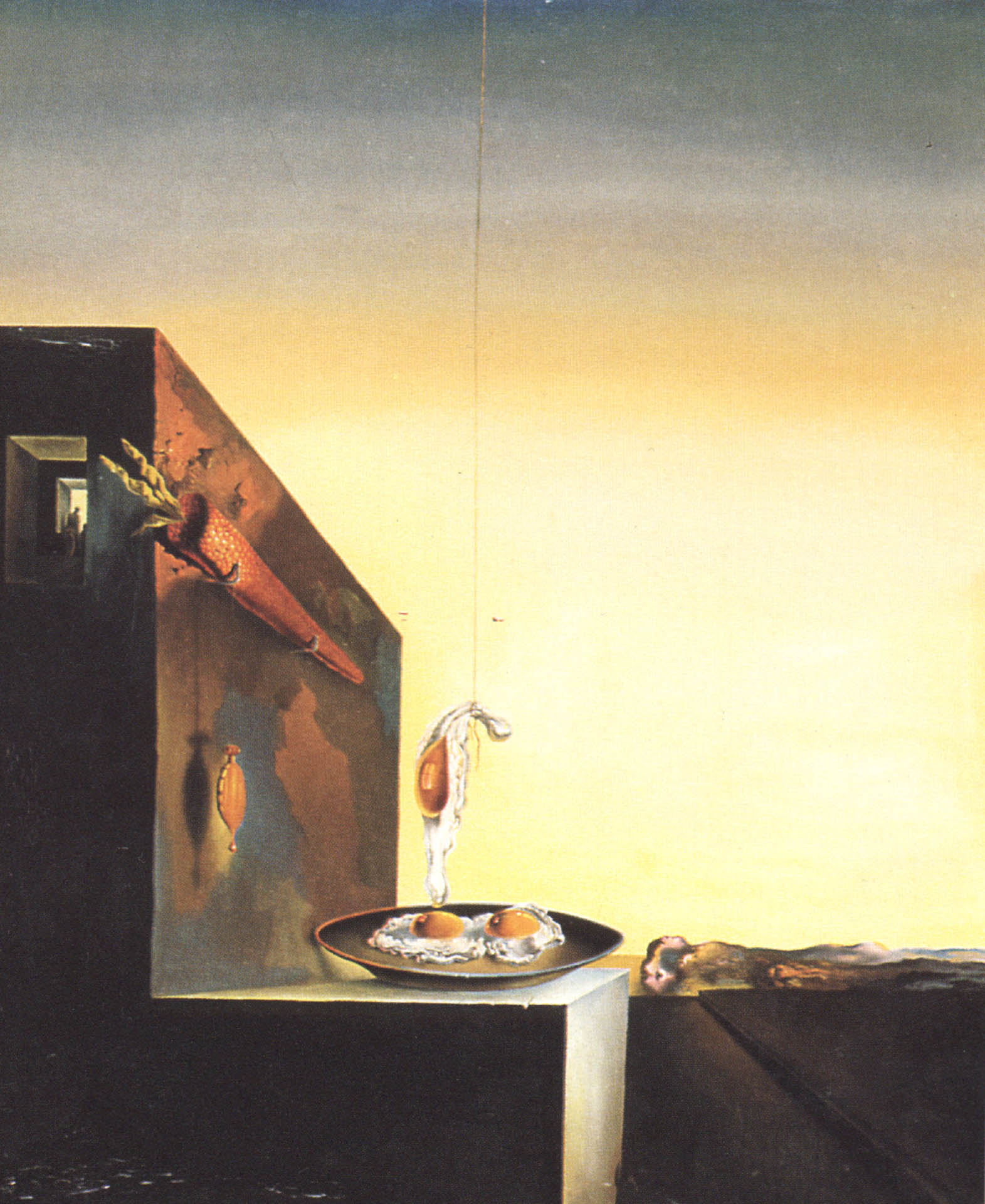
http://ayay.co.uk/arts/surrealist/salvador_dali/plate-of-eggs-without-the-plate.jpg
Eggs on a Plate Without the Plate - Salvador Dali
Then Barry took the reins for an adventure in Tekumel using Lamentations rules -- a really nice introduction to that exotic and hierarchical setting that had the party carrying out a tenement eviction, with rainy, moldy atmospherics that brought to mind a cross between The Raid and Se7en.

It was a great day with the opportunity to put faces to a lot of names across the British blogosphere and G+alaxy. I hope there's another such one of these days.

Thursday, 25 September 2014

Back and Forth and Sideways in Time

Last time I offered a breakdown of all the different ways a fantasy world could be tied to our own. Commenters offered a couple of extra ways, which I'll incorporate into this next phase: further describing the plot moves available to the creative world-rigger with each arrangement. This post covers the first three of (now) 14 arrangements.


1. You are in Earth's far or mythic past. 

Clues:

  • prehistoric animals are everywhere 
  • important names, maybe distorted, are recognizable as legendary heroes and places (Tolkien pulled this off with the lost continent called by some "Atalante" and reverse-engineered his language so that worked and also Artur means "noble lord")
  • euhemerism is in effect so the local king may be called Lord Horus and his shield is a hawk and his chief advisor is the one-eyed Wizard Odin and in the throne room hangs the Golden Fleece 
  • the maps have familiar if somewhat skewed shapes
  • early-civ signifiers like ziggurats, human sacrifice, eyeliner and chariots are mixed in with the magitech and rustless pillars
  • sense of boundless possibilities and newness. 
Plots:

  •  "The magic is drying up" as in Larry Niven's stories
  • a cataclysm is impending that little of the weird stuff will survive past, paving the way for the world as we know it
  • you are trapped in a stasis cell destined to disgorge you sometime in Earth's timeline. Perhaps some deep-earth miners will find you. Have fun! 
2. You are in the present world's future.

Clues:

  • the creatures and peoples that you meet show signs of fanciful mutation, alien origin, genetic engineering
  • your legends are of modern-day celebrities, your place names worn-down distortions, look hard enough and you can find the Statue of Liberty, beware the Belieber Cult 
  • the familiar maps are all marked up by global warming and nuclear megacraters and deserts and unspecified cataclysmic events 
  • artifacts of the old world are everywhere or incredibly rare, depending on how much time has passed, sometimes tended by engineers of St. Leibowitz indistinguishable from a priesthood 
  • sense of late-days malaise like in Dying Earth or Riddley Walker: the minerals are all mined, every tale has been told, there are no new genres of music just unfashionable ones, the sun could go out at any moment 

Plots:

  • stasis works both ways, and some 21st century people who have just unwarped/ unfrozen/ unmirrored expecting utopia are having their expectations cruelly, cruelly broken 
  • they're trying to bring back the Technology of the Ancients but of course they're about to do it horribly wrong 
  • those deep-space near-lightspeed astronauts from the old order's final days are baaack 
3. You are in a parallel dimension, communicable with Earth.

Clues:

  • strange wanderers who talk funny, dress funny, carry weird objects and drop completely baffling pop culture references 
  • doctrine and teaching of the Multiverse, every schoolchild knows 
  • someone in the distant past came, saw, conquered based on superior native technology, gravity, or disbelief of magic - and disappeared conveniently when things got hot 
  • ethereal creatures and travelers sing strangely familiar and catchy songs 
Plots:

  • fair enough, you find the gateway in the basement of Castle Greyhawk 
  • one of those strange wanderers rolls up on you and is trying to convince you to make all these mixtures and build all these weird devices and is telling you when the next eclipse is going to be and you don't have the heart to tell him about 9th level spells 
  •  oh psych that other universe isn't exactly our Earth it's a parallel universe Earth where ..