Sunday, 7 July 2024

Mass Combat 3: Delta's Book of War (and its inspiration)

Back in the early days of the Old School Revival, Delta's D&D Hotspot was a place to go for thoughtful design and scholarship, firmly rooted in the classic games and free of the edgy or curmudgeonly posing indulged elsewhere. Like many of that blogging generation, Delta (Daniel R. Collins) has put out books of his house rules, modifications and expansions of Original D&D, all in a familiar trade dress. One of these, revised in 2021, is a set of rules for miniatures battles in D&D campaigns, called Book of War.


OD&D itself had a mass combat supplement: Swords & Spells, authored by Gary Gygax in 1976, but little noticed by revivalists today. Still, its features clearly influenced the more widely known and promoted Battlesystem, and also Delta's battle rules for OD&D. All three share a 10 soldiers:1 figure scale with provision for lone heroes and leaders. All three, in different ways, scale unit stats to D&D individual stats. Command, movement, and morale, though handled in slightly different ways, follow a common model that was also not far from standard rules for formed historical battles. We can also see a preview of AD&D in the percentile morale approach and weapon-to-armor modifiying tables.


Delta's foreword briefly mentions Swords & Spells as "based firmly on D&D, but frankly not fun to play." Indeed, S&S damage is dealt out completely deterministically. Dice only figure into the deeds of individuals (played out using D&D rules) and the morale of units. There is an option to add random damage, but as a clunky percentage modifier to casualties, which layers onto an equally inelegant appendix handling differences in troop and weapon quality. For in true old-style grognard fashion, S&S also depends enormously on double-digit calculations: dealing out casualties according to a combat table similar to Battlesystem's, in modifying said casualties, and adding up the myriad of modifiers for percentile morale checks.

Book of War is also meant to be compatible with OD&D. But it goes the opposite way, abandoning calculations and tables in favour of a feature taken from the most successful wargame rules sets of all time: rolling huge handfuls of dice against a defender's set number, and scoring the hits as Hit Dice of figure casualties. Some granularity is lost in scaling down the d20-based stats to d6: armor class and hit bonuses improve only by groups of 3. So the work of calculation and lookups go into creating the unit stats in the first place. Those stats then, although superficially different from their D&D originals, dispense with the need to use a table in play. 

Book of War's innovations, by the way, resemble Battlesystem's 2nd edition improvements, which merged THAC0 and damage die into an attack rating which then scored hits against the defender using dice of different sizes. Both revisions realize that there's something primal and satisfying about throwing lots of dice and seeing the results right there.

Otherwise, Book of War is geared toward simplicity of use. There are none of the detailed formation or commander rules you see in Battlesystem or S&S. Morale is based on pass-or-rout checks, with only a few modifiers. Apart from some long division when figuring out casualty rates for morale checks, there is little math beyond what's necessary. This simplicity, however, works against the rules' ability to scale effectively and simulate any but the grossest differences in equipment and quality between troops. A goblin fights just as well as a dwarf here. Morale differences are handled only very broadly, as a function of Hit Dice and troop alignment. As a PC commander you may want to drain your treasure chest buying shields, training, or improved weapons for your troops. But these upgrades will likely not register in play.

Book of War, then, meets all the desirables we have listed in a D&D mass combat system: scaleability, bounded chance, PC participation, emergent properties (mostly morale), and incrementality. The rule set is also relatively elegant and easy to use. But because of the way this affects scaling, it is best for battles that happen as a backdrop to the action. DMs whose players are in a position to equip and train their own armies may want to look at using a more fine-grained system.

Thursday, 4 July 2024

Mass Combat 2: Battlesystem (1st Edition)

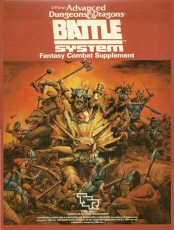
Battlesystem - Wikipedia 

Let's have a look at the grandpa of all D&D mass combat rules, Douglas Niles' first edition Battlesystem, supporting both the AD&D and D&D lines. The product received a big rollout in 1985 with tie-ins to adventure modules using its system, namely the Bloodstone Pass H series for Forgotten Realms, and Dragons of War for the Dragonlance setting. 

It's easy to see Battlesystem as a cynical move to get people to buy miniatures in the hundreds. In 1985 TSR had just made a deal with Citadel to produce a new line of official figures. No doubt they were eyeing the burgeoning popularity of the parent company's Warhammer game. But Battlesystem also provides cardboard counters if figures are lacking. So it's fair to say that it was designed functionally, with the aim of enabling a kind of action that many campaigns naturally grow into. The boxed set does promote the miniatures hobby, but stays realistic about the ability of most tables to field large 3D forces to order.

Battlesystem distinguishes itself from other miniatures games of the day by advertising its scaleability to D&D individual stats. For most troops each figure represents 10 individuals grouped into units of 4-48 figures. Units have the D&D stats of their constituents: hit dice (the measure of damage), armor class, movement rate, damage die. What's different from D&D are: morale on a 2d10 scale, compromising between D&D's 2d6 and AD&D's percentile system; required unit commanders who affect morale and command; and some effects of formation (formations can be open or closed, and formed units are more effective than skirmishers and mobs). These are all sensible ways to model the emergent properties of units that a pure scaling approach would miss.

The notorious THAC0 (To Hit Armor Class 0) stat underlies Battlesystem's one unforced break from the RPG rules. Popular pressure at the time was moving design away from the venerable combat matrices and into this simpler and more transparent way to resolve hit rolls. Instead of just using THAC0, though, Battlesystem takes it as the basis to calculate an Attack Rating, factoring in a number of formation and tactical modifiers. Then, Attack Rating minus defending Armor Class plus 2d6 feeds into a table factoring in the attacker's damage die and giving the Hit Dice of expected enemy casualties per attacking figure. While this mechanism is clunkier than some of the other rules sets we'll consider, it does improve on the swingy, all-or-none d20 hit rolls of the RPG, in a nod to the bounded chance criterion. And the table is by no means deterministic. A unit of hobgoblins with 10 figures in the front line can do as much as 40 Hit Dice damage (on a lucky 2) or as little as 2 (on an unlucky 12).

Hidden in this table is a clever resolution of the problem I alluded to last time. To recap: literally applying the D&D combat rules en masse would result in much higher casualties in front-line clashes than historical battles ever knew. Even in the systems of the 80's, where one combat round was a glacial full minute, troops with average training and equipment would hit each other on, let's say, a 13 (40% chance), and deal, on average, killing damage with one weapon blow. After three rounds of this, there's only about a 20% chance that any individual would be missed three times. And so, close to half the fighting troops would be dead: nearly everyone who was hit twice and half those who were hit once.

In Battlesystem, one mass combat round equals three D&D rounds. And in that space of time, each figure, usually representing 10 troops, deals out on average 1 hit die of damage, enough to kill one of the aforementioned average individual troops. Instead of a 50% casualty rate per three minutes, we get the more historically bounded 10%. This pace, by the way, serves the incrementality criterion well -- it might take a few rounds of fighting before morale gets to the break point.

Why is skirmish combat held to be more lethal than mass combat? The answer would deserve its own post, explaining the gap between largely fictional views of heroic combat and the realities of military history and psychology.  For now, it's a sign of canny design instincts that the scaleability of the system is broken in the one place where it makes for both a better simulation and a better game.

Battlesystem is otherwise a typical miniatures rules set in its allowances for casualties, movement, command, morale, terrain, and so forth. But how does it do on the final criterion left, the interface between PCs and the mass battle? Even without the player characters fighting, a fantasy miniatures game has to factor in the doings of heroes, wizards, and outsized monsters -- both how they fare against troops, and how troops fare against them. 

Battlesystem introduces this heroic layer into the second helping of rules, the Intermediate Game. The options are interesting on paper: a PC can embed themselves into a unit, act as a commander or deputy commander of a unit, or range the battlefield freely as a hero.

As a unit member you might improve the unit's fighting ability somewhat, but you share the fate of the unit if it is destroyed or routed, rolling on a table to see if you survive albeit unconscious or badly wounded. This is not a very interesting or palatable role, but might be appropriate for lower-level characters who find themselves on the battlefield.

The commander is a defined role in the unit and is important for cohesion and command, and the rules also allow for higher-up commanding roles, right up to general. A deputy is there to step up if the commander is killed or incapacitated by magic or assassination. These rules are  on the whole less interesting than they could be. Commanders are immune to harm from military sources until their whole unit is killed, reducing the risk of battle and the chance for deputies to be promoted. What's more, command is incompatible with spell casting, but opens up a role for deputies to take command while the usual leader is brewing a spell. A unit commander will probably have to go along with orders, while more agency can be found in higher ranks - but how to convince the generals to let you in?

One gets the impression that the hero, shades of Chainmail, is the main way competent PCs are supposed to enter the battlefield. If heroes meet fellow individuals or monsters, they fight it out using normal rules, three rounds to one Battlesystem round. Damage between individual figures and units is easily translated, each figure being 10 individuals and hit dice being convertible 1:4 to hit points. In any round, only the most undermatched attackers can hope to do more than wound a figure, which translates to laying low 5 individual soldiers. Of course, area damage spells have much more potential.

These rules are generally satisfactory, but underplay the ability of individuals to target and eliminate enemy commanders, except through magic or (yuck) assassin abilities. Around the turn of the 18th century, revolutionary armies in America and France fielded sharpshooters or tirailleurs armed with longer-ranged rifles. Their mission was to harass units and pick off their leaders, to the great dismay of armies used to 18th century style - not cricket to target officers of noble blood! But eventually even the British army made use of such tactics. The fantasy equivalent would be, as a hero, charging the orc lieutenant commanding a battalion of 300 and cutting him down in a one-to-one duel. Allowing for such a mission would be more satisfying and consequential for would-be heroes than dealing out abstract figure-level wounds, and more equalizing for the balance between mid-level fighter-types and magic-users.

Overall, although suffering from some of the inelegance that lingers in 1980's game design, Battlesystem is a worthy old Studebaker of a ruleset that hits most of the desirables.

Next up: We turn to some of the new-old-school solutions.

Monday, 1 July 2024

Mass Combat 1: What Makes a Good System for a Roleplaying Game?

In many an adventure roleplaying campaign, there comes a time when the heroes' struggle gets caught up in larger politics and warfare. They may find themselves helping villagers to defend against a marauding army; get embroiled in a street fight between rival gangs; or, at higher levels, use their hard-earned treasure to hire a mercenary army and rid the land of a nasty orc warlord.

Scenarios at this scope and scale would be tedious to fully play out, rolling for the hits and damage output of each single figure. This is where mass combat comes in. 

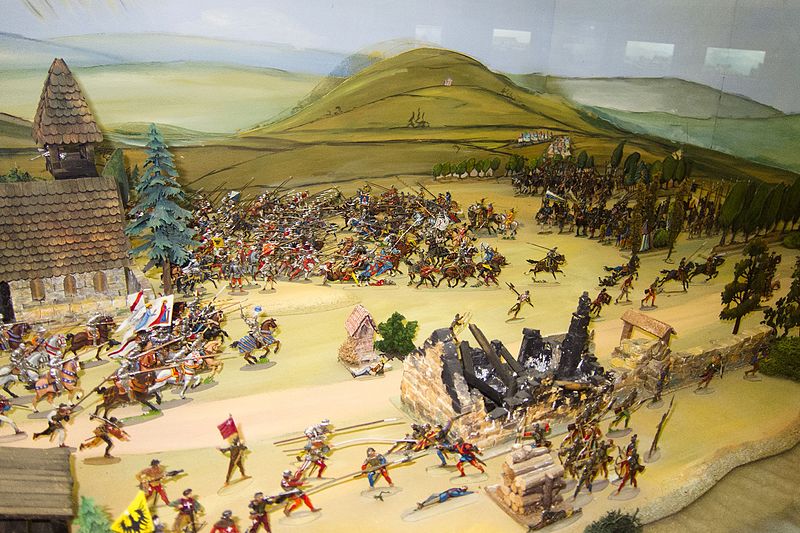
File:Great medieval battle (25637965160).jpg
Photo by Thom Quine, CC BY 2.0

Mass Combat Desirables

The irony of developing a mass combat system for D&D was fully apparent to the authors of the first such rule set, AD&D Battlesystem. In the introduction to the first edition core book (1985), Douglas Niles points out that the D&D game developed from the Chainmail system for fighting medieval battles at scale, so this product represents a return to the roots of the game. 

Chainmail itself contained rules for fantasy creatures as well as castle assaults involving individual figures. Indeed, early games at Gygax's and Arneson's tables used the dicey, insta-kill Chainmail man-to-man combat system, before Dungeons and Dragons adopted the more heroic wearing down of characters' hits derived from naval combat. 

However, Chainmail mass combat in relation to Original D&D skirmish combat lacks one property: the ability to directly transfer statistics from the roleplaying game to the combat procedure. Indeed, if mass combat bears no mechanical resemblance to the roleplaying rules, you may as well use any tabletop wargame system, be it Warhammer, De Bellis Antiquitatis, or whatever. 

What we are looking for is scaleability: the ability to simply and uncontroversially convert stats from characters and monsters to the stats of the units they make up. This goal is compromised when complicated equations and statistics intervene between one layer and the game and the next. Ideally, you want your units to have Armor Class, hit bonuses, hit dice/points, and movement rate on similar scales to the stats for their constituent figures.

A particularly tricky part of scaleability is the mixing of individual characters such as leaders, wizards, and heroes with masses of troops. You want your system to not just handle battles as a spectator sport, but to actively involve PC participation. The role of individuals in a mass wargame is likely to be abstracted, as a commander token with +2 morale and 3 command points, or an embedded hero who gives +1 to the attack roll. Players, however, will want to see their characters embodied, with access to the familiar set of combat moves and tactics. 

This simulational seam can be finessed, somewhat, by playing out the wargame abstractly when PCs remain in a purely command role, but then zooming in to standard D&D rules when the PCs themselves make contact with the enemy. However, using this method, it might not be clear how the PCs' kill count transfers back into the play of the larger battle. How does eliminating eight knights out of a unit of 100 affect the morale and cohesion of that unit? A satisfying mass combat system for D&D will integrate individual and mass levels organically.

There are other traits that you want the mass combat system to share with other wargames. You could adopt a "power grinder" approach where you feed in troop totals, armament, morale and other factors influencing the battle, then make a single roll that tells you which side won and with how many casualties, like the venerable old computer game Civil War. But that would lack the desirable trait of incrementality - the feeling that the battle is evolving in stages, going back and forth, and you can see exactly when a command decision, a heroic charge, or a well-placed fireball turns the tide.

Another desirable trait is bounded chance. War is chaos, and you don't want the results when two forces meet to be completely predictable. At the same time, you don't want 100 scrawny kobolds to have any kind of plausible chance to defeat 300 brawny gnolls in melee. If seen as a collection of individual combat outcomes, the law of large numbers gives rather predictable casualty figures. For example, if 100 orcs meet another 100 identically armed orcs in D&D combat, with a 25% chance for each figure to kill its opponent on the first round, then 95% of the time the casualties on that round will be between 16 and 34 inclusive, per side attacking.

However, it's on the larger scale that chance reasserts itself. In premodern warfare the question is not how many soldiers will die, a low number compared to the carnage that 0-level D&D figures can wreak on each other in the space of 30 game seconds. Rather, the question is when one side will break and run. This is where the higher-level resolution of the morale check comes in, even more applicable to mass combat than to skirmish. Included under this heading, too, are factors like the formation of the group, which has important consequences for casualties taken and received but cannot be easily equated to the traits of individual combatants. As with any wargame on this level, unit games need to model the emergent group-level properties of morale and formation alongside raw casualties.

It might be tempting to simply treat a hundred gnolls like a single gnoll, having them swing, take damage, and have a chance to run when wounded using the D&D rules. Eric Diaz at Methods & Madness broached this technique recently, but while it is eminently scaleable, it trades away bounded chance and needs its own rule for morale. At the other side of the range are overly complex or wargamey systems that don't scale to D&D stats or don't allow for PC-level input.

Next post, I'll talk about some of the systems out there that I've looked at or tried in practice. Post after that will be my own offering, recently tried out in a street battle in my ongoing campaign.

Friday, 28 June 2024

Four-Way Wilderness Descriptions

David McGrogan recently requests:

People may already have done this, but providing DMs with handy, accessible and beautiful three-line descriptors of what the players can see as they traverse one hex or another, or go from one point to another on a pointcrawl, would I think be a very useful addition to wilderness campaigning. 

Without overdoing things, my suggestion for improvising these in play or writing would be: when breaking new ground, describe three aspects of background (down, sides, up), one of atmosphere (around), and add in "figures" where appropriate.

How the Transcendentalists Shaped American Art, Philosophy ...
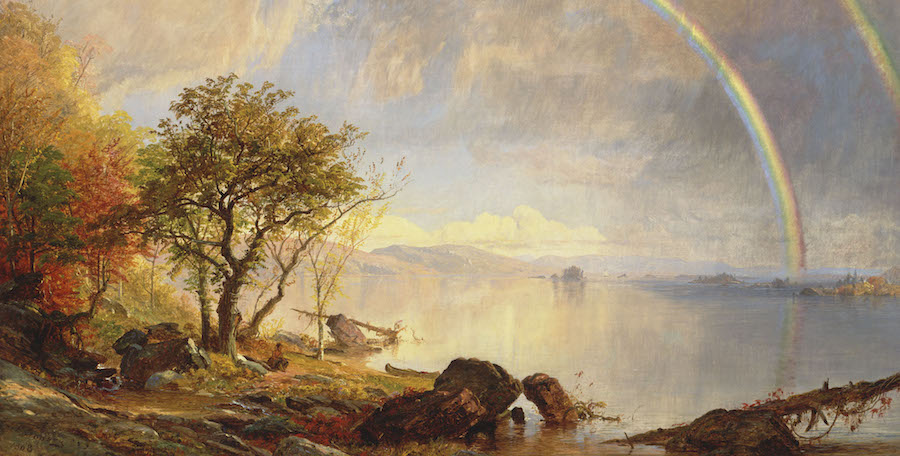
A 19th century Transcendentalist landscape by Jasper Francis Cropsey

The narrative should tell you what you see and hear from below (the ground on which you walk), to the side (the sightline or blockage of the vista), and above (the condition of the sky). The atmosphere covers the motion, feeling, and scent of the air immediately around you. Figures, then, are any specific landmarks, ships, throngs, or creatures that may be glimpsed among these backing elements, and it's wise to use them sparingly and only double up on special occasions.

One or two things from each of these lists with appropriate detail and maybe a bit of prose imagery should give a rich and narratable description to go on for any given stretch of travel. Then, part of the art is narrating change in the conditions when the terrain or weather themselves change.

Below. Is the ground ...? rising, falling, or level; flat, rolling, uneven, humped, jagged; solid, treacherous, shaky, slippery; muddy (deep, sticky, malodorous, water-washed); earthy (red clay, black loam, dry earth, silt); sandy (packed, drifting, red, pale); rocky (pebbles, shingle, boulders, fissures; slate, chalk, limestone, granite, volcanic); snowy (thin, drifting, deep, ice-crusted, melting); grassy (dry. lush, tall, grazed-down, sparse, weedy); brushy (thorns, berries, holly, chaparral); forest floor (dry leaves, dry needles, moist mulch, ivy). Is the path straight, curving, meandering, winding? If on water, is it salt or fresh, clear or clouded, fast or sluggish, smooth, wavy, or turbulent, strangely dead or teeming with plant and insect life?

To the sides. Is the view clear and unobstructed? On a curved Earth, the horizon stands at 5 km (3 miles) at ground level, but climbing just 300 meters (1000 feet) lets you see ten times that. If anything obstructs your view, what is it? Hills, cliffs, mountains, canyon walls, tall trees, fog, haze, dust. If nothing is in the way, what do you see?

Above. How much light in the sky - sun, moon, stars? How many clouds, what shape, how do they filter or reflect the light? Is it sunrise, sunset, high noon, dusk, night? If the sky is visible, is it clear or hazy? Does the moon show at day? Are there birds, sun dogs, a rainbow?

Atmosphere. Is the temperature bone-freezing cold, breath-clouding cold, chilly, warm, hot, dangerously hot? Is the air crisp, humid, misty, thin, oppressive? Is the air moving, is the wind steady or fitful, the direction constant or changeable? Are there mineral smells - sulfur, mineral oil, chalk dust - or vegetable smells - pine needles, moldering leaves, wild flowers, tree pollen - or, rarely, the scent of a passing animal, a corpse or some dung? Are there intangibles that can be summed up in a word - brilliant, harsh, eerie, serene?

A couple of examples that might have been applied in my current campaign, with an example "figure" in red:

1. The party, on horseback, is proceeding through a valley in an area of scrub and wooded hills, then mounting the end of the valley and descending to where there's a river and a ferry. It's late October.

"Dry fallen leaves and needles crunch under the horses' hooves as you make your way through the valley. The trail winds through low bushes, holly and others with a few quivering leaves in the wind, and to either side the ground rises, pine trees and yellow-leaved birches on the slopes and heights. The sky is deep blue and crisp with a few scudding clouds high up. A chilly wind blows from the west and sets the fallen leaves to dancing and flying with a dusty, papery scent."

2. The party, on a commercial boat, is traveling up-river between the wooded hills and a less covered highland, toward a town near a mountain lake. The season is similar, but the weather is still and overcast.

"The river is dotted with fallen leaves, yellow and brown against the dark water. The oarsmen move confidently against the weak and sluggish current with heaving, steady strokes. To your right, the rising land is masked by pine trees that emerge from a curtain of river willows with strings of sparse yellowing leaves. To your left, the hills are bare, sheer faces of dark granite with grassy shelves. The clouds above are stony and gray, at times letting distant shafts of light down into the still, ominous air. In the gaps ahead, when the river runs straight, rise the black snow-capped peaks of a tall mountain range."

No great poetic imagination is needed to follow this template more or less freely. Like all narrative devices it has to be applied with tact and moderation -- you don't need to lavish such description when going over the same ground a second time, for instance. However, much like the procedure of considering all five senses when describing a dungeon room, I think this down- sides - up - around procedure has good potentional to add weight and color to your outdoor description.