You should know, if you don't already, that I'm a big fan of graphically enabled, boiled down adventure game rules; also, that a good chunk of this blog is about my attempts to create such rules; also, that I'm not the greatest freehand artist, which I compensate by using an Isotype-style design aesthetic, so I stand perpetually in awe of works like Kata Kumbas with their gorgeous illustrated equipment shops and catalogues.
Another enviable work, just released by Doug Anderson of the Blue Boxer Rebellion blog, is the kid-friendly player pack (pdf) for his RPG Dungeonteller.
One page rules supplements, you say? Procedural rules for the whole game are a spacious, breezy one page. The rest is content, including great character illustrations, and equipment-shops with price tags. Many neat touches, including different font sizes to make your character's good skills really stand out. Advancement, resolution, basic equipment - everything for players is here, on an ample and very readable two-sided character sheet.
A more conventional presentation of the full Dungeonteller game can be found here (pdf), including a nice little tutorial scenario. Both downloads are free.
Thursday, 28 February 2013
Wednesday, 27 February 2013
Sketches From Faerie
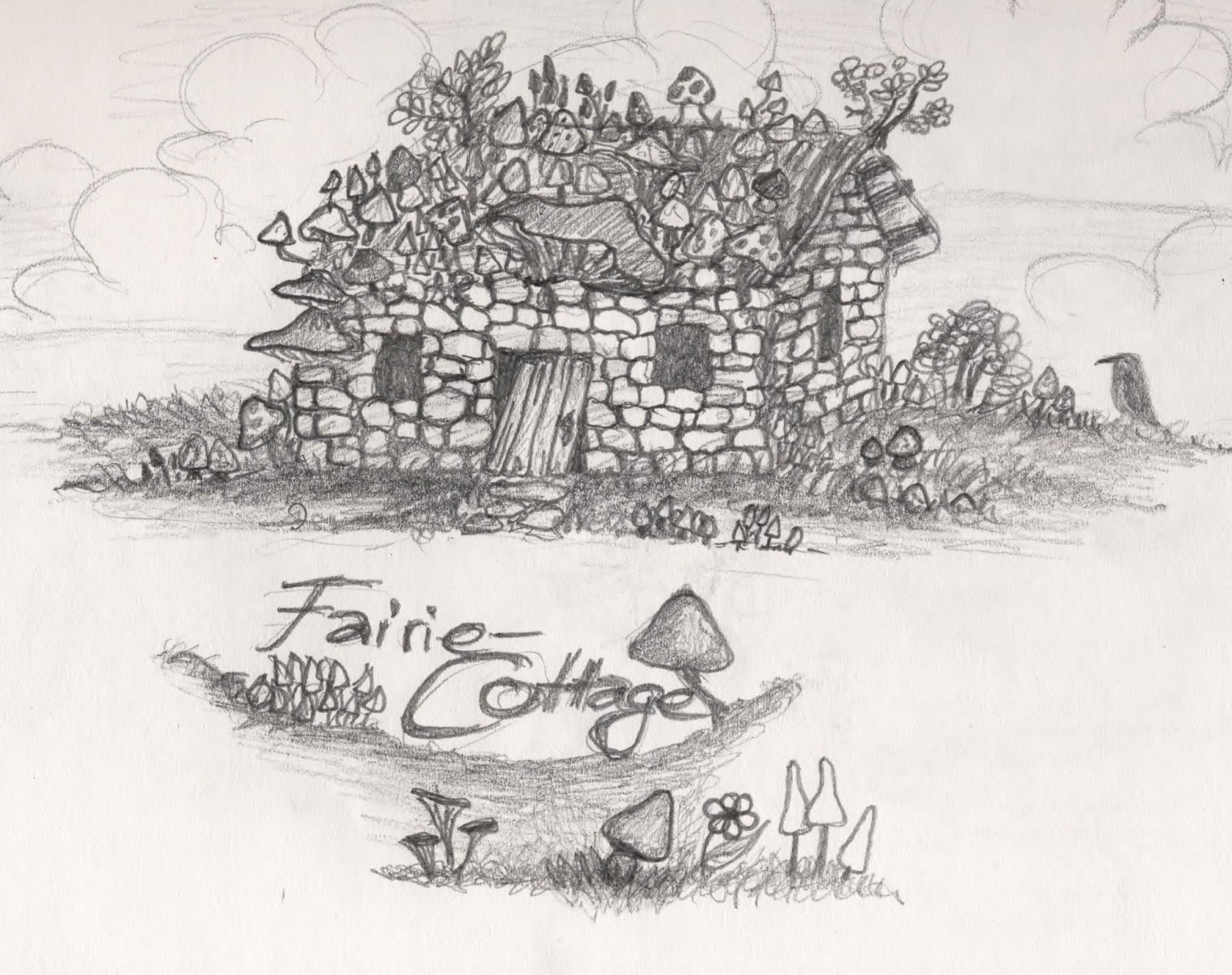
And now, a few pages from our player Lui's sketchbook (creator of the wonderful Tomb of the Iron God maps). These illustrate sights and marvels seen by the Band of Iron in connection with the faerie realms.
The mind-altering faerie fruit doesn't actually have the Goofy Grape and Loudmouth Lime faces, but it is very addictive. Lui's character has been lucky to survive this far, considering that the high-concept is "an elf who wants to taste everything."
On the road, the Band had to step aside and avert their eyes as a faerie army marched by on the way to war. The elf must have peeked because this is a pretty good likeness of the scene.
The two guards I placed at the gate of Leslie Furlong's One Page Dungeon Contest winning scenario, the Faerie Market.
Say hello to the bad guy: Anton the Mountain, retail faerie fruit greengrocer.
Tuesday, 26 February 2013
Prestige? Hell, I Was Born This Way
A contradiction:
First, the best way to do classes in a Basic D&D hybrid is start out with a simple list pretty much keyed to the ability scores. Fighter STR, Thief DEX, you know the routine ... Dwarf CON and Elf CHA pretty much slide in there. The runty class, I think, is best reserved for little nippers with no exceptional scores - that's how I make my gnomes. So seven classes, and it's damn clear which ones you're cut out for, and if your DM is a softie they can let you swap a pair of scores to play what you want.
It is also the easiest thing to slip out of that discipline - to get bored of the repetition, and sneak in a druid here, a bard there, a paladin or ranger or illusionist ... And then a genius insight! You can have your simplicity cake and eat complexity too. Just keep the more advanced options as 3rd Edition-style "prestige classes" for later levels, at a point in the game when the players are well used to it, and looking for new challenges and options.
The contradiction? For some classes that people want to play, it makes no sense, because the class is tied in with a background. Why should my vanilla cleric forsake his god and become a druid? That's as outlandish as a Christian curate suddenly becoming a Buddhist lama at 7th level (oh wait). Why should a vanilla fighter suddenly discover her barbarian roots? While it's easy for a wizard to start specializing, or a fighter to join holy orders, or a rogue to pick up the lute and become a bard, some other class-based choices cut to the identity of the character.
Sure, you could require that the would-be barbarian declare a wilderness background as a plain level 1 fighter, but then that's just another option players have to keep in mind when they start, to avoid the disappointment of being trapped in a choice they made when they didn't know any better. That way lies Third Edition madness, where optimal builds are mapped out level by level from the start like some kind of retirement plan.
So another solution presents itself: to make further specialization about what you can do, not who you are. Not about being a barbarian, but about gaining a Berserk Rage feat at level 3. Not about starting as a druid, but getting closer to nature within your faith, picking up some wilderness miracles at level 3.
But then you risk losing the simplicity of class-based design when it comes to NPCs. Instead of being able to say "This is a level 9 druid" now you have to say "This is a level 9 cleric with the Animal Friend and Plant Baron and Rockslide Impresario and Storm Meister special options."
Anyway, I see two ways out of the maze:
1. Different rules for player and nonplayer characters. The PC gets more specialized by feats, the NPCs have a set of named classes that involve a regular progression of those feats. The PCs, then, start out with a simple set of choices, but then have more diverse options than the NPCs in the fullness of time. In the meantime, the DM can handle the complexity that comes from having twenty or so NPC class options.
2. Realize that players evolve over more than one character. So, give players new to gaming or to your particular system the easy, limited set of options. By the time that first character dies or they are ready to join a new campaign, they will be more able to handle a complex set of class choices.
Which one do you prefer?
First, the best way to do classes in a Basic D&D hybrid is start out with a simple list pretty much keyed to the ability scores. Fighter STR, Thief DEX, you know the routine ... Dwarf CON and Elf CHA pretty much slide in there. The runty class, I think, is best reserved for little nippers with no exceptional scores - that's how I make my gnomes. So seven classes, and it's damn clear which ones you're cut out for, and if your DM is a softie they can let you swap a pair of scores to play what you want.
![]() |
| The Grimdarckane Cricketeer Bladerager (tm) |
The contradiction? For some classes that people want to play, it makes no sense, because the class is tied in with a background. Why should my vanilla cleric forsake his god and become a druid? That's as outlandish as a Christian curate suddenly becoming a Buddhist lama at 7th level (oh wait). Why should a vanilla fighter suddenly discover her barbarian roots? While it's easy for a wizard to start specializing, or a fighter to join holy orders, or a rogue to pick up the lute and become a bard, some other class-based choices cut to the identity of the character.
Sure, you could require that the would-be barbarian declare a wilderness background as a plain level 1 fighter, but then that's just another option players have to keep in mind when they start, to avoid the disappointment of being trapped in a choice they made when they didn't know any better. That way lies Third Edition madness, where optimal builds are mapped out level by level from the start like some kind of retirement plan.
So another solution presents itself: to make further specialization about what you can do, not who you are. Not about being a barbarian, but about gaining a Berserk Rage feat at level 3. Not about starting as a druid, but getting closer to nature within your faith, picking up some wilderness miracles at level 3.
But then you risk losing the simplicity of class-based design when it comes to NPCs. Instead of being able to say "This is a level 9 druid" now you have to say "This is a level 9 cleric with the Animal Friend and Plant Baron and Rockslide Impresario and Storm Meister special options."
Anyway, I see two ways out of the maze:
1. Different rules for player and nonplayer characters. The PC gets more specialized by feats, the NPCs have a set of named classes that involve a regular progression of those feats. The PCs, then, start out with a simple set of choices, but then have more diverse options than the NPCs in the fullness of time. In the meantime, the DM can handle the complexity that comes from having twenty or so NPC class options.
2. Realize that players evolve over more than one character. So, give players new to gaming or to your particular system the easy, limited set of options. By the time that first character dies or they are ready to join a new campaign, they will be more able to handle a complex set of class choices.
Which one do you prefer?
Sunday, 24 February 2013
One Page Campaign
Moving on in the 52 Pages project, this is the first page after the character creation section. The basic points of the game have already been explained. Now it's time to be a little bit directive toward the DM and propose a tried and tested training-wheels approach to the campaign for levels 1-3. Amazingly, the isometric graphics are all public domain, from clker.com.
I think there's still a lot of room for DM creativity within this framework, but probably the most disagreement will be had about the campaign goal. My reasoning is:
Which brings me to the final reason of all. It's foolish to pretend, when inventing the by now twenty-dozenth variation on D&D, that this is the Muad'Dib of heartbreakers that will sweep all before it and forge a new world order of roleplaying. No, the best you can hope for is that people will dabble with the system and swipe some of your best ideas. With that in mind I've tried to make it easy to carve the 52 Pages at the joints. Another logical progression from that idea is that, when choosing between generic and distinctive - go distinctive. You may be wrong, but you are doing something nobody else is doing, and diversifying the DNA of this much mutated game.
I think there's still a lot of room for DM creativity within this framework, but probably the most disagreement will be had about the campaign goal. My reasoning is:
- It's something to work towards, beyond just gaining levels.
- It gives a little taste of the domain game in a situation where very few adventure gaming groups stick it through to the high levels usually associated with that kind of action.
- It's a good move anyway, to have a safe "bank" protected by a grateful populace as more and more treasure flows through the party's hands.
- It drains off some the glut of money that can come with adventuring - and having a base to return to from far travels also drains off some of the glut of time in a campaign.
Which brings me to the final reason of all. It's foolish to pretend, when inventing the by now twenty-dozenth variation on D&D, that this is the Muad'Dib of heartbreakers that will sweep all before it and forge a new world order of roleplaying. No, the best you can hope for is that people will dabble with the system and swipe some of your best ideas. With that in mind I've tried to make it easy to carve the 52 Pages at the joints. Another logical progression from that idea is that, when choosing between generic and distinctive - go distinctive. You may be wrong, but you are doing something nobody else is doing, and diversifying the DNA of this much mutated game.
Saturday, 23 February 2013
One Page Dogs and Horses
I figured the 52 Pages needed this one. At the level 1-3 stage it's boiled down to the obvious adventuring needs, cavalry steeds for your foes, and a handful of dungeon-fodder trap-trippers. As always, some silhouettes courtesy of Telecanter, and relative prices checked with my existing price lists and the Medieval Prices guide (where one of my sp = 5 historical pence).
Friday, 22 February 2013
A Marked-Up Map
I'm much too kind to show the influence map the Band of Iron left behind in the northern lands. Let's just say that purple worm example in the last post was their doing. It ate a whole section of the town of Goran's Anvil, and the town elders know who was responsible. They also left mortal enemies in the town of Parmentell when they discovered the worm ivory scam, left a controversial legacy in Kaserolle, and oh yeah, the Onyx Sorceress wants to have a word with them about how they shamed one of her agents in Ironhoof.
Here's their much more respectable career in the South. (Ignore the animal lairs for now.)
They started out in the village of Poynemara at the top, where they left roots (the white triangle) by settling a retired hireling, Adrem, there, and picking up a new henchwoman, Lintilla. Villages are easy when it comes to fame; the party got two stars pretty much by showing up and having those interactions.
Next stop was the small town of Famorgane, a trading post corrupted by fairy-fruit addiction and de facto ruled by the crime boss Anton. Their adventures there initially got the party two crosses at the top, as they somehow fell in Anton's good graces. But Famorgane became occupied by a holy army during the war with Faerie and Anton has fled, so the party only count on one star there, legacy of a public duel with one of Anton's henchmen.
The larger town of Lugho is a place the party has never been, but due to services rendered on behalf of the Duke and Hierarch of the place, they enjoy two forward slashes (beneficial deeds) and one cross of high-level influence.
Schiecchi is the city of the region. It's harder to get fame there, but due to some carousing and a noteworthy incident in which the party's hermit prophet impressed a rich woman with her generosity, they are on one star. They also have a connection with the influential white magician Ulena, hence the one cross.
Finally, they are undoubtedly in the bad books of the faerie lady of the Vernal House for stealing away her mesmerized bard lover. Perhaps there should be "X" 's on top for enmity instead of influence with the ruler? At any rate, the whole house will be talking about the raid for years to come, so three stars.
The passage of time, and normal social forces, can alter the ratings. For example, fame can spread to settlements of equal or lesser size. If they do something that gets them two stars in Schiecchi, Lugho will almost certainly hear of it.
Influence can also spread, following political lines. The famous deed against the interests of the Vernal House will certainly cause enmity among the House's allies, and may even gain the party good will among its enemies. This is what happened in the north, as the warlord Hugo became friendly to the party largely because they were causing so much havoc among his rivals.
And of course, if enough years pass, fickle fame will fade from memory; but the party's roots, influence and deeds will live longer.
Here's their much more respectable career in the South. (Ignore the animal lairs for now.)
![]() |
| Made with Hexographer Pro. |
Next stop was the small town of Famorgane, a trading post corrupted by fairy-fruit addiction and de facto ruled by the crime boss Anton. Their adventures there initially got the party two crosses at the top, as they somehow fell in Anton's good graces. But Famorgane became occupied by a holy army during the war with Faerie and Anton has fled, so the party only count on one star there, legacy of a public duel with one of Anton's henchmen.
The larger town of Lugho is a place the party has never been, but due to services rendered on behalf of the Duke and Hierarch of the place, they enjoy two forward slashes (beneficial deeds) and one cross of high-level influence.
Schiecchi is the city of the region. It's harder to get fame there, but due to some carousing and a noteworthy incident in which the party's hermit prophet impressed a rich woman with her generosity, they are on one star. They also have a connection with the influential white magician Ulena, hence the one cross.
Finally, they are undoubtedly in the bad books of the faerie lady of the Vernal House for stealing away her mesmerized bard lover. Perhaps there should be "X" 's on top for enmity instead of influence with the ruler? At any rate, the whole house will be talking about the raid for years to come, so three stars.
The passage of time, and normal social forces, can alter the ratings. For example, fame can spread to settlements of equal or lesser size. If they do something that gets them two stars in Schiecchi, Lugho will almost certainly hear of it.
Influence can also spread, following political lines. The famous deed against the interests of the Vernal House will certainly cause enmity among the House's allies, and may even gain the party good will among its enemies. This is what happened in the north, as the warlord Hugo became friendly to the party largely because they were causing so much havoc among his rivals.
And of course, if enough years pass, fickle fame will fade from memory; but the party's roots, influence and deeds will live longer.
Wednesday, 20 February 2013
Making a Mark on the Map
Players love their character sheets, the filling in, gearing up, gaining levels and skills and goodies. They also love maps, filling in the blank spaces of the unknown. But what if the map of a realm - like character sheets - also told a story of their gaining power, influence, and notoriety in the world?
Below is a fairly simple way to mark up the icons for cities, towns or strongholds on a map, that records what kind of legacy an adventuring party is leaving there. Here are the icons that can be written around the place's symbol on the map (shown here by a square):
Influence: This is the sway of the party with the powerful folk of the place.
Next post: An example from actual play.
Below is a fairly simple way to mark up the icons for cities, towns or strongholds on a map, that records what kind of legacy an adventuring party is leaving there. Here are the icons that can be written around the place's symbol on the map (shown here by a square):
Influence: This is the sway of the party with the powerful folk of the place.
- No crosses mean they have no pull, or are even sworn enemies.
- One cross means they have an ally in at least one influential figure.
- Two crosses mean the actual ruler of the place is friendly to them.
- Three crosses mean the party actually rules the place, or at least can dictate to its rulers.
- No star means they're unknown, except to a few they've interacted with.
- One star means they have become known among a section of the people.
- Two stars mean they have become the talk of the town, at least for a while.
- Three stars mean they have left a lasting legend that will endure for many years to come.
- No triangles means the party has no real investment there.
- One triangle means a personal connection - maybe one of them comes from there, or they settled a retired henchman down in the place.
- Two triangles mean the party owns property there and visits at least once a year.
- Three triangles mean the party spends at least two months a year there and takes an active part in its affairs.
- One slash is a deed affecting the temporary interests of the place (for example, robbing a citizen's purse, or buying the bar out at every tavern in town).
- Two is a deed that leaves a permanent mark (for example, murdering or saving the life of a prominent citizen).
- Three is an act that changes the place drastically forever, or saves it from an utter calamity (for example, causing a giant purple worm to rampage through a district, saving the city from the purple worm, or building and endowing an entire magical college there).
Next post: An example from actual play.
Labels:
awards,
city,
Maps,
reputation,
settlements,
social adventure
Subscribe to:
Posts (Atom)


.jpg)