Showing posts with label fortresses. Show all posts

Sunday, 25 January 2026

TSR's module A1, Slave Pits of the Undercity

TSR module A1, Slave Pits of the Undercity, is the first and the most coherent of the Slavers modules: inventive and challenging while being the most sensibly drafted of these disorderly villain lairs.

The history of the series further emerges from a thread on Dragonsfoot remembering the specifics of the GenCon tournament that gave rise to the four A series modules. The temple and dungeon levels of A1 and A2 each were a single, linear adventure. Player groups in the first round were randomly assigned into one of these four qualifiers or a fifth one corresponding to the early section of A3.  From these five, the best-scoring made it to the semifinal and final rounds, which respectively used versions of the later (city) part of A3, and all of A4.

From such a genesis we can trace the design of Slave Pits of the Undercity (and here, perforce, the spoilers begin). Helpfully for our archaeology, the module includes the original tournament railroad maps for the top and dungeon levels.

Wayne's Books - Sales Site - RPGs, Sci-Fi & Fantasy
New monsters, meant as a surprise, were regularly "spoiled" on the A series covers - here, the aspis


TEMPLE LEVEL

The tournament scenario gives the players inside information about a secret door in the wall of the temple. This door is trapped but not guarded - such is the security protocol of a disorderly fortress - and leads to a twisting corridor through an abandoned area of the building. The "railroad" takes the party past some well-set fights, and other situations that act like puzzles without seeming contrived, such as a deceptive plank over a pit, or a combat dilemma involving a new plant monster, the giant sundew, that becomes much easier if the party realizes how the fortress forces manage this menace in its midst. After this gauntlet, the party will run into the actual slaver forces, and these encounters are devised with the same art, combining trickery, interesting combat problems, and traps.

That's the end of the railroad; but even the tournament scenario has a couple of distractions and dead-ends. One of them, a roughly patched wall that if broken through leads to a face-to-face encounter with a basilisk, had the distinction of taking out a player-character in my own 5th edition campaign.  And in the campaign version of the module, more areas are added branching from the tournament path - a stable guarded by slaver forces, a haunted cemetery and a garrison of terrified orcs, and a spacious courtyard, possibly a shortcut, but where more undead lurk. The reissue of the module in 1986 added a gate from this courtyard into the midst of the organized opposition area, further adding options for the attack.

This expansion allows different approaches to the temple complex. Jason Thompson's cartoon walkthrough of the module shows two of these: one party sneaking in through the tournament entrance, the other masquerading as slave-buying customers to go through the front door. Entering by the stables, by the graveyard orc door, or simply climbing the wall in an unguarded spot are also possibilities.

DUNGEON LEVEL

There are ways down from the temple, most obviously at the end of the final boss fight of the temple railroad; but the full module places two more descents to vary play in the dungeon level. This underground jams together four quite different areas: the eponymous slave pits, with slaves, slavers, and minions; a set of caves that hosts a tribe of orcs allied with the slavers; another set of caves that hosts a population of another new monster, the fearsome four-armed insectoid aspis folk; and a network of wet and filthy sewer passages that ties the whole place together.

The railroad version of the dungeon has the players first encountering some nasty larvae in the acidic spawning pool of the aspis; then crossing the sewer to muscle through a protracted fight with most of the orc tribe; then finally engaging the slavers, including some of their aspis allies, before confronting the slaver leader - who, it has to be said, is less formidable and treacherous than the final encounter of the temple. 

The open version develops the aspis zone and has more connections to approach the bad guys. While the temple is infested with ghouls and a wight, the underground is only semi-unruly - these are groups cooperating with the slavers for now, but if a way can be found to communicate, faction bargaining in the classic big-dungeon style can happen.

BEST OF THE SERIES

My current party cleared out most of A1, using a conversion to 5th edition. Running it was a delight -- the combat challenges tough and packed with surprises, but not in a way that felt forced or unfair. The tricks and traps have a gritty, naturalistic feel to them, and the different areas of the complex are balanced between abandoned/haunted, main bad guys, and side factions. We see how the garrison of orcs, half-orcs, and evil humans deals with the unruly forces in their midst - finding a way to tame the sundew, cringing in fear from the haunted cemetery, hiring some of the aspis. This was also the deadliest module of my campaign, claiming two PCs. Probably, this is just due to incautious player mistakes snagging on two of 5th edition's few remaining teeth. One, doppelgangers have an absolutely deadly surprise attack if they can catch a party member alone; two, even with two saves, there is no easy answer to petrification until characters hit ninth level.

As we'll see in the pieces to come, the other A-series modules, in my opinion, are less deft at presenting an unruly stronghold: A2 is ambitious but strained, A3 a mess, and A4 returns to better form but famously hangs on a railroading premise that may not sit well with new-old-school values.

Friday, 21 November 2025

TSR's "A" series of adventures in unusually unruly strongholds: Introduction

Illustration from Slave Pits of the Undercity (1980) by David S. LaForce

D&D was born in the castle. The Castle and Crusade Society of wargamers brought Gygax and Arneson together over miniature battles fought at Bodenburg, a scale model of a medieval fortress. Castle sieges were one suggested scenario for the Man-to-Man section of Perren and Gygax's Chainmail rules, the predecessor to D&D's combat system. But despite the genesis of Gygax's and Arneson's dungeons as the cellar levels of castles, it was these underworlds and not the upper rooms that captured the imagination of generations going forward.

Indeed, it's not hard to see how attacks on fully manned fortresses can fall flat as an adventure. The horn is blown, the defenders stream forth from their barracks. Pitched battle on unfavorable terrain ensues. One might, perhaps, set up a night-time infiltration. But then the play only becomes catastrophic: one failure to sneak takes you to the pitched battle again. The appeal of the dungeon environment is precisely its disorganization. There, the adventurers control the tempo of exploration, deciding whether to push their luck, encamp, or retreat.

Still, TSR's first published adventure module was a stronghold assault, the enemy being hill giants (G1, Steading of the Hill Giant Chief), and the next two continued on to fortresses run by frost and fire giants. This choice joins the wargaming castle instinct with a wish to recreate the adventures of De Camp and Pratt's protagonist Harold Shea, guest and prisoner in the stronghold of the frost giant Utgardaloki. Also, the high character levels capable of taking on multiple giants at the same time can access the kind of magic - invisibility, illusions, distractions, knock spells, and the like - that'll support effective infiltration. 

In aid of this goal, the steading is not exactly on a war footing. Giants are drunk, feasting, asleep, on errands: plenty of gaps in the defenses for smaller folk to exploit. As well, the cellars play  more like a classic dungeon - one retrospective has called the lower level a "monster motel" -  - a pattern  followed in the Frost and Fire sequels. If they win through to the underground, the party can take back control of the tempo, switching to the more usual room-by-room exploration.

But let's turn to the next major series of campaign modules after the high adventure of the G-D-Q series. The A series was based on four adventures that made up the AD&D tournament at GenCon XIII in 1980, run on consecutive days as qualifier rounds, semi-finals and finals, at huge scale: 40 tables to start with. Each adventure had a different authorship, but the connecting plot was simple enough: you were mid-level characters infiltrating and attacking the bases of a ring of slavers in the failed state of the Pomarj, World of Greyhawk. 

A word about tournament play. Although this style has largely fallen out of favor these days, it was a well-subscribed activity at early conventions, an answer to the question, "How do I win at D&D?" Tournament mode differed from home-campaign D&D in design choices that equalized experiences across tables, so that in theory, the most skilled player groups could prevail. In the 1980 tournament, each group ran the same set of pre-generated player characters; the adventures were linear, presenting the same challenges in the same order; and sometimes, DMs were told to apply a standard amount of damage from traps and the like, instead of rolling dice. To determine winners, each run was scored by awarding points for dealing with enemies, bonus points for discoveries or anticipated clever solutions, and points deducted for party casualties along the way.

The linearity in these adventures, in particular, deserves comment. It's an innovation that appeared at Origins 1979 with the Hidden Shrine of Tamoachan; the previous year's tournament module, the aforementioned Giants series, was more open-plan. TSR realized that what was good for the tournament might not be good for campaign play, so when the A series was published, some alternative paths were added to give players more of a sense of agency. For the most part, these revisions work, although the final chapter still presumes an escape from having been thrown in prison -- a plot fiat that shines notoriously in the gallery of Railroading Through the Ages.

In reviewing these A adventures, I'll examine how each one spices up the organized stronghold concept by presenting it as an unruly place -- factions that chafe, distracted guards, abandoned areas that follow their own rules, and clever defensive tricks that sometimes try a little too hard. The quality of this series, unfortunately, falls off from A1 to the later modules. It's not that the creativity is lacking. Rather, the idea of the unruly stronghold starts to repeat itself and challenge the limits of plausibility.

Sunday, 3 March 2024

Night's Dark Terror 8: Raid on the Goblin Fort

This is part of a series of posts with a scene-by-scene critique, appreciation, and improvement of the 1986 TSR module B10, Night's Dark Terror

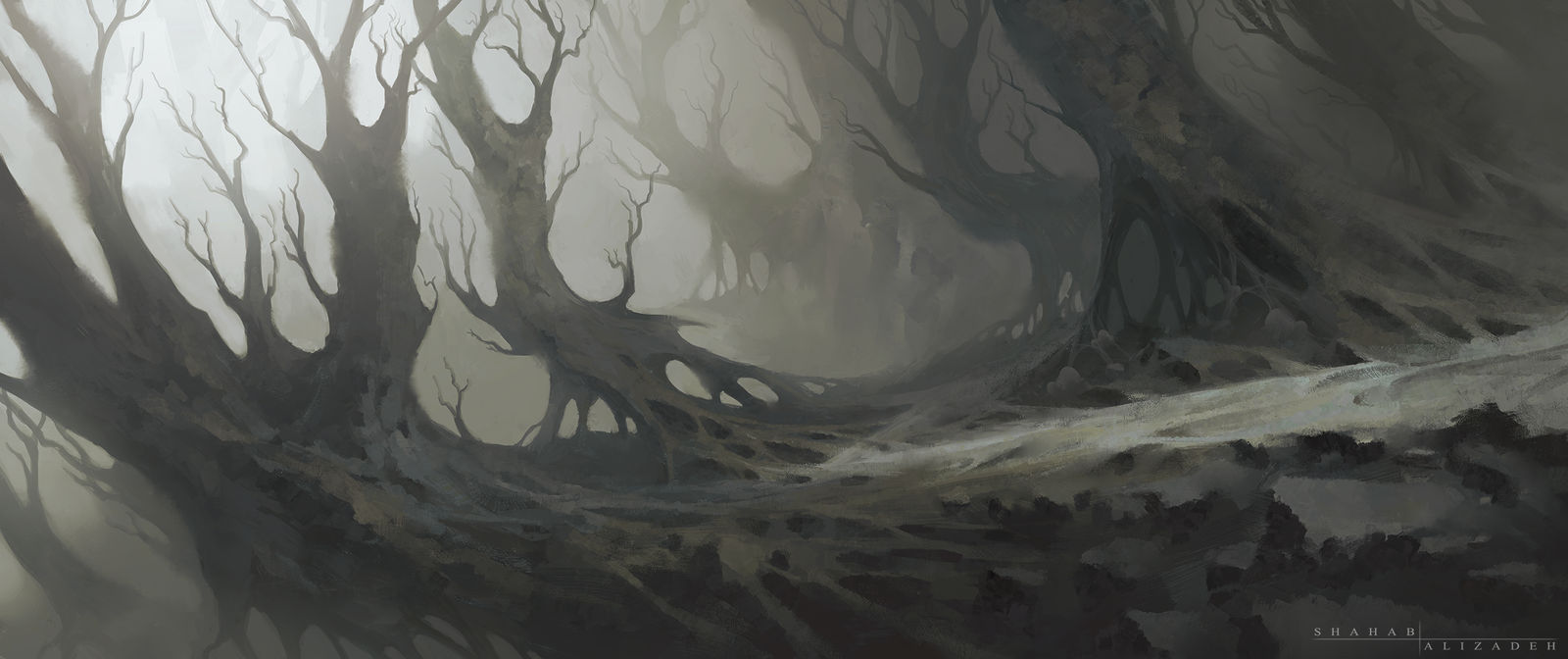
When the adventurers find it, the lair of the Wolfskull goblins is properly atmospheric. It's in the middle of a miles-wide petrified forest -- not the paltry fossilized remains found on Earth, but a whole forest turned to stone, birds, squirrels, leaves, and all. This strange and gloomy place will attract the attention of the adventurers when they discover it, and channel them to one of the paths that runs through it, which all lead to the Wolfskull fort at the center.

Petrified Forest by ShahabAlizadeh on DeviantArt
Art by ShahabAlizadeh

There's a fight with some giant bats (confusingly, not the same bats that are the hobgoblin Vlack's pets), then a more consequential run-in with a goblin patrol. Although the party see the foes in time to arrange an ambush, letting just one goblin get away can mean trouble - and we can assume the foot-goblins at least are more able to scramble through the petrified underbrush than a typical adventurer.

But if the garrison isn't alerted, there are just two guards in the entrance of this memorable fort, built of and around the stone timber of frozen trees. Two guards lit by torches, who are not even looking out their one door ... OK, hold up a second. Goblins can see in the dark and wolves have a great nose, so all the fires and torches described lighting up this fort's interior are besides the point. Just make it a dark hole with two red eyes staring out that, if you're lucky, you see before they see you. And don't fall in the river moat - if cold-water piranhas are too much for you, they can always be replaced by good old mundane giant leeches.

This is a strange little castle, to be sure. It can't be defended with archers, no battlements or window slits. But actually, that suits the armaments of the Wolfskulls, which are throwing spears and axes and the jaws of their mounts. And forget the boxed text that has the goblins "rushing forward with weapons drawn." Instead, the best strategy would allow the goblins' numbers to tell by luring a force of stronger but fewer invaders inside the walls, deep ebough in to be attacked from all sides with no escape possible.

But does the fortress' layout actually support that strategy? Sort of. If the goblins abandon area c quickly, darting in and out of cover to throw spears or (in 5th edition) striking and disangaging with their hand axes, the defenders of areas d, g, and e would do best to hide away out of sight, forcing the invading vanguard to enter that room while the other areas bide their time and attack from the flank.

Then again, perhaps the goblins would absolutely slaughter a third level party, especially playing by Basic rules, if allowed to use optimal tactics. As written, the defenders are quick to attack but slow to be alerted, allowing for a series of manageable battles. Still, you might prefer balance to come from a reduction in numbers rather than from dumbing down the goblins -- perhaps subtracting one or two patrols like the ones encountered outside from the roster, to come back later and put the victors on the defensive.

A smart party will avoid Vlack's rooms across the log bridge, which have no proactive forces in them, until they've recovered from the main fight. The split skull painted on the door (why not a bloody head, the insignia of Vlack's tribe?) should be warning enough. Vlack's not home, but his pet giant weasels are in, and a pair of the most iconic Basic D&D-only monsters: thouls, those misbegotten creatures that happen when a hobgoblin, a ghoul, a troll, and an OD&D typographical error love each other very much.

[]
Thoul, by Steve Zeiser


There's a good mix of obvious and hidden loot in the lair, but the object of your quest - Stefan Sukiskyn - is in another castle. One of the left-behind prisoners, a Slavic granny literally called Babushka, has overheard the word "Xitaqa" as Stefan's destination. We can assume that the people who came to get him were not goblins, but servants of the Iron Ring whose description should match the attackers that start out the adventure -- that gives them a reason to speak Common and for Babushka to overhear. If you feel there should be a few more clues to what's going on, you can have some of the loot give those clues - a rough map of the raid locations in Vlack's room, or an heirloom from one of the raided settlements.

The bridge to the hobgoblins' quarters also gives the goblins a way out if the battle goes against them, assuming they follow their retreat strategy and end up concentrated in room h. But where will they go? It might be a relief that there are no goblin civilians, the traditional "women and children" of D&D moral philosophy. But it's also a puzzle, and my reckoning was that the goblins had a civilian settlement hidden away in the stone forest, not obviously at the conjunction of all the paths like the fort was. In about ten years there will be a new generation of Wolfskulls raising hell.

Some other hacks I applied to make the magic loot here more interesting:

* Whatever the potion of delusion is, it's likely the goblin king Kloss would keep it on his person. In this case it's an emperor's new invisibility potion - you can't see yourself but everyone else can.

* The shield +2 in my campaign is a heirloom of the slaughtered Segenyev family, known as the "White Wall." It is a large, heavy shield that goblins cannot use, white with a red stag, and gives resistance to cold when held but is only +2 after a combat round (turn) spent without moving, as shields with pluses are a little overpowered in 5th edition.

Next: What's a Xitaqa?

Thursday, 5 October 2023

Hex Crawl 23 #263: Punishment Fortress of the Fifth Maniple

Three hexes northwest, ten north of Alakran.


Another of the manipular legions of the Wahatti Army is stationed nearby, but this small brick oblong with only one watchtower is not its main fortress. This place is known only as Siptu, "Punishment," and holds five spearmen and five archers detached from the main garrison, along with a sergeant (fighter-3), the fearful ox-strong taskmaster Berabaku (barbarian-5), and four savage war dogs who obey only Berabaku. 

The twenty-odd prisoners are a mixture of disciplinary cases from all the maniples, and civilian malfeasors who stumbled into military justice. In Wahattu the military units are allowed to capture and try any criminal they catch in the act, with a judge borrowed from the civil courts. Wandering do-gooders may try to rescue these wretched ones from their daily diet of hard and pointless labor on the rocky slopes -- carrying rocks up, then rolling them down again. But they will find that most of the jailbirds are hardened and black-hearted ingrates, with only two or three good men among them.

Saturday, 9 September 2023

Hex Crawl 23 #237: The Black Gazelles of Gilded Horn

Seven hexes northwest, four north of Alakran. 


On an eminence, an out-thrust lip of the eastern Dhuga ridge, accessible only from the east, is the walled fortress of the military and hunting charioteer company, the Black Gazelles of Gilded Horn. Their black enamelled chariots with golden ornaments are drawn by trios of the titular beast, whose delicate strain has been bred to achieve an adequate size for the swift transport of two lithe and lightly protected men. The company numbers some eighty.

Their reputation as lechers and roisterers is confined within the walls of this fortress. There is a central keep, stocked with comforts and luxuries, whereto loose urbanites and wayward shepherdesses are often lured. But in Eryptos and the civilized country to the west, the Gazelles are the very image of rectitude, travelling to and from periods of formal leave in silent groups of 3-18. 

Their hunting excursions, by further contrast, are excuses to get away from both the stiffness of formal manners, and the exhaustion of sybaritic pleasures. In the chariot, in the tent of black silk pitched on the hillside amid a stand of terebinths, the groups of 2-12 Gazelles who roam the Dhuga Hills recover their spent virility. Some are even moved to stirring song, or heroic poetry, by their fellows' exertions in pursuit of the fleet gemsbok or the wrathful rhinoceros.

If you, adventurers, meet a group of Black Gazelles, know that they travel two to a chariot, with odd numbers riding alone. A group of 4 will contain the equivalent of two level 1, one level 2, and one level 3 fighter. The fifth will be a level 5, either fighter, ranger, or rogue. A tenth will be level 8 in one of those classes. They are all skilled and dangerous with the scimitar, long lance, and longbow, as much on foot as from a moving platform. If ten or more are encountered, the Prince of Eryptos (the Radiant Gemsbok of Autumn, level 2 because of his young years, but outranking them all), will be among them 50% of the time.

How will they receive you? With deference, if you are Wahatti nobility, or any kind of Urig from the middle classes upward. With camaraderie, if you are any member of the Wahatti military, for the Gazelles strive to avoid grudges in the fraternity. Anyone else -- out of the way, thou peasant, thou tinker! Or halt -- maybe you are poaching? Scandal, crisis, and relentless persecution from the full weight of the Wahatti state (minus the Prince's particular enemies) will follow anyone who slays one of the Black Gazelles, either the literal kind or the human kind.