Showing posts with label DMing. Show all posts

Saturday, 26 July 2025

52 Pages at Canterbury (UK) Gaming Con

 For my followers who can easily get to Canterbury in the southern UK on August 8-10, the local game shop is hosting a convention on the University of Kent campus and I will be running multiple sessions of Jennell Jaquays' Thracia using 52 Pages rules and pregen characters, including classes from the Next 52 expansion.


Register for the convention here. For my sessions, you can sign up using Warhorn here.

That is all, carry on!

Tuesday, 8 December 2015

Running and Hacking the Lantern of Wyv

At London's one-day convention Dragonmeet last weekend I ran one of the One Page Dungeon Contest winners from this year, "The Lantern of Wyv" by Michael Prescott. As usual, I find one-page adventures near perfect time-wise for four-hour convention slots (though this slot was more like 3 1/2), but can't resist tinkering with the adventure as written.


The pregenerated characters were all based on rock stars from the 60's, mostly associated with the Rolling Stones, in homage to the song "Lantern." Each one had a secret goal - to use the Lantern to get back home; to gather white "moon pebbles" or wyvern venom for, um, alchemical purposes; to experience new sensations; to rid the Bay of the wyverns that had taken over since the owner of the Lantern died; to scrounge spells; to make sure the wizard buried there is resting easily. Some changes were:

1. The adventurers start from a village a half day's walk away from the bay,populated by refugees from the wyvern plague. They had 1/6 chances of encountering a wyvern and a human hunting party from the survivors in the bay, and got the latter. These gave useful information that the wyverns are attracted to shiny and colorful things, and traded a dose of anti-venom for some food and equipment.

2. More detail about the tower where the flying barge "docks" (25 feet above the top). The wizard Radomenus has only been dead 20 years and the tower was the site of her funeral and wake. It's a three-floor octagonal construction some 20' wide and rises 25' with its top levels blasted away (the stone appears melted, which wizards may know is the signature effect of a high-level white fireball). All around the tower in the long grass are melted chunks of stone and the pieces of a dismantled spiral stair.

Also in the grass and leaves by the tilting wooden door is a small iron figurine of a cricket-bodied man in the act of playing the fiddle and bow. If brought within 5' of a place where Radomenus has lain (the biers in the tower and the barge, the black table in the Lantern) the residual radiation will inspire the figure to chirp out a slow rhythm, which gets more hectic with proximity to the white sand or to Radomenus herself.

Inside on the ground floor are scattered, decaying folding chairs (the wizards at the wake quarreled on leaving and the place was never properly cleaned up) surrounding a bare wooden bier with few surprises. A few balled-up scraps of paper when put together reveal a neatly scribed program for the funeral. In the game I prepared this prop on the train up and threw wadded-up pieces of the puzzle at the players as they scoured the floor. This gave such clues as "shrouding and shielding of the body", the hymn "that is not dead which doth eternal lie,"and the conclusion of the wake with an "abolition of the tower."

Using rope to go up past the middle level, with some uninteresting long-spoiled food and drink left over from the wake, the adventurers found themselves on the melted stump-roof of the tower and waited until the flying barge came to stop there, 25' up. A levitate spell from the gnome and some ropework had everyone up there quickly, although the healer fell and broke her ribs.

Using the information from the hunters, everyone lay low and covered up their armor for the ride and survived without a wyvern attack (1/6 chance, up to a certainty if showing bright or shiny objects).

3. There had been a lot of ropework getting up the stairless tower and onto the barge, and rather than go through all that again I decided to make the central shaft of the Lantern different. The levitating magics that allowed people to move between levels are still in place, but have become unstable. For each level in space, each 5' area around the rim of the shaft and each minute in time roll a d6, where 6 = "going up quickly" and 1 ="going down quickly." Various ways to navigate were tried, including trial and error, rope, and throwing flour into the air to see which way the currents go (adventuring use #2,407 for flour). The slight chaos thus caused had the gnome on the third level and the rest of the party on the first.

4. The first level, along with the radioactive "new flesh" healing slab, had the addition of some formless lumps of flesh that used to be servants. I was ready to use them in a fight (as lemures) but seeing no need to kill time I instead had them just be features in an empty room, that protested and asked to be returned to oblivion when put on the resurrection slab.

5. The second level was mostly unexplored, although the shaft room was the venue for the final fight. I had prepared a map of my campaign world with crossing ley lines for the players to find, as well as a kind of a game where a wizard could piece together torn up and incomplete spell names and descriptions to create unreliable new magics.

6. The third level was pretty much as described. The gnome tiptoed past the bulk of the transformed Radomenus (sleeping, by my dice) and messed around a bit with steering crystals and the pit of radioactive sand before filling a wineskin with the stuff and, casting it into the flux currents, found one to gently go back down.

At that time, looking at the less than 30 minutes remaining, I decided that Radomenus would wake up and crawl down for the final boss fight. Well, 8 hit dice of blob don't last long against eight level 4 characters, and the one lightning bolt she licked off before Hideous Mirth and a hail of arrows got to her only critically injured a henchman. I didn't even think to have her summon wyverns before descending, so the party got cheated out of that experience as well. Next time she will be better prepared...

Resolution 1: Prep without mercy. These are one-shot characters and there's no need to be gentle.

Resolution 2: The one-page format lends itself to four hours pretty easily, so any padding added at the front will detract from the meaty, cool stuff at the end.

Friday, 20 November 2015

Paraphrase Third-Party Conversations

It's always an awkward moment in any role-playing game when the game master has to represent two, or worse more, non-player characters talking to each other. The exercise resembles nothing so much as young Danny's conversations with his own wagging finger in "The Shining." Using funny voices, the GM ekes out an extended scene while the players sit and watch.


But this is as destructive of the social nature of RPG as any paragraphs-long set-piece room description or boxed text would be. The point of the game is to construct a shared reality through interaction. Awareness that you, the GM or player, are entering into a monologue-as -dialogue should be a sharp signal to shift gears.

To what, exactly?

While some advise to skip such scenes entirely, I don't think it's possible or desirable. Instead, what I do now when I feel a sock-puppet play scene coming on is to paraphrase. That is, switch from this:

COURT WIZARD (bad Peter Lorre impression): Eeeuhh, my lady, what these adventurers propose is verrry reckless.
QUEEN (bad Renee Zellweger as Bridget Jones impression): But the bones of my forefathers are endangered if the rumors are true!
COURT WIZARD: They were placed there to watch over an ancient evil! Who knows what these bumbling louts will awaken?

To this:

YOU: The Queen supports your mission to rescue the bones in the tomb, but the wizard is agitated and warns her that you may disturb an ancient evil.


This leaves it open for the players to intervene and address either party, at which point a player-GM conversation can take place in character again.

Come to think of it, the goal of maximum interaction also suggests a light touch when describing scenes, but that'a topic for next time ...

Sunday, 25 October 2015

Dragonmeet 2015: Carry the Lantern High

Dragonmeet, London's one-day gaming convention, is coming up on the 5th December and unlike last year I can actually attend. It is my tradition to run an adventure from the one page dungeon contest, using the 52 Pages system, and name it after a rock song. This year is no exception, as I run Michael Prescott's winning adventure.


In which you have to get to that octahedron in the sky and wrestle forth its secrets. And now the theme will extend to the pre-generated characters, viz.

Well, there isn't much of a schedule visible yet because hey, Dragonmeet. But I am looking forward to it!

Thursday, 4 June 2015

Security Through Oldschoolity

Recent discussions started by Kiel and continued on G+ have got me thinking about why completely separating an adventure's text from its map, or printing the map devoid of details, still seems like a viable idea to publishers. Is it just tradition?

Looking at the design of the first TSR modules, it seems clear that one goal was to have the map contain as little information as possible, so that an accidental peek by players behind the screen would not reveal too much.


Thus, the need to constantly flip back and forth between the big map and the numbered section of text, rather than using map insets in the text or text notes on the map.

This technique is what security experts call "security through obfuscation." By making things hard to find for yourself, you try to make them impossible to find for others. Closely related is the idea of "security through obscurity," which you also saw in old school Advanced D&D with the injunctions that players not be able to access the DM book or monster manual. And of course, the very cerulean color of the old-school maps is another security device, to make them unreadable by the xerographic technology of the day.

Today, with everything available online legally or illegally for most published modules, the best defense is just to assume that players are their own security; that they play not to defeat you, but to enjoy discovery and surprise;and that you the GM help them in this goal by keeping the map discreetly covered, but with whatever marks are necessary to help you run the game smoothly.

Tuesday, 17 February 2015

Impulsiveness

I'm not sure if I'll get around to recounting the latest misadventure of the Muleteers, but there's a couple of posts to be had reflecting about the last session.

Huizinga, in The Waning of the Middle Ages, calls to attention "The Violent Tenor of Life"; the ease with which harsh and tender passions in alternation were unleashed, the revelling in cruelty. Although controversial as historiography, this description perhaps tells us more about what we moderns seek in the medieval, the archaic, the Renaissance or the Regency or the Wild West, when these are presented as times where life was cheap, morals were loose.


The role-playing game in its imaginative detachment allows the same vicarious pleasure in the impulsive act of grisly consequence. Vicarious? No, the direct pleasure of being able to say "I waste him with my crossbow" and having it happen as easily as saying it; of watching, horrified and grinning, in the mind's eye as a series of critical and fatal hits makes Peckinpah work of the enemy. The pleasure of being such a fearsome character and choosing to exert a brash and self-serving virtue; of hoisting sacks of coppers to urchins, the equivalent of Nino Brown serving up turkeys. The pleasure, even for mild-mannered character players, of being the monk hiding from the Vikings, the Wild West schoolmarm, the scholar who can live a little shady and still look a saint by comparison.

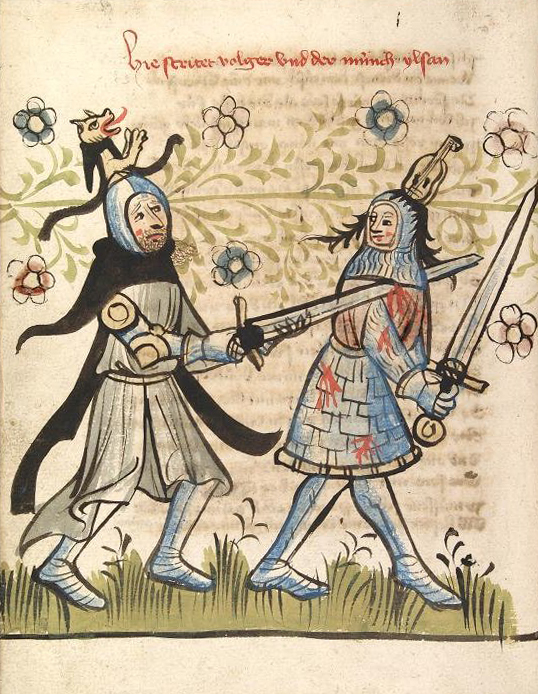
The roleplaying scenario strips away nervous inhibition and allows action as transgressive and pointless as that of the pictured fellow under the terrier crest who is spit-roasting a man for the crime of wearing a rebec on his head. Dealing out violence under these circumstances acquires a palatable irony because these are people long since dead, or better yet, who never could have lived.

One final pleasure, to the player, is finding out the boundaries of the world of action and joy. Does having a handful of hit points above the norm means that world is your arena whose inhabitants are merely bled and bowed bulls for the matador? Or rather, is it a place where crime is abhorred, vengeance is meted, and the arm of punishment is long if not swift?  Hurrah, for the scales are tipped in the favor of the latter option, the morality of the Hays Code, where we see every murder and blasphemy dealt out by the arch-hoodlum before the coppers surround him and fill him full of lead. Because to deal out the rough justice of consequences is the particular pleasure of the gamemaster. And the truly dispassionate gamemaster knows to make the delay or denial of justice, as unlikely as it may seem, a possible adventure in itself, if one of the hardest.

Monday, 17 November 2014

Junji Ito's Psychological Horrors

Pure body horror only goes skin deep. Although Junji Ito's stories sometimes try for little more than pure gross-out (most successfully in Glyceride, with its palpable conflation of grease, fat, meat and acne) the best ones touch on psychological anxieties below the surface.

Western stories often present the loss of individuality as a horrific fate. In Poe it's the 19th century horror that a gentleman's reputation might be ruined by a debauched double, in The Case of Mr. Pelham, possibly the best episode of Alfred Hitchcock Presents (by Cockrell and Armstrong), it's the 20th century horror that your salaryman double might be better, more confident, harder working than you. Think about the end of 1984, or of The Stepford Wives.

Junji Ito sometimes writes from the other point of view. What if the horror is not to lose your individuality, but to have it?  What if the monster is personalized; what if the horror is not in being forgotten, but in being targeted and sought out? Japanese culture may be particularly sensitive to this question, as its collectivist tradition collides with a postwar individualist modernity.

Spoilers, of course, follow.

Enigma of Amigara Fault (previously) and Hanging Balloons both evoke the horror of individuality. In Enigma, perfectly personalized holes in the rock call out to people, seducing and ultimately warping them. In Balloons, large balloons with the faces of individuals appear, pursuing their originals with pendant nooses and relentless cunning. Despite their preposterous premises, both stories succeed in haunting the reader with unease, a clue that deeper allegories are at work here.

The Internet uses personal data as a kind of soul you can sign away for content and functionality and connectivity. But it seems that people only get creeped out when reminded explicitly who has their data - when Google puts up an ad that's a little too close to the content of one of your emails. And in the case of identity theft, or getting doxxed, the creepy becomes frightening. Ito's stories from the 90's prefigure the anxieties of hyper-personalization. Significantly, the first victim of the Hanging Balloons is a celebrity; fame as a curse.


In gaming it is all too easy to put the players in the eye of peril, thanks to the omniscience of the game master. One of the best instances is in Death Frost Doom when the characters find a portrait of themselves. The doppleganger is a well-known adversary, and the corny plot hook of being the "ones spoken of in prophecy" can have as much dread as promise resting in it..

A particularly evil twist would be to confront the party not with their exact doubles, but with a group of rivals that by coincidence duplicates their class and character concepts ... only with a turn toward the cliche side. The fair and noble warrior becomes a bland do-gooder, the sneaky thief has the brooding and antiheroic angst turned up off the dial, and so on. Who dares steal the most vital element of player character identification - individuality?

If modern individuality is scary in Ito's world, so is tradition. I wish I could just erase time and have "human centipede" refer instead to the monster in My Dear Ancestors. This less gross, more disturbing insect is made up of a centuries-old chain of brains, skulls and hair, each one growing on the next head (literally) of the family. The allegory about the dead weight of obligation is heavy, but not heavy-handed, as the lineage-beast is revealed as the sinister force behind its only heir's courtship of our heroine.  The composite creature practically writes itself as a monster, and in a world of wizardry, might represent an accumulation of power to rival even the oldest lich.


Ito's psychological adroitness comes through even in the stories that fail. In Ice Cream Bus, a divorced father's need to win his son's affection is expertly twisted as he finally gives in and lets the kid go onto the titular vehicle, and, well, what do you expect from the free ice cream rides around the block? The strong point is the sticky sweetness of ice cream as a bland mask for unspeakable desires, from the moms purring after the handsome ice cream man, to the unforgettable glimpse of mounds of ice cream inside the bus, children crawling and licking away on them. The denouement, sadly, falls flat and silly - a less literal, less fantastic final horror would have worked better.

Another chilling story with an unsatisfying ending is House of Puppets. Here we consider how people may choose to live as puppets - exerting no energy, their limbs responding to the impulses of puppeteers living in the upper story, freed from the difficulty of life. There are shades of Erich Fromm's "escape from freedom" here, but also of the more sinister tones of Thomas Ligotti's existential horror. Not  coincidentally does Ligotti also make use of puppets and dolls as he opens up the nihilistic possibilities of denying and rejecting the self.


Ito's supernatural, trite turn betrays the real possibilities of the setting. Psychology experiments, from Milgram's Cyranoids to Wegner's less well known explorations of the merely perceptual nature of agency, leave it a real possibility that the sensation of self in ourselves is an illusion; that things we think we have done are the work of unconscious automatisms. Now imagine the surrender of something as precious as the self as an ambiguous horror, pulsing also with relief.

Fantasy gives us such a possibility through magic, so that a critical failure to save against a charm effect might indicate a Stockholm syndrome- a newly acquired flunky whose lack of initiative is as disturbing and counterproductive as it is useful.

Or for a more perverse act of gamemastering, offer a Faustian bargain; through sorcery, the control of a player's character to be transferred to an altogether more competent agency, unearthing powers and possibilities, earning experience at a double clip while so possessed, seemingly (or in a shocker, actually) working for the good of the character and the party with inside knowledge and superior craft.

What price freedom, indeed?

Friday, 1 August 2014

GenCon Run: A Mule Called Golgotha

All right. I have taken the step of registering my 52 Pages Old School Basic/3E hybrid game run with GenCon. It will be August 15 (Friday) 10AM-2PM in Embassy Suites, Chancellor 1. If you are already logged into Gencon events manager the link is this un. I want to see some of my blog readers in the crazy mix! Here is the splash page for my GM screen.
The scenario is a delve into Castle of the Mad Archmage's Crypt level with 5th level pre-gens using the 52 Pages system (see downloads, right). The mule is what you will be using to transport the bodies of the blameless dead back to the surface, but the dungeon might have other plans.

I hope I can get some of you fellow bloggers, readers and commenters out of the woodwork for this one!

Wednesday, 23 July 2014

Appears-Book-Isms

Here's how it probably starts.

There's a slip between the input and the output of the Gamemaster-In-The-Middle. The adventure writer communicating to the GM says "This appears to be a worn stone stairway leading down, but really is a sloping passage floored with the sticky illusion-casting tongue of a Deceptive Devourer, the rest of which lurks in wait in room 15 of the next level." The GM then communicates to players,  "You see what appears to be ... an old set of stone steps leading down into the darkness." Or consulting the "appears" synonym book, "seems," "looks like," "apparently is," et al.

Who knows why they do this, but two reasons come to mind. It could just be literal-mindedness, relying on the words in the description to craft a speech to the players. It could also be a reflex of honesty; the inner moral angel balking at saying there "is" a flight of stairs leading down when it just isn't true. Whatever the reason, it becomes immediately clear to the players that using "appears"-isms in this way is a giveaway that something funny is up.

Now, there's still time for you, the GM, to repent of your folly. Realize that your job is only to describe reality as it appears at any given time to the players. A successful deception will appear with the full force of reality;  "is," actually, is fully appropriate.

But in some games I've seen, the GM instead takes the left-hand path, doubling down on "appears"-ism by applying it as a decoy to things that aren't deceptive at all.

"What seem to be some mushrooms are growing from the dung heap." (They're just mushrooms.)
"There are some humanoids approaching. They appear to be orcs." (And they are.)
"A stream of what looks like clear water flows from the left wall to the right." (PSYCH! It's acid, save or take 4d6!!)

In any case, "appears"-ism usually gets left by the wayside when the players enter safe surroundings. Or at least imagine this:
You find what appears to be the same trail leading back to the village through superficially familiar birch and fir trees. After walking a distance that feels similar to the distance you took to get there, you see what may very well indeed be the buildings of the village. You go to a low house that looks very much like your inn. A hot meal for five is seemingly brought out within what feels like minutes by the self-styled innkeeper, who closely resembles the man you remember from this morning. Pewter-look plates apparently are sitting on what looks like a table, with a liquid having the appearance of ale in a ceramic-like pitcher. The "plates" are heaped with putative sausage and ostensible beans ...
This, I think you'll agree, is a Brechtian alienation effect gone too far; it turns the game into an exercise in Plato's Cave or radical philosophical solipsism. Whenever appears-speak is used, it will keep the players vaguely tipped-off and on guard, lending a hallucinatory aspect to the proceedings.

But I'm not sure it's necessary to use such a blunt instrument to get that effect -- shouldn't players naturally be wary in the dungeon? And more to the point, how do you really spring the classic "innkeeper-is-a-werewolf" surprise when you telegraph safe and dangerous areas so obviously?

In conclusion, there can only be one response to an environment described through "appears"-book-isms ...

"I DISBELIEVE!"

Saturday, 19 July 2014

Is-Book-Isms

In fiction writing you may have heard of the said-book-ism -- the overly descriptive dialogue synonym that went out of style around the 1970's largely due to its naming and shaming in the Turkey City Lexicon.

Well, if you're writing adventure scenarios you shouldn't be writing dialogue. Really. But there's a parallel in scenario descriptions: let's call it the "is-book-ism."

An idol of a horned demon looms over the room.
An idol of a horned demon dominates the room.
An idol of a horned demon commands the room.
An idol of a horned demon squats in the room.
An idol of a horned demon stands in the room.
An idol of a horned demon occupies the room.
An idol of a horned demon exists in the room.
An idol of a horned demon can be found in the room.

All to avoid the humble verb "to be" with its drabness and its insinuations of the passive voice...

An idol of a horned demon is in the room.

Most of these locutions are called out as cliches in the Fantasy RPG Bingo Card page by Ryan Macklin (refresh several times to get the picture). But is this fair?

Writing RPG scenario text is a unique literary enterprise. It's best compared to writing stage directions in a play, or the art directions in a comic book script. At its best, the genre works this way: a scenario author creates vivid images and interesting contingencies in the mind of the reader, the gamemaster, which she or he then describes to the players, who in turn react, unlocking more images and contingencies from the GM. Let's call this the GM-In-The-Middle Theory.

Trying to cut out the GM-In-The-Middle and communicate directly author-to-player, through boxed read-aloud text, is a widely and justly denounced "cheat" in this procedure. Having ruled that out, how then to write the module text in a way that helps the GM communicate and interact with the players?

Useful principles emerge from the GM-In-The-Middle Theory, if you consider you are writing for the players through their characters. So, don't describe anything the players will never get to know. Write the most apparent things first, then the more subtle things, then things that can only be known by interacting. Don't force the characters' reactions.

A harder question is, how deeply should these descriptions be written? Some have advocated a minimal, list-like format, to try to break the habit of read-aloud; dispensing with the humble "is" in much the same way that the Russian language does. I've never been happy or comfortable with this.

The GM-In-The-Middle approach explains why: to work in this way, the writing must create a fully formed and vivid image in the mind of the GM, an image that he or she envisions and believes in. Reading someone else's list makes me feel like I'm taking inventory in a dollhouse. Reading prose, even prose with archaic or formulaic or dungeon-kitsch elements, can transport the GM so that the job of description becomes natural. Perhaps the prose can furnish a few bright and lapidary phrases that make it through to the players, but the heavy lifting should happen directly through imagery -- just as someone who is fluent in a second language forms their words directly from raw thought rather than passing them through a process of conscious translation.

All this supports the Is-Book against its naysayers. As long as the prose is descriptive and evocative, without compromising either mission with cliched or rote genre-copying (who the hell knows what a gambrel roof is anyway?) it's OK to have pillars march away into darkness, idols loom, portcullises menace, balconies survey, and wardrobes dominate.

Sunday, 16 March 2014

Between Gygax and Greenwood

Here is a representative treasure description written by Gary Gygax. It's from Steading of the Hill Giant Chief.
The jade coffer is worth 5,000 g.p. and contains 6 healing potions. The crown is begemmed and worth 25,000 g.p. The small sack holds 276 p.p., 29 base 10 g.p. gems, a scroll of 7 magicuser spells (pretend to roll, but they are all 1st and 2nd level), and a map showing a location several hundred miles away which supposedly has a rich treasure (it is a fake, naturally).
(I love that "naturally". Whaddya expect? A treasure map for free? This is the guy who invented the ear seeker! Suck it up!)

Now here is part of a vampire's hoard, published by Ed Greenwood about 13 years later, from Ruins of Undermountain.
Also in the sack is a small (5"” × 5"” × 2”" high), flat, plain ivory box (value: 7 gp). Its lid slides off in grooves to reveal the contents: a black silk garter and a coin-sized plate of human bone, carved and polished into the semblance of a staring eye. These items are actually a band of denial and an eye of aiming, respectively; both items are detailed in the Magical Items chapter. 
There is also a stout book, of parchment pages locked with iron hasps between two pieces of black, smooth-polished slate. It is a spell book, the spells recorded one to a page; the book has six blank pages at the end. Thearyn'’s spell book details the following spells: [long list] 
There is finally a leather drawstring bag, heavy with coins (43 cp, 21 sp, 36 gp, and 18 pp), and a small copper coffer (worth 5 gp) which contains satin wrappings. Within the satin folds are a tiny ivory statuette of a mermaid (worth 4 gp) and gems: six 5000 gp rubies (deep crimson red, crown cut); and four unusually large sapphires, each worth 4,000 gp (clear blue, cabochon cut). DMs are urged to modify this hoard to fit the individual campaign.
Of course, the differences between writers may be exaggerated - there are Gygax treasures that are more unique and Greenwood treasures that are more bare-bones. But it's no exaggeration  that Greenwood got his start in the hobby by elaborating on what had before been left generic, through his eye-opening treasure and ecology descriptions in the Dragon magazine.

"The skull belonged to a jester, Yorick..."
Still, looking back, the descriptions seem less magical and more self-indulgent. Can't the DM just determine how small a small box is, or that a spellbook has parchment pages? Are we required to study the terms of the jeweller's art? Old School writers today have to navigate between these two poles. Some are kinder to the Greenwood way, some less so, but the general agreement is: you need to make descriptions interesting, but do it efficiently. Here are some guidelines for doing that.

Information has to ultimately be of use to the players. It has to give them information useful in problem solving, evocative descriptions that create an atmosphere, details that add to the sense of discovery and piecing things together.

  • Don't write about what the characters can't actually discover. The classic example is the room in an early draft of Dwimmermount where "There were plaques, statues, and other similar ornaments all long since looted and removed to other parts of the fortress." There's a tiny example in the vampire's hoard, too: the disk of "human bone." Boy, that's going to put a chill down the players' backs when they get the DNA results back from the lab.
  • Detail for the sake of detail may give short-term interest, but detail that supports top-down discovery pays off better in the long term. In the page or so that the vampire's hoard takes up, there's no hook to larger discoveries. You'd never know that "He is searching for a way to augment his magical powers so he can master the creation and control of gates," his main motivation from earlier in the description.
    Does he deal and trade with other powers in the dungeon? Why the hell is this vampire living in a dungeon, anyway?  That last unanswered question makes clear that beneath all the clever traps, combat situations, and treasures, Undermountain is still at heart a monster zoo.
At the same time, it's also a mistake to think of the DM as an invisible conduit through which information should flow from writer to players. The DM is a person who wants to be entertained by creating entertainment. A lot of advice on adventure writing focuses on making the descriptions easy to read in play, on describing things in a logical order. That's good, but not enough.
  • A description should involve the DM actively, while saving space, by leaving to the DM things that can be easily imagined. The dimensions of the box, how its lid opens, the ordinary material the bag is made of: none of that is necessary to describe unless it challenges the players or contributes to a larger meaning.
  • This means that description should be reserved for things that can't be improvised: details of startling originality, or clues that support a larger process of discovery. I like how the nested containers and wrappings of the treasures give drama to the unpacking of the vampire's trove, and the basic descriptions of the items are certainly original. So, the first paragraph can boil down to: "Also in the sack is a small flat ivory box worth 7 gp. It holds a black silk garter (a magical band of denial, p. **) and a carved bone eye (an eye of aiming, p. **)."
  • Writers should keep in mind that a good DM will want to fit the adventure into their own world. That's another difference between Gygax's wide-open Greyhawk world and Greenwood's detailed Forgotten Realms. Let's suppose that the vampire's hoard gave some clues to his former life as "an 18th level adventurer-wizard, once of Lantan." Perhaps the box has a Lantanian design, or the gems are an unusual type known to come from there. That description would still only be good in a world containing Lantan. A better way to go is to make Lantan generic, describe it as "a far-off land of scholars to the south" and give appropriate descriptions to some of the goods and treasure. 
  • Too much time describing the history and set-up of the adventure in loving, campaign-specific detail is also useless to a DM with their own agenda. "A baroness wants evidence of her past crimes erased. She has tracked down all copies of an executed historian's book, except one, traced to a wizard's tower in the wilderness which swears fealty to a different law. She needs deniable agents to go get that last book by force." That is all the DM needs to fit the adventure into their own campaign.
It's because of the need to involve the DM that I have a certain tolerance for bare-bones descriptions like Castle of the Mad Archmage's. Yes, there certainly could be more, but what I have to fill in during the course of play takes on a life of its own - almost like writing my own adventure, with very little preparation needed.

Tuesday, 11 February 2014

Listen To Your Boredom

For myself and many others, writing-for-a-living places great importance on getting it right. Doing any kind of research, engineering, technical writing, even rules writing for a game requires long stretches of tedium. Fact-checking, revising, setting down the details, these all need careful work.From this activity we learn how to react to boredom as technical writers: Persevere!

Writing creative material, on the other hand, needs a different reaction to boredom. If you are bored writing something, or dreading the task because it is dull; that is your signal to cut that piece of writing out. If you are having fun writing something, then there's a chance - only a chance - that the person reading it will enjoy it. But bored writing is dead writing.

This explains why I can do creative work at times when technical writing eludes me, while other times I need to deaden my mind with drudgery and word-crunching. They are two different resources, two different skill sets. There is no virtue in writing boring creative prose!

Consider: I am describing the wizard's tower of a castle. The tedium of describing five or six small rooms, each stacked on top of each other, weighs on me. To escape this, I decree that the tower's interior is mostly taken up by a misty extradimensional space, threaded by a winding stair; I describe that and the wizard's chamber at the top, and state that a number of other rooms and storages exist in the mist but are not accessible to anyone but the wizard. Need I feel guilty, lazy? On the contrary, I have done something new and added interest to the adventure.

Consider: I am describing the rooms of a group of NPCs in that castle. To escape the tedium of describing the furnishings of each one I simply say "rooms 21-26 are furnished in the usual manner of bedrooms" and presume that any game master of 6 years or older knows what that means. This leaves me the room and motivation to put in the interesting stuff - goods to loot, things to interact with if invited back there.

As anyone who has ever sped up the action, thrown out a rule, or handwaved a procedure will recognize, the rule of boredom applies to game-mastering, too. Boredom occurs when players are neither engaged in adventure, anticipating adventure, or savoring the last adventure. All quiet moments in the game should be strongly focused on one or both or the last two of these.

Monday, 25 November 2013

Wandering Monsters, Theory and Practice

In theory: The Dungeon Master keeps careful track of time as the party explores the dungeon, minute by minute, and at prescribed intervals he or she rolls dice for wandering monsters.

In practice: The Dungeon Master rolls for wandering monsters when he or she remembers that wandering monsters are supposed to be rolled for. This usually happens at a time when the party is dithering, arguing, meandering, or otherwise failing to entertain the Dungeon Master. This also happens when the party resorts to noisy, obvious solutions to a problem.


Also applies to torches, lanterns, rations, &c.

Monday, 18 November 2013

One Page GM Advice

Here is page 52 of the 52 pages. (Page 51 still needs to be finished, the sample adventure, but we are almost there folks.)


Anything obvious I left out?

Tuesday, 10 September 2013

The Lichway My Way, and Diorama Encounters

The Lichway (previously) belongs to that admirable class of adventure writing, where engaging ideas are presented with just enough detail for a DM to improve and improvise. As a low-level dungeon with a one-page map, and yes, as a tomb, I rank it up there with Tomb of the Iron God.

Here are some of the hacks and improvisations I did for my GenCon run:

1. Why are people suddenly interested in this abandoned tomb? Well, it turns out that linguistic pedantry is responsible. For years, adventurers kept out because they thought "lichway" was a warning that a skeletal super-sorcerer was in residence. Only recently did some tavern busybody point out that "lich" as an old English word simply refers to a corpse. This started a wave of exploration involving the party as at least the third human group to enter the dungeon.

(British audiences, perhaps, were clearer on this linguistic point due to the common usage of "lich-gate" to refer to a church's cemetery gate, and the general deeper history grounding of UK vs. US gaming circles.)

2. The map uses architectural notation for door hingeing, not Elvis notation. At first I interpreted this as the doors all being ajar, with some weird results (intelligent creatures that should have been hearing each other were ignoring each other instead). As always, discretion and situation awareness are key.


3. I thought people might recognize the susurrus from the Fiend Folio, so I transformed it into a pan flute golem. Yes, a pan flute golem. That meant it had to keep pacing within its cage to keep the undead-sleeping sound up, which meant that when the adventurers lassoed it and brought it to its feet ... party over.

I also really appreciated that a few key encounters were described as diorama-like tableaux - rival adventurers getting set to bash in a door, goblins torturing a stirge, xvarts telling jokes among eaach other, that kind of thing. I've tend to avoid these in my own writing - they seemed stagey and set-piece - but they really work in practice, and one of my adventures was criticized on tenfootpole.org for not having more of them, or as Bryce put it, "Hex encounters need lots of active things." 

It's even possible that the traditional surprise roll can be replaced by a more descriptive "what are the monsters doing?" roll, which together with the manner of the party's approach would determine surprise in a more natural way. If written into the scenario, this roll can be replaced with whatever the creatures are said to be doing. I might approach this sometime soon as a partial replacement for my more complex-looking 52 Pages surprise system.

Monday, 2 September 2013

Considerations of the One-Shot Dungeon

Justin Alexander's blog posts about "Jaquaying the dungeon" are often cited in support of building non-linear pathways into an adventure location. I've found one case where things need to proceed a little differently, though: the one-shot adventure, meant to be played in the four hours or so allotted in a convention slot or a gaming club meeting, with no campaign following through.


The one-shot adventure adds the following two considerations:

1. At most, you have four to eight chunks of significant interaction to work with before the adventure is over, which can be combats, exploration problems to overcome, or rooms that invite deep exploration.

2. It's desirable to have the party be able to reach some kind of goal or climax, with skillful play, by the end of the adventure. Note that "skillful play" part; I've seen DMs in tournament modules fudge dice rolls to help the party reach the end, but there has to be some sense of earning it, or the reward is hollow.

Thing is, the campaign has all the time in the world. If the party spends their four to eight chunks noodling around the insignificant halls of the dungeon, they can make it up next time. If they never reach the climax now, they can wait to reach it later. But if the one-shot party misses, they get no more chances. If they miss, it should be because of something they did, not because they took the wrong random turning somewhere. This suggests a couple of different approaches ...

White Pluming it. In the manner of TSR's S2, where a forking hallway early on leads the party into one of three mostly self-contained adventure paths. There's something not quite satisfying about this. I mean, they might as well have been going through the wilderness and choosing between separate adventures.

Jaquaying with signposts. The dungeon architecture is porous, but clues lead the players to the climactic area or areas, with distractions to tempt the unwary. This could work.

Forget Jaquaying. Does the sense of player choice have to come from changes in the direction of travel? Could it be choosing instead what to try, what to look into, what to disturb and what not to, what to take and what to leave? Although Hidden Shrine of Tamoachan is sometimes lambasted as a "railroad," its design is really a sensible choice for a one-shot tournament module. The players really have to think about what to get involved with and what to leave alone; just as time is the players' ally in letting them stretch their exploration across the sessions of an extended campaign, it's their enemy in the one-shot, which can add to the challenge instead of subtracting.

Next post: The experience that sparked these musings - running The Lichway after midnight at GenCon!

Sunday, 4 August 2013

Lessons from 'Vikings': Parley Crosstalk

I posted a while back, about whether GMs should insist that players only say things that their characters would actually say. Now, in house we have been watching the History Channel's Vikings series, and while it's not a perfect portrayal, it has a lot of things to say about warrior societies. One of those things that bears on the gaming issues happens in episode 3, when our titular Vikings meet armed men of England for the first time.


Around 00:50 in the above clip we see the two sides warily approaching each other to parley. It's a familiar situation to adventure game players - the one person in the party who speaks the others' language steps up and starts talking. Here, it's the raid's leader Ragnar who speaks Old English, while the language gap is underscored by having the Vikings speak among themselves in subtitled Old Norse.

Then, another familiar situation happens. The Vikings start to disagree and argue in front of the opposition. Some distrust them and want to fight instead of talk. The English, not the most confident warriors, get nervous. They yield more to show good will, the leader even giving up the chain around his neck, but that only shows weakness. With one rash act, Floki, the Viking band's force of chaos, rips the cross from another man's neck, and negotiations have decisively failed.


This superb scene shows game runners how to handle such a situation. A party that shows discipline and skill, letting the chosen caller talk, will naturally inspire more confidence than one that interrupts the spokesperson, or pulls out of negotiations to huddle. It's really the same principle, on a collective level, that makes us more trusting of individuals who speak quickly and with confidence. Thus, based on player actions the GM can levy a penalty to the reaction roll, and make clear that the dithering and bickering is having a negative impact on their presentation. It's not about blocking choices, but setting up consequences.

The scene also shows the cost of concessions when dealing with a warlike folk. Bribes and offers must be dealt out from a position of strength. Too eager to please, and the calculation becomes that you are afraid and will be easily defeated - so why not try? In this case it would be reasonable for appeasement to have a negative, not positive, effect on reaction rolls.

Monday, 29 July 2013

The Cyranoids

I learned today about one of the weirder concepts of Stanley Milgram, the social psychologist who did that (possibly dubious) electric shock experiment and started the idea (possibly dubious) of "six degrees of separation."

The concept is this: If you wear an earpiece and repeat what is said through the earpiece, you are speaking for someone else - as the handsome Christian spoke for Cyrano de Bergerac in Rostand's play - and so you are a cyranoid. (in which case, wouldn't the other person, the original speaker, be more like Cyrano? But I digress.)

Milgram's point, probably inspired by the correspondence bias in social psychology, was that observers would fall prey to appearances and judge the speaker in the light of the cyranized words. For example, to demonstrate that people construct unitary personalities in others with no real basis, he ran one experiment where multiple people sequentially provided the words for a cyranoid in a conversation, and the person speaking with them noticed nothing out of the ordinary - although the evidence for this rests largely on Milgram's own interpretation. There is even one apocryphal legend of a psychology convention where Milgram had a cyranized six-year-old girl give a physics professor's talk.

Since then there has been some toying with the idea. Some people threw a party and tried it out (pdf). It was weird. This guy is all like "FOR WE ARE ALL CYRANOIDS ARE WE NOT." Cyranoia strikes deep in reality TV shows. Some say the President is a cyranoid.

And adventure gaming? Three ideas.

In frame: You meet a representative with an oddly disjointed, rapid way of speaking. In fact she is possessed by three spirits/devils/wizards. When one pauses, another can take the chance to leap in. This may require a virtuoso performance on behalf of the game master. Each possessor should have a slightly different agenda, which will make the representative seem very indecisive until the secret is figured out.

Half in frame: Next time there is a statue or ghost or some other disembodied voice booming out, let it possess a player's character. Hand them notes and have them read them out loud. The effect can be immediate and startling. Instead of "Okay, let's try and do what the statue says" it is more like "Oh man this is creepy."

Out of frame: Gaming by cyranoid. With the right setup, a party of five at table can become a party of ten - five to play and five to talk, each participating in their own way. A single game master can work by committee, with three wizards, devils or spirits feeding him or her ideas remotely.

Do any of these live up to the sheer looniness of the word "cyranoid"? Probably not, but what can? I'm picturing 1950's science fiction, Invasion of the Cyranoids, an army of big-nose androids who at the last minute can only be stopped by the army's secret weapon - an aerial log bombardment.

Friday, 5 July 2013

Gygax's Treasure Obsession and Mistake

Brendan's comment on my previous post had me going back to the first AD&D Dungeon Master's Guide trying to pinpoint exactly how the game progressed from the monster-related random treasure types in the Monster Manual and OD&D, to the "place what you will" philosophy that has ruled the game ever since.

Arguably, this hurt the game, as DMs became personally responsible for handing out treasure. Eventually the official advice for this became as structured as an office Christmas party gift exchange, with treasures carefully rationed out in a challenge- and level-appropriate manner. Gone from this approach, as from the DM-controlled approach to encounters, is the feeling of discovery for the DM that lets him or her participate in the players' exploration, when preparing an adventure from random elements or from a published module - both of which, of course, still allow for sensible adjustments.

I hardly need to point out that the first edition DMG is organizationally a mess. In this case information about generating treasure is scattered in three different parts - the section on gems and valuable items, tables in the back for generating random maps, hoards and magic items, and a fateful section on pp. 91-92 which gives Gygaxian advice on treasure.

The tables seem entirely compatible with the OD&D/Monster Manual approach, expanding on the OD&D magic item tables and providing random determination for hoards that might be guarded by traps, locks or puzzles rather than monsters. Trouble starts with the valuable items section; while eye-opening, it's hardly clear how furs, ivory, perfume and other luxury goods  fit into the random treasure system. And then in "Placement of Monetary Treasure" ...

"This is not a contradiction in the rules!"

This statement is the tip of a toxic iceberg that lurks hidden throughout the DMG. Gary has been burnt by high-treasure campaigns, and now it has become his white whale. Restrict acquisition of treasure - a party of 5 would have to defeat 333 orcs and pick up 333 of these exemplary 11-20 gp value troves to get the 10,000 xp required for most of them to make it to 2nd level! And wrest it out of players' hands wherever possible - through student-debt-sized training costs, taxes and levies, spell material costs! If by-the-book OD&D can be impossible to figure out, by-the-book AD&D is impossible to play and enjoy.

A bit later, Gygax gets more sensible with the example of two tough ogres guarding 2000 gp, and downright poetic in detailing the use of valuable items and equipment to compose the trove. However, this is still only a tiny fraction of the xp a 3rd-level party would need to make 4th level, the ogres themselves being worth at most 250 xp each. Clearly, AD&D was a game made to be played several times a week, with 40-50 encounters fueling advancement in each level.

A much healthier approach in the DMG, though presented as an afterthought without the authority of Gygax's ex cathedra rumblings, comes from the Appendix A random dungeon generation tables. There, 60% of monsters will have treasure and an average monster-guarded hoard works out to about 600 g.p. per dungeon level.

What has always been lacking, until about 3rd edition, was a comprehensive treasure table that would include all kinds of interesting and surprising finds, scaling well with the experience charts. This would let the DM be objective in placing treasure, while making the generation of adventures more of a surprise and less of a chore for him or her. The droughts or excesses of treasure that would worry some people can, of course, be dealt with intelligently - either allowing such variance as part of  the realism and excitement of the world, or filing off the rougher edges to give a steadier experience.

Wednesday, 3 July 2013

Magic Items: You Are Your Stuff

Recently playing a little of the "roguelike" computer game Brogue, I was struck by one aspect of its stripped-down design. You are guiding a character through a dungeon, but the character has no variable stats, no levels, no class, no race, not even a name. The powers of this adventurer derive entirely from the items found in the dungeon - magic items to wear and wield, potions that increase strength and health permanently.
.
He's a bro. He's a rogue.
This brings up loot-based enhancements in a tabletop game. Players' characters can get more powerful and specialized in three ways: through automatic level-ups in the rules; through choices they make in leveling their character (feats, options, spell choices and the like); and through loot, spells and enhancement found in adventuring. While the first two are in the player's hands, the last factor is the GM's responsibility. 

At the same time, especially if you're running a stripped-down system where class choices are few and customization options limited, AND if you put a lot of special flavor into your magic items, the items can end up helping define the character - a dwarf with boots of leaping and a +2 shortsword/dagger combo; a priest with a necklace of lightning bolts; a henchman fighter who prefers a pole arm with a purple worm tooth blade.

So, not just power but fun gets placed in the GM's hands. Let's just dismiss entirely the notion, from later D&D editions, that item gain should be programmed and expected, level by level, as part of a "build." The essence of my old school approach is presenting a world that isn't always built around the saga of the PCs. But some technique needs to apply to these choices. It's one of the most difficult balancing acts in the game.

I suggest an average - not a guarantee - of one permanent and two expendable items per every three character levels of advancement, for each character. This should not be a sure thing for the players or the GM, either, and I find it's better to let magical treasure come up semi-randomly or as a result of other people's modules you use (with appropriate pruning) than to put yourself in charge of rationing out the players' fun. In practice, I've tended to stick to these limits, plus buyable "special" items, but if anything being a little stingy on the expendable stuff.

Is it too much of a coincidence that most roguelike games - including Brogue - go for approximately equal ratios of the three classic item categories: potions, scrolls and permanents (armor, weapons, rings, wands)? That is, a 2:1 ratio of expendable to permanent items?