Showing posts with label puzzles. Show all posts

Friday, 29 March 2013

Four Visual Riddles


DICE OF LEAD AND GOLD

At one location is this page; at three other locations, dice of lead with gold pips; at a third, a lead door with (unremovable) gold nails. The first time two or three dice are rolled each day, speaking that password will open the door. If only two dice are rolled, the trap behind the door remains active; it takes a three-dice password to disarm the trap as well.

(Can someone who can read old German decipher the rhyme at top?)


CYPHER OF THE BIRDS AND BEASTS

This page is the key to a tapestry found elsewhere, having groups of birds and beasts arranged on either side of a pictured magical gauntlet, which is hidden at a third location.  The left side animals spell out "FORTINBRAS" - a command word that gives the gauntlet ogre strength once per day - and the right side ones spell out "LEGHERDEMAIN" - a command word that allows the gauntlet to float and animate as a third hand once per day - both effects lasting three minutes.


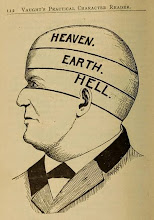
THE ZODIAC BUST

This page illustrates a brass head found at another location. If a character touches the spot on the head corresponding to his or her zodiac sign, it speaks a horoscope that portends, at equal chances, either weal (+2 on all d20 rolls), woe (-2), or average luck for the next 24 hours. Only one horoscope per day per character.

THE BRONZE DOOR OF SAINT EULENA

A knowledge of the order of events in the legend of Saint Eulena, the Pullets, and the Snakes is required to touch the bronze panels of this puzzle door in the correct order so that the pull ring will open the door, rather than uttering a malediction.

Wednesday, 2 May 2012

When to Role, When to Rule and When to Roll

One point, left dangling from my recent series, I'd like to address: When should a DM use an analog mode of task resolution based on player descriptions of actions in role and your rulings on them, and when should he or she use a digital mode, rolling dice against set skills and difficulties?


There's a great benefit to seeing the physical environment of an adventure for what it is, rather than an abstract map dotted with "trap" and "secret" symbols. A lot of task resolutions then become simple. Is there a naked, unworked stone corridor? Then any tripwires or pressure plates or door seams will be evident to anyone with two good eyes, even in flickering torchlight, when proceeding forward at the glacial pace of dungeon exploration. I mean, try not noticing everything there is to notice while taking a minute or more to examine a 12' stretch of corridor, 1st Edition AD&D style.

What if the task is more difficult? Say there's a gossamer-thin tripwire spun by dark elves, or a seam of uncanny dwarven construction. Say there's a complicated bas-relief that could be hiding any number of buttons or holes, or a cracked floor with any number of outlines possible. For these, I would say that a long and close inspection would reveal the hidden feature. In player terms, they would have to give me a detailed description of what they are doing, and repeat that each time they are doing it.

Player attention, in other words, is a resource, drained by repetition and boredom. But forget what I said about trying to model this with limits on character attention. It's a player thing, not character. And player things, too, are analog.

If you want to reach the heights of immersion and intellectual challenge that come from an analog game, you have to trust your players to respect their time and enjoyment. You have to trust them not to abuse your system by giving long descriptions of detailed searches  at all times. If you're playing with dopey kids or grown-up asshats or hyper-task-focused fun-murderers, use a more rules- and dice-bound system - please!

You also have to resolve not to let them cheat their way into this resource, using crappy min-maxer crutches like the standing-order instruction sheet (see under "excel spreadsheet" anecdote there).This is just one of those times where you have to know what your group is like. Don't assume the worst right away. But don't think that the right system can substitute for mutual consent to have fun. Good players will fret about the possibility that an asshat could ruin the game, or even the possibility that they could be that asshat. But they won't actually do it.

Eventually, the environment will channel their attention. They'll zoom along a blank corridor or room in real time, because they know that any danger there will be spotted by their cautious in-game progress. They'll stop and check out mosaic floors, complex sculptures or patterns ... if they're wise. Your naturalistic, analog signaling of opportunities for complication will guide their attention. "Dwarven craftsmanship" or "illusionist's castle", of course, should spur them to new and temporary heights of paranoia.

Now, when do you roll? Yes, my game has a "notice detail" skill. And I use it for the same purpose as saving throws in James M's classic analysis. It gives players a digital chance when their analog skills don't quite meet the challenge. Even if you're running down a corridor, you might notice the tripwire that your slow advance would make obvious. Even if you're just standing next to a bookcase casting idle eyes on it, you might notice the odd jointwork that sends you looking for an opening device.

There's one caution, though: I haven't yet had players get up to the point where their skill in notice detail becomes near-automatic. In my system a rogue could get there by level 4, though at the cost of everything else roguely. With more even development they're likely to max out the Notice skill around level 8.

I'm not sure whether the greater chance of success at those heights is a just reward for sticking it through, or a blow to the fun in analog gaming. Perhaps the balancing factor is this: At higher levels, you're more likely to face complex, brain-challenging mechanisms and effects, so that the challenge is not whether you see them, but what you do once you see them.

Saturday, 8 May 2010

Text to Tabletop 3: Breaking Context

One theme I treated in my old Crimes Against Mimesis essays (see previous posts) was the clash between the elements of a puzzle and its context. I urged game designers to integrate game objects and puzzle situations more fully into their fictional worlds. A chainsaw shouldn't just be sitting there on a table for no reason; why not link it to a lumberjack that you've heard about in another scene? A cryptogram shouldn't just be there as a puzzle on a wall; maybe it's a way that the Red Hood Monks communicated to each other privately without breaking their vows of silence.

In the gonzo context, the player of the game is self-aware, and we see all sorts of random objects and puzzles, frame-breaking references to pop culture, genre intrusions, and other elements of gonzo.  What I was setting up as a standard in my Mimesis essays, though, was closer to James Maliszewksi's label of "Gygaxian naturalism" in D&D (though you could just as easily tag gonzo with the "Gygaxian" label). Naturalism applied to monsters leads to developing other characteristics than combat stats - to flesh out their feeding, reproduction, social structure, anatomy, and other mundane details. Naturalism in puzzles, likewise, makes sure each puzzle or problem has some meaning outside of the experience of the players trying to solve it. Naturalism creates more immersion in the world and strengthens the fictional frame rather than breaking it.

With the benefit of time and perspective, I would still recommend the designers of puzzles in role-playing scenarios to put them into context if they are going for a naturalistic feel. I think gonzo dungeons inflicted on a willing public are perfectly OK, the current belt-holder being Joe Bloch's Castle of the Mad Archmage, a sprawling reconstruction/homage to Castle Greyhawk. At the same time, there is something very satisfying about a puzzle or dungeon trick put into naturalistic context, and you have to respect the art and craft required to reconcile an artificial obstacle with a realistic world.

I've also realized there is a third option for puzzle context in roleplaying games, or for that matter, interactive fiction. There can be a mythic resonance to puzzles, monsters, dungeons, and other elements of an RPG.

Wednesday, 5 May 2010

Text to Tabletop 2: Return to the Scene of the Crimes

Crimes Against Mimesis is a series of web articles I wrote in 1996 about the representation of reality in text adventure games, or "interactive fiction". It's gotten a certain amount of fame, even cited in Wikipedia, despite my leaving the IF community shortly thereafter without really having done anything other than writing those articles. Ironically, the text adventure I had been preparing and left half-finished was more a collection of puzzles than anything literary. Its first puzzle, "Cube and Key," was actually an adaptation of an RPG puzzle room I'd come up with earlier on. So it's only full circle to bring these observations about puzzles back to the RPG context.

In-game puzzles and problem solving are one big way to answer the call for more player skill involvement in what's come to be called the Old School Renaissance of Dungeons & Dragons. Even running a system neck-deep in character skills, I doubt if there was ever a DM so bold as to create a riddle and then make the players roll dice against their character's Intelligence to see if they solved it. For all the huffing and puffing about dimwit characters "cheating" by solving puzzles with their players' true IQ, this is one area where the players have always refused to abdicate responsibility.

The big difference between programming a computer and running a live game? Many of the unrealistic aspects of puzzles I objected to in Crimes are irrelevant. The DM understands all the command words the player can use, has a mental model of the world that can tell the players how their attempts are working out, and if any area of the mental model is hazy the DM can consult the oracular dice. The items available with which to manipulate the world do not have to be pre-set and scattered around, but can be bought in town, manufactured, or improvised.

One wide-open area of the tabletop RPG, too, is the possibility for player solutions that surprise the DM. It's an even more gutsy move to put a problem in the way of the players that you don't know the solution to yourself. But really, any interactive problem takes a certain combination of faith in the players to solve it, and faith in the robustness of the game to survive the consequences of their possible failure to solve it.

You will notice here I said "problem" instead of "puzzle." Problems, as I see it, are tasks like "get across this chasm inhabited by hungry bats" or "get through this bolted and barred iron door." Puzzles are more constrained - "Speak 'eggs' as the answer to this riddle" or "Put a spear in the empty right hand of the statue." Problems are more amenable to being solved more quickly and easily than their setter would have liked, but both problems and puzzles hold out the possibility of player failure, so the GM had better be prepared to route around the damage. (There was, in fact, one memorable late night in our hometown campaign where Dave the DM, after the better part of two hours, pretty much had to feed us the answer to the puzzle "SHOATMMSPEIRO" to keep the linear scenario going.)

In Crimes one of my main pleas (in part 4 of the essay) was for text adventure puzzles to become more like real-life problems - goals that can be reached by several different means, or by combining several different objects in a way that makes sense. Even if implemented with real-world objects, a lock-and-key puzzle is still a lock and key. You need the broom to frighten away the cat so you can reach in the mousehole and get the flashlight. You can't frighten away the cat with the crowbar - so says the computer program, but a good GM (or for that matter a good programmer) will increase the realism of the world simulation so that you can.

Even with all these possibilities, many old-edition D&D adventure designers didn't (and don't) take full advantage of them. The game has a good system for combat, and improvised actions and environment effects can be taken into account using it. But there's less of a vocabulary, less of a system, less of a precedent for handling non-combat problem solving. We all know a good puzzle or a tricky problem when we see it; but how do you get there in the first place?

I'd like to know your thoughts before I write on...