Showing posts with label band of iron. Show all posts

Monday, 14 July 2014

D&D Meets the Literary Bigtime

This article in the website of record -- the New York Times -- uses the generic form "D&D" but I have to give special props to Junot Diaz. In his Pulitzer-winning novel The Brief and Wondrous Life of Oscar Wao*, Diaz gives shout-outs to the obscure 80's majesties of Fantasy Games Unlimited (Villains and Vigilantes, Aftermath!), Rolemaster, and holy shit Tekumel and Skyrealms of Jorune. A fuller set of annotations to all the roleplaying, sci-fi and Latin American references, though not as complete as the author-annotated excerpt on Litgenius, is here.
Junot Diaz (photo: ALA)

And here we don't even touch the "role-playing backwash" into fantasy literature I mentioned before. As more or less realist authors, the literati in the NYT article instead are reminiscing about the effect of the real game on its real players. One way to answer the question I previously posed -- "What would literature that draws on role-playing be, without role-playing that draws on literature?"

I also have to say that in a well-run campaign, the experience is literary in a way that cannot be reproduced in a novel. It is a collaboration-through-roles, lived but not written down. As an example, the current metaplot in my 2 1/2 year Band of Iron campaign comes from a new mid-campaign player's starting magic item improvised from two randomly drawn spells (Strength and Hand of Doom), an iron hand which the player then gave a backstory to (discovered exploring an ancient mound), which then fed into the campaign backstory as its purpose as a larger set of iron bodily parts was revealed, and so forth. All developed in real time into a world-pounding mega-plot that has also grafted in third-party adventure modules like Matt Finch's Tomb of the Iron God and Monte Cook's Ptolus.

And oh yeah, as usual New York Times about 4 years late to the trend.

*cover tragi-cluelessly illustrated in the UK edition with a photo of an East Asian youngster (Oh yeah, Wao, sounds Chinese) even though the protagonist is a Dominican-American of Afro-European extraction, who gets his sobriquet through a slurring of "Oscar Wilde."

Tuesday, 10 June 2014

Cheever vs. Plot

The stories of John Cheever are said to epitomize late 20th Century middle-class life in New York and its suburbs. But he's got much more than his contemporaries John Updike or Philip Roth achieved in that department. There is a willingness to reach into magical realism, a sense of life's capriciousness, a tendency to play it as it lays. The influence of Cheever can be found, by Matt Weiner's own admission, in Mad Men. Cheever would have hated Dragonlance or Ravenloft. If Roald Dahl had written Tomb of Horrors, Cheever might be responsible for Caverns of Thracia, and Tom Wolfe, perhaps, Rahasia.

Let Metro-North be your only railroad.
John Cheever, interview, Paris Review, published 1976, set as free verse:

I don’t work with plots.
I work with intuition, apprehension, dreams, concepts.
Characters and events come simultaneously to me.
Plot implies narrative and a lot of crap.
It is a calculated attempt to hold the reader’s interest at the sacrifice of moral conviction.
Of course, one doesn’t want to be boring . . . one needs an element of suspense.
But a good narrative is a rudimentary structure, rather like a kidney.


In an improvised game, apprehension and intuition come from the tentative advance of a concept - and then a Darwinian selection as it either becomes more elaborated or drops out of the game entirely - depending on the will of the players to pursue it and of the game master to play along - or on the will of the game master to develop it and of the players to play along.

Last time in Game of Iron I presented the players with a dragon. It attacked a place they were in -- but it wasn't a Hollywood second-act "base invasion," rather more of an illustration of the heating up of the conflict between powers that they were entering into. They chose to withdraw rather than fight it, chose to pursue their existing quest rather than go dragon hunting. The dragon had a lair in my book, from an old Dungeon magazine - had a whole plot attached, fitted into the power structure. That dragon may or may not show up again. 

Plot is what you look back on. I only started out running Tomb of the Iron God and somehow that iron statue spawned a whole conspiratorial prophetic mythology over the run of two and a half years. It spawned a gigantic iron statue in pieces and the smaller wearable pieces that control the big pieces and the revelation that this is only one possible way the coming Iron Age could turn out.

Plot is the kidney, not the heart or the brain. All you need is a number of powers, a number of places and maguffins and people that are key to that power, the revelation of the need to transport or unite or create or destroy or defend in order to shift or preserve the balance of power- and that is enough for play.

Tuesday, 6 May 2014

Today You Need A Maltese Name Generator

As the action in my Band of Iron campaign promises to shift to the fake-Mediterranean island of fake-Malta

if Malta were brachiated instead of compact and huge instead of tiny and populated by dragons instead of rabbits and the battlefield between three faiths some of which have cannons and some of which have dinosaurs

here is an edited-down version of a list of Maltese surnames I found online. It is perfect for generating slightly off-Mediterranean nomenclature for memorable characters and gadabouts.


Click to generate in a pop-up. Copy and paste the link location for a peek at the table.

Thusly, your next five henchmen can be Medati, Cauchi, Segond, Ciarlo and Xuereb. Fiorentino is already spoken for; taken on for great toughness and a willingness to reconcile his own belief in the Platinum Dragon with his orthodox Militant boss' devotion to St. Gonsalvo.

Monday, 31 March 2014

Treachery and Inebriation

Betraying your players is difficult. Nevertheless, I thought the most reasonable course for a band of pirates the players had been allying with for the last several game sessions was to set up a send-off that would put our heroes at a disadvantage and rob them of all that fancy loot. After all, the players did charm the captain's wife and put to sleep most of the pirate away party when they thought the captain might be possessed by a giant iron head, and despite their reasons for doing so, the wife is a wizard, a proud one.

All the same, I thought it wasn't fair to completely blindside them. I dropped some hints, a few details that got them suspicious and investigating further. But by that time, the revel on the pirate ship was under way. I brought the miniatures out on the pretext of having a number of carnival-like entertainments the characters could take part in - a dice game, a rope walk, knife throwing and storytelling contests (the latter along the lines of Baron Munchhausen), a dance area. And I gave everyone this drunkenness chart, and sent the drinks round generally, and as forfeits in the contests.


Long story short, half the party wound up "legless" and, without resisting, they were rounded up to be "honored" by the system of Doctor Webb and Professor Spell. A few alert ones who had feigned wooziness and dodged the drinks managed to escape the sticky strands and leap overboard, while others used various magical means to break the webs and get to a place where they could free themselves. A duel commenced, but the captain's wife was soon taken hostage by a leaping dwarf. The dark heart of Captain van der Masque faltered, and a truce arranged whereby the remaining adventurers would depart for the nearby land on a ship's boat.

The drinking system worked all right for these purposes. A normal person has about 1/3 chance of making a Body save in my system, these adventurers closer to 1/2 and more in the case of a dwarf. Experienced drinkers with low levels of adventuring should nonetheless be given some bonuses. 

Thursday, 30 January 2014

Fantasy Science

For the past six or so sessions I have been DM'ing the Band of Iron in an adventure set in an ancient compound on a remote, mountainous island, built by the lost race of Golden Men. It's fair to say that the adventure, while light on treasure, has opened up unknown vistas, revelations about cosmic and human history,and encounters with wonders unknown to our heroes so far.

Now, a classic conceit of Science Fantasy is to have the "wonders of the ancients" be the products of a technological civilization, even ours ...

YOU BASTARDS
Not so, the World of Mittellus. It's inevitable that a game of exploration eventually reveals deep secrets of the far past, but in doing so I consciously tried to avoid that particular cliche. My reasoning (Band of Iron players may read on, as you have already figured out what I'm going to say about the Golden Race):

The kind of adventure scenarios that D&D-type games support best involve medieval-level technology people journeying to a lost, mysterious labyrinth, there to confront monsters and perils, and haul back wondrous artifacts and treasures. As some have noted, this encourages a background assumption of a fallen world, consistent with many of the source inspirations for D&D. In particular, Jack Vance's Dying Earth gives a well-reasoned background for magic, in which the "basic science" that allowed generation of new spells has been lost, leaving only an "applied science" of spells learned by rote - literally crammed into the brain!

Specifically, let's think of any technique or technology as having four elements:

Research:  theoretical knowledge of the underlying phenomena generates new ideas;
Development: experimentation and testing creates new applications;
Engineering: specialist knowledge keeps the techniques running in a stable state; and
User Interface: the techniques are adapted for use by non-specialists.

In D&D, as in Vance, the Research stage has been lost - otherwise, the magic would look more like Ars Magica's theoretically coherent system. Wizardry in Vance is essentially Engineering, learning set spells at a great cost in training, and only rare and costly magic items present an easy User Interface. And D&D allows for spell research, but only by trial and error, typical of the Development layer cut off from Research.

Golden Race: so old they used Myspace.
The era of the Golden Race, I thought, would be one in which the Research and UI aspects of the color magic system had been fully developed, unlike the present Vancian age of the world Mittellus. Magical forces had been harnessed beyond the single spell; forget "Continual Light streetlights" when power, heat and illumination were provided by raw Red magic, force fields and matter creation by Blue, alteration by Yellow and so on. Additionally, the reversed colors of magic were understood; anti-Red gave stasis, anti-Blue gave utter destruction (great for garbage disposal), anti-Yellow preservation and so on.

On the user level, the most simple magical powers were coded into site-specific patches of color, as well as items, most of which are now lost or destroyed. More complicated procedures like medical regeneration required some degree of specialist knowledge and mental training.

For other people's games, the above analysis of technology provides an easy rebuttal to those who wonder why magic doesn't automatically lead to sorcerous streetcars and demonic dishwashers. If magic is confined to a guild where specialized knowledge is needed to wield it, then individual wizards may conjure up invisible butlers for themselves or for the masters they serve, but the lack of an large Engineering class means that magic never becomes an institution. Without the engineers of magic, its phenomena are confined to the lab and testing grounds.

Think of the analogy in technological fiction; it's no coincidence that the typical pulp techno-villain is someone who has hatched an advanced technique of mass control or destruction in isolation. The only thing distinguishing the D&D wizard from the Bond villain is the flavor of handwavium needed to explain their wondrous deeds.

Friday, 26 April 2013

Review: Microscope, as Campaign Helper

Ben Robbins' "story roleplaying game" Microscope is actually more like a writers' workshop exercise - but a very good one. It's a structure for a number of people to narrate a history within a given genre, with a definite starting and ending period. There are good rules for making the premises fresh (actively including non-cliched elements and excluding select cliched ones - I really appreciate this), for ensuring that everyone gets to contribute, and for working through detailed scenes in which small slices of the history are role-played out.

The end result - if somebody were taking dictation of the play - would read something like the Old Testament or Silmarillion: a succession of broadly described historically important events, punctuated by small, vivid, significant scenes. During the game, I found myself thinking of the "periods" level of detail as a timeline:


the "events" level as iconic historical painting:


and the "scenes" level as historical pageants expanding on the stories implied by the paintings.


The rules also ensure a certain amount of continuity across eras, as players take turns developing specific characters or themes in multiple settings.

One great use of Microscope is as a campaign session filler when there isn't a quorum to adventure; similar to playing out a contemporary NPC scene, the few players who have showed up can help develop the legends and known history of the world they live in. In this case, my campaign's elf and dwarf players worked with me to tell the story of the rupture between the elven and dwarven inhabitants of the Olbestaum, a large area of wooded mountains, and the migration away of the dwarves. About 200 minutes of play yielded the epic tale of a great underground tree that became the symbol of dwarven-elven cooperation in arts and technology, then was corrupted by a misguided attempt to break the creative stagnation that descended on the Olbestaum, involving the sacrifice of the first and only half-elf, half-dwarf child. The motivations, misdeeds and eventual destruction of the villains played out in a half-dozen scenes or so, with players taking shifting roles. As DM I subtly pushed the story toward establishing a perilous underground adventure setting around the ruins of the Tree and of the city built above it, now infested by horrible demons but brimming with the fallen treasures of the city.

If I have one criticism of Microscope it's that there are some mechanisms that seem unnecessarily complicated. For example, we ended up just ignoring the micro-level "push rule" about how to play scenes, leaving only the goal of answering a question in the story, scene setting and character thoughts, and the process of choosing and excluding characters. We figured that if there were serious disagreements about the tone or plot of a scene we would just take a vote and move on. Perhaps the push rules are there in case of a less congenial set of players, but I'm of the mind that cooperative games should assume a certain amount of, well, cooperation and good intent.

I also didn't get the reason for the mechanism of Legacies, in which players champion a particular plot element persistently throughout the game. It seemed that continuity was adequately provided by the Lens/Focus rule, in which each round of adding to the story centers on a particular theme. If players have particular interests or obsessions, they will emerge naturally as additional threads. Including Legacies just seemed to delay and complicate the otherwise very natural sequence of a round.

Overall, though, the game is well worth the ten Yankee dollars for a pdf. Another plus: because the rules are geared toward respecting the creative contributions of each player, it seems a particularly good story/indie game for including less assertive players, who can make other kinds of GM-less games a little awkward.

Wednesday, 27 March 2013

Homework for Players Bogged Down In A City

It turns out cities are not just the most dangerous adventure, but also the most bewildering, and least rewarding.
Where they are now, more or less.

Least rewarding in the traditional schemes of things because killing and stealing has nasty consequences and feels wrong most of the time.

Most bewildering especially when the party, like my own Band of Iron, is in between adventures ... and trying to buy stuff and work out contacts ... and living in the world I created, where there are visible signposts to the next adventure, but there is more than one signpost and they're merely visible or sometimes actually tucked away rather than neon-lit and blinking.

For any such players in a big and sprawling campaign, and especially my own, think about using "city time" in the following way:

1. Write down a list of "locks" - mysteries that remain mysterious, opportunities you don't quite know how to crack, things you would like to see happen.

2. Write down a list of "keys" - things that remain to be investigated, potential clues or leads, all the other social and magical ways you have of getting information.

3. When next you meet, prioritize the "keys" that seem to correspond to the most appealing "locks" but investigate as much as you have time for.

Or just ignore this advice and spend time wandering around in this wonderful huge city. Despite all your expenses, you've still got a chance to carouse, a chariot race to see ... Rule Number One is fun!

Thursday, 7 March 2013

The Final Four Sins

Continuing the account of diabolic temptation ...

4. Gluttony.
The concept: Six imp chefs, cooks and butlers throw dangerous and tasty food at the party and the penitent, trying to get everyone to succumb to gluttony, using their powers of suggestion (once per day).
The execution: Three "courses" were served.

  • The first was stew, siphoned through a hose from the imp's cauldron to the party's convenient defensive ditch. If you gave in and ate the stew, you were incapacitated for a round, then make a Body save in order to vomit or be further incapacitated while the stew was in you. 
  • This was followed by the imps hurling animated cuts of meat - serpentine sausages, geese and fowl, legs and hams, racks and roasts and livers and a nasty haggis. The meat tried to get in your mouth and choke you, or make its way past you to tempt the by now two-days-fasting penitent. 
  • The dessert was brought over the party on a huge tray by invisible imps. Breaking the fourth wall, I described just about every sweet and piece of junk food the Band of Iron's players had consumed over the past year. There was nothing sinister about the dish; the imps were just trying to upend it over the penitent for more gluttony temptation.

The verdict: This was a funny episode but I didn't feel that the party was that threatened by it. In hindsight this should have been mostly about throwing suggestions on the hungry penitent and trying to get the food past the wall of bodyguards. The imps went down quickly in combat.

5. Lust. 
The concept: This was a lone succubus. Hell didn't throw their all into this one because the penitent had pretty much had it with women.
We got gonzo here.
The execution: I worked the epicene incubus/ succubus for camp, having it deliver cruel Freudian analyses of the player characters - who had mostly been lustless in the campaign, turning down opportunities for romance - before settling on the henchwoman Lintilla, who, shall we say, had not been without lust in the campaign. The party quickly shielded her from the succubus' charm ability and engaged it with missiles and melee before it could use its suggestion spell. A mighty lightning bolt from the cleric's magic amulet sent it reeling, and swords and silver arrows did the rest. On being sent hellwards, the creature briefly showed its true form: rather than a fabulous Aubrey Beardsley androgynous fashion model, the succubus was just an ordinary, plump, bright red Coop hot rod devil girl.
The verdict: Probably, getting hit shouldn't forestall monsters' spell-like abilities. Could have been tougher.

6. Sloth.
The concept: Three wraiths attack. Instead of draining levels, they drain movement points equal to the damage caused (d6). At less than 3 move, you cannot attack and at 0 move, you fall asleep.
The execution: Pretty straightforward, slug-em-out.
The verdict: This one created some tension, with party members dropping out in rough proportion to the wraiths dispatched. I put it last - a move the players anticipated - following the setting logic that people would be more tired at the end of the last night, rather than doing what was strategically right, and putting them in the lineup at a position where they could take out party members in preparation for other sins.

7. Pride.
As drawn by Crumb.
The concept: The temptation is not over with the cock's crow. The morning comes and the Son of the Morning sends his last best hope from another dimension - a certain blues musician who sold his soul to the Devil, at the crossroads, at midnight, so he could play guitar and sing like nobody else.
The execution: A strangely dressed, dark-skinned man with an odd musical instrument comes down the road from the west, singing this song (which I actually put on in the session). He is not unholy, or magical, or a devil; just a mortal trying to pay off the mortgage on his soul, and there will surely be trouble if he is struck or killed. The musician humbly approaches and congratulates the party on their victory, asking them what kinds of rewards they expect. He is really aiming at the NPC penitent, suggesting that some kind of acclaim and sainthood are in the offing for having resisted the three nights. This is entirely a psychological challenge, and the party must show humility and encourage the penitent to do the same, or all is lost at the last moment.
The verdict: One of my players fell for it, mainly out of wanting the blues singer to be the good guy. Another nailed the challenge, and all it took was one. This wise fellow denied all credit, offering praise instead to the saints and Creator. Everyone else followed suit, and Mr. Johnson graciously took his leave, marking the true end of the ordeal.

Anyway ... wait until May and you'll hopefully see if I can pack all of this into one page.

Wednesday, 6 March 2013

The First Three Sins


Continuing the account of how I tried to tempt players, characters, and NPCs on the last two Nights of the Devil ... the tale of Night the First.

1. Wrath.
The concept: Three erinyes, each armed with seven magic arrows of Wrath (Mind save or charge out to attack them), circle and shoot at the party. They at first used their illusion to masquerade as tempting ex-lovers of the penitent Diarmuid, but this was not done to excite his Lust, but his Wrath - right now he was feeling nothing but rage at the evil fay who had charmed him for year on year and drained over half his hit points.
The execution: As it turned out, the magic of the arrows did not exactly overwhelm the characters; only a couple of party members got hit once they got behind cover, and these were easily enough restrained. But the players! One of them got really, really mad at the whole situation - just taking incoming fire, not going to do a thing about it, not knowing if the DM had just set up a certain slow death situation! After cooler heads decided to stick it out some more, the erinyes ran out of arrows, fired a final salvo of the party's own shot arrows, and departed.
The verdict: Worked great as a player temptation. Magic arrows almost not necessary.

2. Avarice.
The concept: Seven bearded devils with magic sacks throw treasure at the party trying to get them to pick it up. For each one who succumbs to avarice, a devil may enter the magic circle and attack.
The execution: In practice this temptation was pretty obvious, so I had to step it up with numerous waves of treasure. Soon enough, the devils were throwing crowns that tried to land on people's heads, and snaky gold chains that dragged away pieces of equipment if they hit you. The last trick was for the bags to call out a large portion of coins from each character's purse. Now that hit them where they live! The self-same player who had succumbed to wrath now made to stomp on a fleeing gold piece, and thereby admitted one devil into the circle. The party defeated it in more or less short order, and the "temptation" paid off as that devil's sack, containing his stolen gold, got left behind ...
The verdict: Another great way to get under the skin of the players ... they're used to steering clear of treasure that looks to good to be true, but their materialism really shows when you start to take their stuff. I made all the treasure fake, but in hindsight it should have been real.

3. Envy.
The concept: Sixteen threads of ghostly, whispering letters, two for each person in the circle, come snaking in. If they get in your ear and you fail a save, they whisper envious words and make you attack another party member you have cause to envy.
The execution: Magic and silver weapons could fray and disperse the threads, but soon enough a large number of them were in threat range. A henchman and the dwarf succumbed. Cold holy water in the face allowed a repeat save, and the henchman rallied, but the dwarf did not, and he rushed and pummeled the lower-level fighter PC to whom the holy knights had given the devil-slaying sword, that cheesy noob! The brawling rules got a workout as the two ended up in the defensive ditch they'd dug.
The verdict: The actual challenge was not the toughest, but not knowing what the threads were and seeing them come from all sides made for a frightening experience, as did the possibility of turning the party against itself. I only later thought that maybe the players could be induced to feel envy if the threads redistributed experience points from one character to the other ... but how this feeling would lead to the characters committing the sin, exactly, remains to be seen.

I was also prepared for player skill to help break the threads - anyone who tried to think of ways their character was great, all right and really okay would resist them without a save. Maybe because the encounter played out as a combat rather than psychological challenge, this didn't occur to anyone.

Next: the final night and its four sins.

Tuesday, 5 March 2013

The Devil's Acre: Temptation

How do you represent spiritual temptation in an adventure game?

Well, you could play Pendragon RPG, a system that explicitly rates each character's vulnerability to different character flaws and passions. A Pendragon knight beset by an unearthly vision of lust would roll a 20-sided die, check his character sheet, and either succeed or succumb. In service of a more picaresque story, a Dying Earth RPG character might be overcome by a persuasive flourish and be compelled sit down at the gambling table with a known master swindler.

Temptation is part of those games' moral mechanics. It's not part of most other games, though. You may have alignment, or resistance to mental influence, but nothing stops the characters from making choices like perfect Puritanical optimizers, every day of the week. Except maybe under "carousing for experience" rules, which kind of proves the point.


As I threw wave after wave of diabolical tempters at the party on the last two nights of their ordeal, defending the praying penitent in the Devil's Acre, a number of options arose:

1. Have the tempters target the NPC penitent; the PCs have to stop them from getting into range and distracting the penitent, and the tempters will fight to get close. If the blockade fails, then being an NPC, the penitent has to make some kind of save or check against the temptation.

Um, yeah, just like that.
2. Have the tempters target the PCs, trying to pull them away from the penitent or claim them as prizes in their own right. "You succumb to lust unless you save" doesn't seem quite right, but magical temptation does lie with in the rules of the traditional adventure game, as a spell-like effect. And, what do you know, quite a few devils as written come with charm and suggestion effects.

3. Note the past behavior of the PCs and their allies, and use this to direct the efforts and outcome of strategy #2. It's not a matter of rolling a die, but of having raided a merchant ship for its treasure four sessions ago, so Avarice already has its claws in you. This makes the most sense if sin pays in your campaign, at least temporarily; for example, if spending gold on carousing nets you more experience points than donating it safely to a church does.

4. Target the players. I need to explain this some.

In the past here, I've argued for drawing on the concerns and tendencies of the players themselves to stand in for such traits in their characters as alignment and morale. Obviously, this won't always work. Some of these theological sins refer to the satiation of bodily needs: lust and gluttony in particular. All right, there were some pretty delicious chocolate and banana cakes on the table at our session, and I could have worked them in somehow ... but yeah, and then lust, no, yeah, forget it.

Other of the theological sins, however, serve the needs of the ego, the little character we all build for ourselves. I don't care if you don't play D&D. You are still walking around with a "character sheet" in your head, with some idea of your skills and abilities, where you fit in the hierarchy of things (level) and what road you walk in life is (class). It's part of the undying psychological appeal of role-playing - to create a character on paper more free, more disciplined, more interesting, more dramatic, than the one in your skin. But when you role-play, the two egos become one, as you defend the interests and dignity of your character.

With these other sins, to attack the character is to attack the player, whose ego is the character's ego. Wrath? Touch upon the player's need to avenge harm done. Avarice? Throw loot at the player - or better yet, threaten to take it away. Envy? Make the player feel unfairly disadvantaged; take away some experience points and give it to the next guy. Pride? It's what makes them go "Let me tell you about my character..." Work with it.

All right. In the actual Devil's Acre session, some of these ploys worked better than other. Next post: a play-by-play of the seven-round knockout the Band of Iron dealt the Prince of Darkness.

Sunday, 3 March 2013

The Devil's Acre: Defense

This afternoon I finished up a three-session adventure that did a lot of things my players and I were not used to. I think it was a success, but it may be useful to review some of the oddities about this set-up.

They had just rescued the bard Diarmuid from his evil faerie lover, in line with the prophecy that he would sing at the religious Synod and strengthen the cause of peace in the brewing war between humanity and the Otherworld. But in order to be accepted at the Synod, Diarmuid would have to undergo a swift and efficacious, if dangerous, penance. Three nights of vigil at the Devil's Acre were prescribed.

This huge hoofprint-shaped field is the site of pacts and contracts between Heaven and Hell, under which a soul claimed by Hell can be redeemed if the person endures three nights praying in the Acre. Unfortunately, devils and other damned beings proportional to the person's importance will climb out of the caves and fissures in the Acre and try to devour the penitent's body and corrupt his or her soul. Fortunately, the rules allow you to take some bodyguards along.


Perhaps for a more jaded party I would have served up the more grotesque of Bosch's devils. But because the Band's players are largely unfamiliar with the Monster Manual, the adventure was stocked with the standard Gygaxian "products of the imagination": lemures and nupperabos herded by a pair of spined devils, hell hounds, a sarcastic barbed devil, erinyes and so forth.

For a group used to going forth and exploring, the point defense scenario was a novel challenge.  Assailed from all sides by waves of foes, and needing to stay between them and a vulnerable bard playing the rebec and singing hymns, the mood was tense even when they ended up winning with some margin of ease. On the first night, a beloved henchman was slain, and on the last night, movement-point-draining wraiths of sloth managed to sleep one PC and nearly kill another henchman. Things would have been even more hairy if the keepers of a nearby holy citadel, charged with watching over the Acre, hadn't been convinced to sell two barrels of holy water to our heroes and loan them a two-handed sword, +3 against devils.

The defense scenario, in short, was an excellent change of tone and had me thinking about the ways it could get even crazier. The terrain they were defending was minimalist - a hill, a stone cross, a bonfire, a magic circle that only let so many devils in at a time.

But what if there was more pick and choose about where to defend?  A ruined town, a mound with megaliths that could be reinforced with stakes and traps, a besieged castle with crypts to explore and rumors of tunnels leading out - safety measure or security breach? A temple where you have to decide what's scarier - breaking the sealed crypt in hope of some advantage, or getting overwhelmed by the hordes drawn to your presence there? I'll have to think about that.


At any rate, I have made up my mind. A version of the Devil's Acre will be my entry in the One Page Dungeon contest this year. Which means I'll also have to grapple with the far knottier problem I faced in designing the adventure: how to represent temptation as a challenge to the players and their characters. More on that, next post.

Wednesday, 27 February 2013

Sketches From Faerie

And now, a few pages from our player Lui's sketchbook (creator of the wonderful Tomb of the Iron God maps). These illustrate sights and marvels seen by the Band of Iron in connection with the faerie realms.

 
The mind-altering faerie fruit doesn't actually have the Goofy Grape and Loudmouth Lime faces, but it is very addictive. Lui's character has been lucky to survive this far, considering that the high-concept is "an elf who wants to taste everything." 

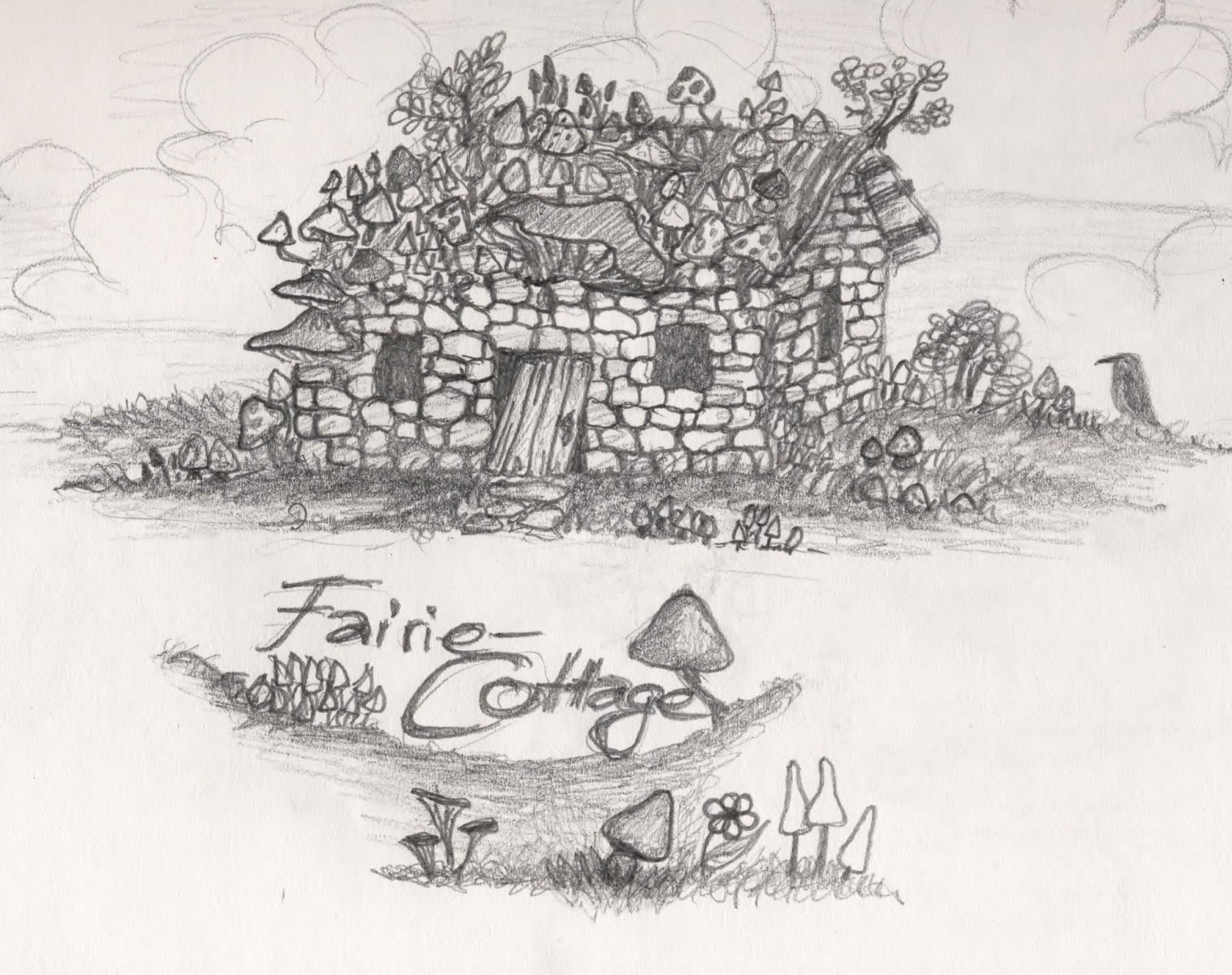
This is a stop on one of the Faerie Roads - an overgrown cottage where dwells a little fungus-man, skilled at healing with moss and honey-slugs.

On the road, the Band had to step aside and avert their eyes as a faerie army marched by on the way to war. The elf must have peeked because this is a pretty good likeness of the scene.

The two guards I placed at the gate of Leslie Furlong's One Page Dungeon Contest winning scenario, the Faerie Market.

Say hello to the bad guy: Anton the Mountain, retail faerie fruit greengrocer.

Friday, 22 February 2013

A Marked-Up Map

I'm much too kind to show the influence map the Band of Iron left behind in the northern lands. Let's just say that purple worm example in the last post was their doing. It ate a whole section of the town of Goran's Anvil, and the town elders know who was responsible. They also left mortal enemies in the town of Parmentell when they discovered the worm ivory scam, left a controversial legacy in Kaserolle, and oh yeah, the Onyx Sorceress wants to have a word with them about how they shamed one of her agents in Ironhoof.

Here's their much more respectable career in the South. (Ignore the animal lairs for now.)

Made with Hexographer Pro.
They started out in the village of Poynemara at the top, where they left roots (the white triangle) by settling a retired hireling, Adrem, there, and picking up a new henchwoman, Lintilla. Villages are easy when it comes to fame; the party got two stars pretty much by showing up and having those interactions.

Next stop was the small town of Famorgane, a trading post corrupted by fairy-fruit addiction and de facto ruled by the crime boss Anton. Their adventures there initially got the party two crosses at the top, as they somehow fell in Anton's good graces. But Famorgane became occupied by a holy army during the war with Faerie and Anton has fled, so the party only count on one star there, legacy of a public duel with one of Anton's henchmen.

The larger town of Lugho is a place the party has never been, but due to services rendered on behalf of the Duke and Hierarch of the place, they enjoy two forward slashes (beneficial deeds) and one cross of high-level influence.

Schiecchi is the city of the region. It's harder to get fame there, but due to some carousing and a noteworthy incident in which the party's hermit prophet impressed a rich woman with her generosity, they are on one star. They also have a connection with the influential white magician Ulena, hence the one cross.

Finally, they are undoubtedly in the bad books of the faerie lady of the Vernal House for stealing away her mesmerized bard lover. Perhaps there should be "X" 's on top for enmity instead of influence with the ruler? At any rate, the whole house will be talking about the raid for years to come, so three stars.

The passage of time, and normal social forces, can alter the ratings. For example, fame can spread to settlements of equal or lesser size. If they do something that gets them two stars in Schiecchi, Lugho will almost certainly hear of it.

Influence can also spread, following political lines. The famous deed against the interests of the Vernal House will certainly cause enmity among the House's allies, and may even gain the party good will among its enemies. This is what happened in the north, as the warlord Hugo became friendly to the party largely because they were causing so much havoc among his rivals.

And of course, if enough years pass, fickle fame will fade from memory; but the party's roots, influence and deeds will live longer.

Thursday, 8 November 2012

The Dungeon Is Safer Than the City

I'm reflecting on our last game session. It was one of those where not a lot of high adventure went down. Mostly it was about traveling to a new city, settling in there and accomplishing various administrative tasks - selling loot, buying goods, carousing for experience, setting some henchmen to leveling up. One player was absent, so her character was parked with an NPC for the duration.

And it's a "what now" moment for the party - having just finished a big quest, they're finding that events are moving rather quickly, and a war is brewing between humans and Faerie. After sending a "telegram" to warn a kind-of-ally on the borderlands (magpie + speak with & befriend animals + Magic Mouth), what next?

Well, our heroes have some idea they should stop the war, but how? Call it an intriguebox or what you will, but the railway station is far from evident at this point. There were some cautious attempts at intelligence gathering, but still, the realization was heavy that, well, one does not just walk into the Archimandrite's audience room with an audacious plan.

Get out now, while you can!
I still believe that these low periods are necessary to play up the moments of high adventure. All the same, this session also made me realize that adventurers have a reason to play out their city visit as a peaceful interlude. Yes, an urban setting can provide more than enough adventure and has possibilities the standard wilderness/dungeon expedition doesn't. But precisely because of this, it can feel more threatening to a cautious, pragmatic party than the terrors of the underdepths. And this in turn can cramp their style.

See, in a dungeon, you are confined and channeled ... but so are the monsters. You take things, generally speaking, one thing at a time. In a wilderness, the enemies are all around, but few and far between. But if you seek adventure in a city, there's a web of interconnections and interests all around you. Pull the wrong string, and the city guard, the lynch mob, the thieves' and wizards' and vampires' guilds are all on your tail. Not to mention the guilt of all that collateral damage to innocent citizens as your fireballs and lightning bolts vaporize your foes.

And the dungeon is nice and easy to find your way through. One door, two doors, three doors, dead end. It's even laid out in nice 10 foot squares for your mapping convenience. The city, though ... how do you sift out the adventure location from the rag-picker's house or the vacant lot? How do you follow a trail through tens of thousands of people?

Finally, once you're done with the dungeon, you're done and you move on. But with a city, you want it to stick around for you, with all its possibilities, commerical opportunities, and allies. Wrecking a dungeon is much less consequential than wrecking a city, or otherwise turning it against you.

Hell, get me out of this city, with its taxes and tithes, its envious eyes, its rats and 8% chance of diseases, its teeming masses all looking for a chance to overbear you and roll your corpse for its suspiciously weighty cache of gold pieces and magic items! Put me in a nice, safe, predictable dungeon - that's where I know I can be the adventurer I want to be.

Tuesday, 31 July 2012

When Your Party Teleports

The intrepid Band of Iron ought to be wearing their knees ragged and knocking their foreheads blue, thanking the hell out of Mr. Tony Dowler for his gonzo foresight in designing the Purple Worm Graveyard (spoilers follow).

Another expedition into the great worm roads beneath the earth hit what they were looking for ... the cavernous Graveyard, carpeted with a fortune in purple worm teeth, illuminated by a hole in the ceiling. Fortunately, this came at a time when one worm-guard was distracted picking at a purple worm carcass and two were behind an illusionary wall (I rolled d6 3 times which put them in those locations, possibly the best ones possible for the party's sneaking advance.)

What a worm guard looks like, by Ilvj. Wish I still had the mini.

In the ensuing rumble, the party quickly realized it would not be a good thing at all if the guards were to reach the bronze gong, etched with wormsigns, atop the stepped dais. An unearthly metallic humming, growing louder, emanated from the going, reinforcing their anxieties. This led to some tense tactical moments as various worms, seeing themselves outmatched, made a dash for the gong.

Eventually, the worms were dispatched and the party fell to looting the piles of tusks. But the noise had attracted attention from topside and soon a fully armored knight, riding a great metallic butterfly and wielding one of the Fire Lances of the Ancient Hyperzephyrians, dropped through the hole. This combatant, which by report lived in the towers of the town Parmentell, confirmed the party's suspicion - the Graveyard actually lay right beneath the tight-fisted and evasive settlement itself, rather than somewhere in the hinterlands, as the town elders had wished it to be believed. Running from the fearsome 3d6 blasts of the lance, the party ducked into a spiraling tunnel that led upwards and upwards ... apparently another worm trail.

Going far enough up, they had a confrontation with Parmentell's town guards that went well at first, then poorly, and ran into the "dungeon" area of the Purple Worm Graveyard. Avoiding several dangerous-looking rooms, they found a secret door, and behind it ... a magical window offering a one-way trip to a peaceful meadow in "a far-away kingdom."

This is a perfect example of what I was saying about improvisation. Had I invented that window on the fly or even planned the dungeon that way, it would have stuck out like a candy-assed deus ex machina. But, being the unassailable writ of a published module, the players were overjoyed to see it as the enormous gift of providence that it was. After casting a fortuitous detection spell that gave them confidence that they'd at least heard of the place, without hesitation they leapt through.

In the noble tradition of Castle Greyhawk, I now have to deal with a party getting dropped into a completely unprepared area hundreds of miles from home. Fortunately, for now I have scraped up enough stuff from the internet and my own fervid imagination to tide over the next session. I look forward to sharing some of the process and product on a future occasion.

Teleportation is a common enough device that I'm sure other referees out there have dealt with this situation before. I wonder, though, if anyone else has felt the exhilaration among both game runner and players, of casting aside the tired and entangled old adventure setting and embarking into a new, strange and maybe perilous world ...