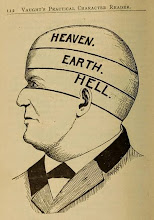
I feel impelled to contribute to Cavegirl's Harry Clarke Project using this fabulous fellow (Bluebeard?) who has sat on my hard drive many a year awaiting his introduction to polite society.
HELLRAKE
Armour class: as leather with +4 magical protection
Hit dice: 6+9 hp
Move: slightly more than human
Attacks: weapon, as 6th or 9th level; spells
No. Appearing: 1, plus entourage
Morale: 4, or 9 in polite society
Treasure: Fabulous weapons and clothing, worn jewellery, magic; nothing he cannot carry and show off
Alignment: Chaos
The parentage of this sterile nonesuch is cruel and improbable: a male-aspected devil of Hell's nobility and an elf-maid of the fey planes. Invariably male, but questionably masculine, hellrakes flaunt the improbable, reedy physique of a clotheshorse, with one or two coy devilish marks such as hooves, horns, wings, tail, talking moles, goatish features, or ruddy skin. Their anatomy only partly explains the bizarre, stiff- or bent-legged gaits they affect when making a grand entrance, for they can run fast enough if they need to.
Hellrakes are notorious, thanks to the legendary Barbramel, as fashion-breakers and fashion-setters. Other of their recorded professions include gambler, verbal duellist, procurer of succubi and incubi, black-market sommelier of potions and philtres, hired mourner, slander poet, and erotic ballet impresario. Each one will usually have the abilities of two character classes at 6th level or one at 9th: fighter, thief and wizard are the favored ones, but they are drawn to more exotic choices if available, such as assassin, illusionist, or bard. They take half damage from spells, no damage from normal weapons of iron or steel, and double damage from silver.
The nature of the breed is whimsical, ostentatious, and vain, their quirks but a masquerade upon a thoroughly rotten core. In front of those who matter, they make a great show of bravery, but when fending for themselves, they are craven. Despite or because of these flaws, they are usually attended by an entourage of 1d4 sycophants, grifters, opportunists, and pleasure-seekers from this list (d12):
1. lascivious succubus
2. coy incubus
3. fawning imp
4. hustling leprechaun
5. abrasive quickling twins
6. perspicacious drow rogue
7. ranting human devil-cult preacher
8. stolid minotaur bodyguard
9. paranoid smoke mephit bagman
10. frantic satyr hypeman
11. sarcastic talking wonder-goat
12. agile troupe of 5 homunculi
The hellrake ilk is inveighed against in a famous theatrical soliloquy of the Autumn Court literata Glingeroyce, thusly: "thou Limbeaux, thou Cocytuscombs, thou Hellsapopinjays, thou Macaro-Nicks; toffs of Tophet, preening pimps of perdition, flouncing fribble-fiends, sad cads of dire sire and glam dam."
Showing posts with label art. Show all posts
Showing posts with label art. Show all posts
Saturday, 13 April 2019


Thursday, 14 May 2015
This Monster Has No Picture
If you doubt the value of art, look upon the creatures in the AD&D Monster Manual that have no illustration. When you leave out the "you know what they look like" (bears, lions, etc.) and the hard to see vermin (cerebral parasites, ear seekers, floating eye, slithering tracker, gelatinous cube), and the "souped-up version" (ghasts but tell me why, why the neo-otyugh gets two illustrations of its own) and the inexplicably passed-up opportunity to illustrate a nymph ...
and the masher, already humiliated enough from losing the purple-worm status it enjoyed in Blackmoor (but it had art, it just got lost) ...
you are left with the monsters that have no illustration because there is nothing to illustrate. There is the shadow, which is visible but shadowy and also would have made a fine illustration. And then there are the monsters that are invisible by nature.
Also inexplicably, there are three of these. You have the aerial servant, the invisible stalker, and the wind walker. Each of them is spun off from the air elemental with a few variations in immunity.
Does nature create redundancies? Ask the dolphin, tuna and penguin. But art demands unity; novels reuse characters, though it stretches the credibility of coincidence; and so, there is something more satisfying about surmising that these three creatures are all just different aspects of the same elemental being.
So, although naturalism in a magic world may breed a huge variety of invisible monsters, from the players' point of view the whole game of figuring out "oh, what invisible monster is attacking us today,or maybe it's a normal monster turned invisible by that darn mad wizard" is not really worth the candle. As well as being disrupted, very simply, by the handy bag of flour.
and the masher, already humiliated enough from losing the purple-worm status it enjoyed in Blackmoor (but it had art, it just got lost) ...
you are left with the monsters that have no illustration because there is nothing to illustrate. There is the shadow, which is visible but shadowy and also would have made a fine illustration. And then there are the monsters that are invisible by nature.
Also inexplicably, there are three of these. You have the aerial servant, the invisible stalker, and the wind walker. Each of them is spun off from the air elemental with a few variations in immunity.
 |
| Ral Partha's Aerial Servant. Funny. |
 |
| Otherworld's Invisible Stalker. Funny. |
- The aerial servant responds to a cleric's high-level spell. With the wisdom of holy magic, the spell only contracts the servant for a clearly defined short-term mission of capture and return, using the power of religion to control it. As a result, the creature serves willingly and commits more of its essence to the task, appearing with a nigh-unstoppable 16 hit dice.
- The invisible stalker responds to a magic-user's high-level spell. This contract of service is more loosely defined, and tempts the wizard to push his or her luck at the risk of having the stalker undermine the instructions. Under these terms, the creature commits less essence, appearing with only 8 hit dice.
- The wind walker is one of these creatures, loosed from service by the death of its summoner a long time ago, or bound to this plane because of some mishap. It is easier to hit because it abandons its dutiful silence to howl and rush, and weaker because of its long residence on the material plane (implying that there are fresher, larger specimens roaming around.) Alienation from their homeland has also turned wind walkers evil-natured and indiscriminate in their destruction. Their telepathy is something implicit in the description of the aerial servant and invisible stalker, else how would those creatures understand instructions in all the possible languages of wizard-dom?
 |
| Wind-powered walker is much cooler, anyway. |
Wednesday, 29 April 2015
One Page Dungeon: Antonius Abducted
The richest place in my formative years was the lending library in my well-funded, open-minded suburban hometown. It was there I laid hands on the Arkham House Lovecraft volumes, everything Tolkien and post-Tolkien, science fiction novels I wasn't even close to understanding but enjoyed anyway, the Holmes edition of D&D, the Monster Manual.
Of these weird materials, some promised a regulation or explanation of the fantastic world - D&D, of course, laying down the rules of fantasy in a way that the heroes of Pratt and DeCamp's Compleat Enchanter series did, with arcane mathematics. The world of Shannara proved nothing more than a post-apocalypse, and Larry Niven's fantasy world was physics by another name.
But I also read Lovecraft, Borges' book of imaginary beings, Dunsany, Brian Froud -- fantasists who made no excuses or explanations. Tying them all together with a visual language of strangeness were the great coffee-table volumes of art where I became acquainted with Hieronymus Bosch. His devils drew from Church iconography, but there was the fantastic and even science-fictional in his ceramic-like architectures, his mutant creatures, flying farragos and garish colors. In my imagination he was as much an illustrator of weird tales as Sidney Sime or Lee Brown Coye. What matter that those tales were not written -- not yet?
Which brings me to my undying fascination with the central panel of Bosch's Temptation of Saint Anthony. Here it is (it gets really big when you click it, and click again).

It hasn't got the symmetries and tapestry-like coverage of the Garden of Earthly Delights, or either of his Last Judgments. There is dynamism, scene, progression, the varied freaks converging on a parody of a Mass laid on a dicing table. Others join the haphazard choir underfoot, or flit overhead. There is that bizarre ruin with its mess of perspective; the disasters in the background -- fire, war, demons -- while nonchalant or dazed washerwomen go down to the filthy water.
Weird symbolism abounds and, as with Bosch's other works, has prompted all sorts of theories about his hidden message: alchemical is it? more broadly esoteric? or politico-religious? nationalist? If his figures illustrate proverbs and expressions that have faded with time, perhaps this is just another form of random generation to create compelling monsters, like the tree-archer with his gauntlets and brace of armored hounds.
Me, I see an adventure here. The first stirrings of this in my gamemastering career happened a couple of years ago when I populated one level of my custom upper works for Castle of the Mad Archmage with a collection of Bosch's creatures, mostly from the Temptation, and somewhat differently imagined than presented here. The Muleteers have had several run-ins with them, all terrifying but none decisive.
As this year's One Page Dungeon Contest approached its Walpurgisnacht deadline, I started to consider adapting this level, which uses a standard maze of rooms and passages. But after thinking I ended up favoring the original outdoors setting with its bulbous ruin, its convergence of monsters, its holy man looking serenely if a little desperately out of the frame, as if to say "Look! These are no figments of my fast, no color trails from ergot-laced crusts! You see them too!"

I set the action a few minutes before the scene in the painting. A tactical problem, asking for the various approaching demon-groups to be defeated in detail or confronted as they appear in the main action. Antony needs his crucifix to be of any use, so that's an action task to retrieve it on the scene. There wasn't really space on the page for a random table with all the skulking lizards, birds, demonlings and flying menaces you see in the art, but the water holds a few such perils.
Well, there you have it, with a little help from my long-dead friend. It'snot strictly one page but I am toying with the idea of taking the other panels of the triptych and expanding them into a GM's screen idea ...
Of these weird materials, some promised a regulation or explanation of the fantastic world - D&D, of course, laying down the rules of fantasy in a way that the heroes of Pratt and DeCamp's Compleat Enchanter series did, with arcane mathematics. The world of Shannara proved nothing more than a post-apocalypse, and Larry Niven's fantasy world was physics by another name.
But I also read Lovecraft, Borges' book of imaginary beings, Dunsany, Brian Froud -- fantasists who made no excuses or explanations. Tying them all together with a visual language of strangeness were the great coffee-table volumes of art where I became acquainted with Hieronymus Bosch. His devils drew from Church iconography, but there was the fantastic and even science-fictional in his ceramic-like architectures, his mutant creatures, flying farragos and garish colors. In my imagination he was as much an illustrator of weird tales as Sidney Sime or Lee Brown Coye. What matter that those tales were not written -- not yet?
Which brings me to my undying fascination with the central panel of Bosch's Temptation of Saint Anthony. Here it is (it gets really big when you click it, and click again).
It hasn't got the symmetries and tapestry-like coverage of the Garden of Earthly Delights, or either of his Last Judgments. There is dynamism, scene, progression, the varied freaks converging on a parody of a Mass laid on a dicing table. Others join the haphazard choir underfoot, or flit overhead. There is that bizarre ruin with its mess of perspective; the disasters in the background -- fire, war, demons -- while nonchalant or dazed washerwomen go down to the filthy water.
Weird symbolism abounds and, as with Bosch's other works, has prompted all sorts of theories about his hidden message: alchemical is it? more broadly esoteric? or politico-religious? nationalist? If his figures illustrate proverbs and expressions that have faded with time, perhaps this is just another form of random generation to create compelling monsters, like the tree-archer with his gauntlets and brace of armored hounds.
Me, I see an adventure here. The first stirrings of this in my gamemastering career happened a couple of years ago when I populated one level of my custom upper works for Castle of the Mad Archmage with a collection of Bosch's creatures, mostly from the Temptation, and somewhat differently imagined than presented here. The Muleteers have had several run-ins with them, all terrifying but none decisive.
As this year's One Page Dungeon Contest approached its Walpurgisnacht deadline, I started to consider adapting this level, which uses a standard maze of rooms and passages. But after thinking I ended up favoring the original outdoors setting with its bulbous ruin, its convergence of monsters, its holy man looking serenely if a little desperately out of the frame, as if to say "Look! These are no figments of my fast, no color trails from ergot-laced crusts! You see them too!"
I set the action a few minutes before the scene in the painting. A tactical problem, asking for the various approaching demon-groups to be defeated in detail or confronted as they appear in the main action. Antony needs his crucifix to be of any use, so that's an action task to retrieve it on the scene. There wasn't really space on the page for a random table with all the skulking lizards, birds, demonlings and flying menaces you see in the art, but the water holds a few such perils.
Well, there you have it, with a little help from my long-dead friend. It'snot strictly one page but I am toying with the idea of taking the other panels of the triptych and expanding them into a GM's screen idea ...
Saturday, 8 November 2014
Junji Ito's Body Horror
Junji Ito is a manga artist you may know through the widespread dissemination of his horror piece, Enigma of Amigara Fault; the one where an earthquake exposes many human-shaped holes in a cliff face.

That story is one of his best and also a fair representation of his method in general. Ito specializes in presenting situations at the far edge of plausibility and driving them through to their halluci-logical conclusion. His illustration style, seemingly stuck in the late 80's for normal characters and scenes, opens up into meticulously stippled and hatched vistas when rendering abominations up close. As those who follow through to the end will see, body horror is his main theme, with occasional psycho-horror and ghost story digressions.
NOTE: Fan translations of many of his works are available online.
Spoilers follow.
Although he sometimes traffics in monsters, his most compelling works are better seen as curses, documenting unnatural misfortunes and transformations of the once-normal body. After all, the monster can be straightforwardly fought; the curse confounds this impulse by tying the horror to a human person, deserving of our care. Sometimes literally, attempts to destroy the monster will destroy the person; a technique I picked up recently in running a semi-improvised game, where among other Boschian horrors, a monstrous fish gaped, disclosing a terrified victim imprisoned behind golden bars; what was done to the fish, happened also to the victim.


In this curse, the tongue grows thick over a period of several days, eventually transforming into an living but rooted swollen slug. An even more gruesome transformation is in store, in the manga a result of the parents' attempt to salt the slug-tongue out, but in a game it can happen naturally: the body withers away, leaving the slug to pull along the still conscious head.
The curse is contagious; coming upon a nest of heads and skulls with fat, pink, living tongues, under no circumstance must they be allowed to slime open, uninfected flesh.
The curse in Red Turtleneck is also, more directly, about the head.

By wrapping a hair around the victim's neck, or tricking them into wearing an object around the neck with the magically treated hair inside, the head detaches from the body by an imperceptibly thin cut. It must be held on rigidly to have any hope of being healed. The manga story itself gets unbearably silly about two thirds of the way through but the basic idea is gripping. For best effect make it unclear whether the curse is real or a delusion, complete with psychosomatic bleeding around the neck.
Ito's masterwork of body horror is the long-form Uzumaki, a suite of increasingly connected variations on the horrific potential of spirals. Various victims: become rolled up like a Swiss roll in cross-section; sprout grotesque warts like a unicorn's horn; grow an inward-spiraling mark on the forehead that consumes more and more; grow a spiral mark on the back that humps outward, transforming them into a giant snail; get rubbery limbs that twist like snakes mating; and the best curse of all, the curse of outlandish spiral hairdos that grant medusa-like shock and awe and hypnosis and choking and grabbiness at the cost of major Constitution drain and the hair getting ideas of its own ...

And variations in counterpoint; like the woman early on who becomes terrified of the natural spirals of her body; or the way the environment expresses the spiral curse, with air, water, earth and the town itself succumbing to vorticist force and form.
With one final idea for gaming: the shape as theme for an adventure, cult or region. The spiral expressed in an array of spiral jewelry, sphincter-like doors and pits, spring-loaded traps, flail snails, air elementals, curling snakes and worms, morkoth labyrinths, hypnotic patterns, maze spells.
The triangle, the zigzag ... the disk.

The horror.
Next: Junji Ito's psycho-social horror.
Wednesday, 30 July 2014
The Indefinite
There is one use of "appears" language, which I mostly panned in a previous post, that actually can be appropriate -- when the character has only an indefinite idea of how to call something they're experiencing.
"In the shadows at the back of the room you see a still figure that appears to be human-shaped" (approach closer and see it's a wooden effigy)
"The vial is full of a fine white grainy powder that looks kind of like salt" (you need to taste it or have alchemy knowledge to find out anything different).
The difficulties in describing this kind of situation are basic to the task of conveying visual information through language. To describe something efficiently you must categorize it. "You see a cylindrical form about two meters high, topped by a sphere, with one long cylinder hanging from each side." That's just a clunky, roundabout, parlor-game way to say "You see a human-shaped figure." But the problem with "human-shaped" is that it forces an interpretation too strongly, while "cylindrical form" doesn't capture the automatic leap to a conclusion that you might experience when you see this feature in silhouette:
 For non-visual cues, using approximate metaphors seems fairer. "You hear a sound like a huge sleeping animal snoring" can be revealed as just waves resounding in a grotto. "You see a powder like salt" but when assayed it's actually the alchemists' compound zafronast. Fortunately, visual cues suggest their own method or resolution, transferring the characters' perceptions' to the players' themselves by means of illustrations.
When shown and not told, whether drawn on the spot or prepared ahead of time, the visually indefinite can be a powerful stimulus to conjecture and mystery. Consider the following glyph that recent adventurers in the Castle of the Mad Archmage found daubed on the wall in the south of the second level:
 Its meaning was much debated -brains? snakes with wings? Looked sinister enough, anyway. Only when a more detailed amulet was found on the body of a cultist was the intent made clear:
 To depict the twin heads and tentacles of the demon lord Demogorgon.
Apart from crude drawings, the visually indefinite can be achieved by holding a mask of random dots printed on an overhead projection over an illustration; else, by holding it up at a distance, as I did in the same adventure when the party glimpsed from afar the notorious fountain of serpents, which is illustrated in the Castle of the Mad Archmage illustrations booklet.
Clues first, then revelation, is a general principle that works wonders when running adventures. A wonder or hazard hinted at before provides a strong guide to play, and makes the final encounter that much more satisfying, than if it comes as a complete surprise.
"In the shadows at the back of the room you see a still figure that appears to be human-shaped" (approach closer and see it's a wooden effigy)
"The vial is full of a fine white grainy powder that looks kind of like salt" (you need to taste it or have alchemy knowledge to find out anything different).
The difficulties in describing this kind of situation are basic to the task of conveying visual information through language. To describe something efficiently you must categorize it. "You see a cylindrical form about two meters high, topped by a sphere, with one long cylinder hanging from each side." That's just a clunky, roundabout, parlor-game way to say "You see a human-shaped figure." But the problem with "human-shaped" is that it forces an interpretation too strongly, while "cylindrical form" doesn't capture the automatic leap to a conclusion that you might experience when you see this feature in silhouette:
When shown and not told, whether drawn on the spot or prepared ahead of time, the visually indefinite can be a powerful stimulus to conjecture and mystery. Consider the following glyph that recent adventurers in the Castle of the Mad Archmage found daubed on the wall in the south of the second level:
Apart from crude drawings, the visually indefinite can be achieved by holding a mask of random dots printed on an overhead projection over an illustration; else, by holding it up at a distance, as I did in the same adventure when the party glimpsed from afar the notorious fountain of serpents, which is illustrated in the Castle of the Mad Archmage illustrations booklet.
Clues first, then revelation, is a general principle that works wonders when running adventures. A wonder or hazard hinted at before provides a strong guide to play, and makes the final encounter that much more satisfying, than if it comes as a complete surprise.
Thursday, 17 April 2014
Adversity Overload
Put together unicorns, rainbow colors, pixies, moonlight and mountains and sparkles and mystery.
Does this fit the description of dungeon adventure kitsch? Not really. This picture may be fantasy overload but it's not dungeon overload because it lacks the element of adversity - or mortal menace and danger. Adversity is what you overload to stress the element of fantasy adventure.
There's a paradox in the ways adversity can be overloaded: either by leaning on obvious signifiers of danger, or by creating an environment where danger is concealed everywhere so that the lack of danger also signifies danger. Let's consider the obvious first.
Skulls on mountains (more the merrier...)
Snakes and daggers on skulls (tattoo flash by Hamera@deviantart):
 Swords on seats ...

Spikes, spiders, sharks, crags, blades, fangs, claws, boulders, chasms, chains, bones, wolves, dragons, fire, lava, ice, lightning, lasers ... Adversity!
Now, the other way to overload adversity has something to do with this meme going around (first spotted in the hands of Jack Holt):

Why is Westeros not somewhere you'd want to go? Because unlike the other two worlds, there is no safe and cozy space there. Adversity is part of adventure, of course, but things become overloaded when it starts to appear everywhere, when players start to take it in and see it everywhere.
Adversity kitsch fuels the killer DM legends, the elaborate traps, the "Gotcha" monsters built to subvert and punish rational player behavior. Most of all it overloads deception to create omnipresent threat in adventure design, endlessly repeated in the kind of adventure-hook cheap heat where the inn is really run by werewolves, the farmhouse is really the head of a demon, the friendly talking badger is the charmed sock puppet of the arch-lich conspiracy, and the treasure, folks, is cursed.
So adversity overload taken to the extreme would present you with this ...

Which is just an illusion, luring you in to this:

And the change in character art after 2000 or so? From facing adversity, character designs now project adversity. Today they bristle with spikes and flanged armor-blades and energy auras, whereas before they were just poor working stiff adventurers plunged into Lava Skull Mountain. But this is all by way of getting at the next and final building block of dungeon kitsch: Awesomeness ...
 |
| Art by PristineDream on Deviantart.com |
There's a paradox in the ways adversity can be overloaded: either by leaning on obvious signifiers of danger, or by creating an environment where danger is concealed everywhere so that the lack of danger also signifies danger. Let's consider the obvious first.
Skulls on mountains (more the merrier...)
 |
| From the D&D cartoon |
Spikes, spiders, sharks, crags, blades, fangs, claws, boulders, chasms, chains, bones, wolves, dragons, fire, lava, ice, lightning, lasers ... Adversity!
Now, the other way to overload adversity has something to do with this meme going around (first spotted in the hands of Jack Holt):
Why is Westeros not somewhere you'd want to go? Because unlike the other two worlds, there is no safe and cozy space there. Adversity is part of adventure, of course, but things become overloaded when it starts to appear everywhere, when players start to take it in and see it everywhere.
Adversity kitsch fuels the killer DM legends, the elaborate traps, the "Gotcha" monsters built to subvert and punish rational player behavior. Most of all it overloads deception to create omnipresent threat in adventure design, endlessly repeated in the kind of adventure-hook cheap heat where the inn is really run by werewolves, the farmhouse is really the head of a demon, the friendly talking badger is the charmed sock puppet of the arch-lich conspiracy, and the treasure, folks, is cursed.
So adversity overload taken to the extreme would present you with this ...
Which is just an illusion, luring you in to this:
And the change in character art after 2000 or so? From facing adversity, character designs now project adversity. Today they bristle with spikes and flanged armor-blades and energy auras, whereas before they were just poor working stiff adventurers plunged into Lava Skull Mountain. But this is all by way of getting at the next and final building block of dungeon kitsch: Awesomeness ...
Tuesday, 15 April 2014
Archaic Overload
Last time, I introduced the concepts of kitsch and overload. Although kitsch-criticism was developed by members and satellites of the Frankfurt School in the mid-20th century, it's been opposed since then, for its aesthetic and economic elitism, its stand against mass production and mass preferences. I tried to separate from the loaded term "kitsch" the concept that a work of art or imagination can have effect by overloading its impact - saturating its content in the direction of commonly accepted forms, rather than perpendicular to or away from them.
I don't think there's any argument that by whatever name, kitsch or overload is the dominant form in the aesthetics of both commercial and DIY adventure gaming. In fact, it can be broken down into three elements of style that begin with an "A". The first one is the overload of Archaism.
Archaism kitsch can be seen in the way artists choose to depict that quintessential adventure setting, the dungeon. Number one earmark is the set-dressing habit of "dungeon architecture." The classic fieldstone walls and ensconced torches have a tendency to adorn even chambers deep in the earth that should be hewn out of the living rock, and where torches would quickly consume all available oxygen, even if there were minions to replace them on the hour ...

The reason for the overload: if you just have economical 5' passages hewn through stone, they could be anything - a Cold War bunker entrance, a Minoan adit, a university steam tunnel. The stone blocks and iron-reinforced doors yell "Castle!" as loudly as they can. But this is not an inevitable choice. Here's an illustration by John Bingham, from Mouth of the Shadowvein, that manages to avoid the medieval style of Archaic dungeon overload (although doubling down on Adversity with its centipede floor):

The bas-reliefs, however, remind us that another way to convey Archaism is to raid the archaeological toybox: statues, reliefs, mosaics, skull doors and demon thrones. In fact, the default overload response to "What part of antiquity?" is "All of it." So we derive the typical adventure setting with its anachronistic cohabitation of Roman, Dark Age, High Medieval, cod-Renaissance, and Nation X imitations.
Fanciful depictions of never-were civilizations and lost races also go in the mix, the costumes and scenery derived from a mix of medieval and faux-barbaric sources, with sex appeal turned way up. Compare the standard loincloths-and-bangles "Conanesque" setting with ones such as Tekumel, drawing on similar source material, but with more originality.
Focus on any one period of history, and you lose the freedom of archaic overload. If the setting is medieval, the question becomes how medieval - fairy-tale medieval, or boils-and-rats medieval? The more representational you get when it comes to history, the more you have to worry about things that make history boring - for example, a party of freebooting adventurers would almost certainly be outlawed in every jurisdiction of a feudal society. So paradoxically, even as dungeon kitsch evokes the medieval, it also avoids its hard questions.
To illustrate -- early gaming illustrations, a stone's throw away from medieval wargaming, felt free to present fairly realistic armaments:
But later developments in art, as producers judged audience reactions, created a glossy, "generic antiquity" overload feel (note the introduction of fanciful elements like the feathers and armor molding in the Larry Elmore Dragonlance piece):

And still later, illustrations cranked up the depiction of the next overload element: Adversity. Yes, even on a costume. More next time.
I don't think there's any argument that by whatever name, kitsch or overload is the dominant form in the aesthetics of both commercial and DIY adventure gaming. In fact, it can be broken down into three elements of style that begin with an "A". The first one is the overload of Archaism.
Archaism kitsch can be seen in the way artists choose to depict that quintessential adventure setting, the dungeon. Number one earmark is the set-dressing habit of "dungeon architecture." The classic fieldstone walls and ensconced torches have a tendency to adorn even chambers deep in the earth that should be hewn out of the living rock, and where torches would quickly consume all available oxygen, even if there were minions to replace them on the hour ...
The reason for the overload: if you just have economical 5' passages hewn through stone, they could be anything - a Cold War bunker entrance, a Minoan adit, a university steam tunnel. The stone blocks and iron-reinforced doors yell "Castle!" as loudly as they can. But this is not an inevitable choice. Here's an illustration by John Bingham, from Mouth of the Shadowvein, that manages to avoid the medieval style of Archaic dungeon overload (although doubling down on Adversity with its centipede floor):
The bas-reliefs, however, remind us that another way to convey Archaism is to raid the archaeological toybox: statues, reliefs, mosaics, skull doors and demon thrones. In fact, the default overload response to "What part of antiquity?" is "All of it." So we derive the typical adventure setting with its anachronistic cohabitation of Roman, Dark Age, High Medieval, cod-Renaissance, and Nation X imitations.
Fanciful depictions of never-were civilizations and lost races also go in the mix, the costumes and scenery derived from a mix of medieval and faux-barbaric sources, with sex appeal turned way up. Compare the standard loincloths-and-bangles "Conanesque" setting with ones such as Tekumel, drawing on similar source material, but with more originality.
Focus on any one period of history, and you lose the freedom of archaic overload. If the setting is medieval, the question becomes how medieval - fairy-tale medieval, or boils-and-rats medieval? The more representational you get when it comes to history, the more you have to worry about things that make history boring - for example, a party of freebooting adventurers would almost certainly be outlawed in every jurisdiction of a feudal society. So paradoxically, even as dungeon kitsch evokes the medieval, it also avoids its hard questions.
To illustrate -- early gaming illustrations, a stone's throw away from medieval wargaming, felt free to present fairly realistic armaments:
 |
| David C Sutherland III |
And still later, illustrations cranked up the depiction of the next overload element: Adversity. Yes, even on a costume. More next time.
Sunday, 13 April 2014
Dungeon Kitsch
I am going to argue that much of the aesthetic of adventure gaming has evolved toward a form of kitsch.
That sounds pretty harsh. I don't mean it to be, exactly. So to start digging out of this rhetorical hole, what is kitsch? And is there a nicer term for it?
Well, first, I have picked out the first three meaningful photographs of "kitsch" that Google Images sees fit to provide, as anchor for the discussion.
Wikipedia opines: "a low-brow style of mass-produced art or design using popular or cultural icons." Oxford Dictionaries have it, "Art, objects, or design considered to be in poor taste because of excessive garishness or sentimentality, but sometimes appreciated in an ironic or knowing way." But those are not quite adequate definitions, for me. They judge, but don't illuminate.
That sounds pretty harsh. I don't mean it to be, exactly. So to start digging out of this rhetorical hole, what is kitsch? And is there a nicer term for it?
 |
| Religious kitsch |
 |
| Tretchikoff's Chinese Girl |
 |
| 1950's-style kitsch wunderkammer |
As it turns out, 20th century visual art critics had a lot to say about kitsch. Writing for the University of Chicago, Whitney Rugg sums up: "Kitsch tends to mimic the effects produced by real sensory experiences ... presenting highly charged imagery, language, or music that triggers an automatic, and therefore unreflective, emotional reaction."
And further... "Milan Kundera calls this key quality of kitsch the 'second tear:' 'Kitsch causes two tears to flow in quick succession. The first tear says: How nice to see the children running in the grass! The second tear says: How nice to be moved, together with all mankind, by children running in the grass! It is the second tear which makes kitsch kitsch.'"
That's more like it. It's about the kitsch aesthetic, not about the kitsch object itself, which can be described as a mass-produced object that simulates opulence or sentiment through the easiest means. In the kitsch aesthetic, there are no defining features, because it necessarily piggybacks on an already achieved mode of culture, as Clement Greenberg remarked in 1939. There is not just kitsch, but cuteness kitsch, nostalgia kitsch, classical-music kitsch, military heroism kitsch, and so on.
Religious kitsch uses excessive realism to depict what should be more stylized (see the Mary plaques, above), but modernity kitsch uses excessive stylization to wink and elbow-nudge its way into the future (see the 50's Populuxe furniture, above.) The Chinese Girl makes most sense as kitsch of the avant-garde; a magazine-art depiction given a banal exoticized subject and an unusual color choice that passes for sophistication.
So, building on Kundera's definition, let's call a kitsch approach this: one that seeks to arouse the feelings most normal for its subject matter, by multiple straightforward and obvious means.
It's this overloading that gives the echo effect, the second tear, the feeling that you are not only seeing something awesome or magnificent or sad, but you are sure that anyone else like you who sees this would also feel that way, pushing you outward into the comfort of conformity rather than inward into the doubts of introspection. It's also this overloading that gives rise to the ironic enjoyment -- climbing down from sophistication to a simpler palate, understanding why it's manipulative and in the same moment refusing to reject it entirely because it is so raw and vivid.
Now, here's that less judgmental name for kitsch -- overload -- although I may not always want to abandon the judgment entirely. And to my eye, Dungeon Overload, if you will, can be defined by its reaching for three A's: Antiquity, Awesomeness and Adversity. But that is a topic to continue next time.
Sunday, 21 April 2013
Weekend Nightmare Fodder
You know Zak's Thogs, AKA hand centaurs? They play jazz. I don't like the look of the "George" one.


COCK O' DOODLE DOOM

The Mirv Toad. Like a giant toad but shoots d8 toadlets for 30' that cling on you when they hit and bite attack for 1 hp.

YOUNG ROBERT NIXON the halfling with umber hulk eyes. If you find an X marked in chalk on your leg, fear the worst.

From a forbidden formulary, The Similitude of Aash-Al-Gathol. Requires a monkey’s head, preserved in some
manner. Returns the deceased’s personality to the head within 1 day of demise, partially distorting his or her likeness upon the monkey’s features. The mockery may use any skills
that depend only on sight, hearing and speech, with Intellect and Wisdom
preserved. As the head, make a Wisdom/Will/Spell save after every month passes or go insane.

The old man in the corner of the tavern says, "If you are walking by the side of a lake and you see a fish lying tail up and nose down in the water, run! That lake is a world. When you walk beside it, you are the one upside down and walking in a lake of air. Do not eat the apples; the fish use them for bait." He puffs his cheeks; air, escaping through the hole in the side, makes a mournful whistling sound.


Friday, 12 April 2013
The Sleep of Reason
Yeah, I know, I should finish the 52 Pages ... and the d20 table series ... and the wilderness encounter series ...
But I've been nursing this idea for a while - a companion to the monstrous visions of the great imaginative artists, Bosch, Breughel, Goya, the Surrealists, and lesser known figures. A sort of sequel to Varlets and Vermin, if you will.


But I've been nursing this idea for a while - a companion to the monstrous visions of the great imaginative artists, Bosch, Breughel, Goya, the Surrealists, and lesser known figures. A sort of sequel to Varlets and Vermin, if you will.

For example, Sir Nathaniel Dance-Holland, who dreamed of gigantic ghouls before ever there was a Lovecraft:

Or John Mortimer's fish-herding mer-satyr.

Or this nonesuch of obscure allegory from George Dance.

Surely the compilation would also contain Bosch's creatures from the "Temptation of St. Anthony" (youtube) level of my Castle Ruins.
Ah well, maybe some other time - back to finishing all the half-finished stuff!
Wednesday, 27 February 2013
Sketches From Faerie
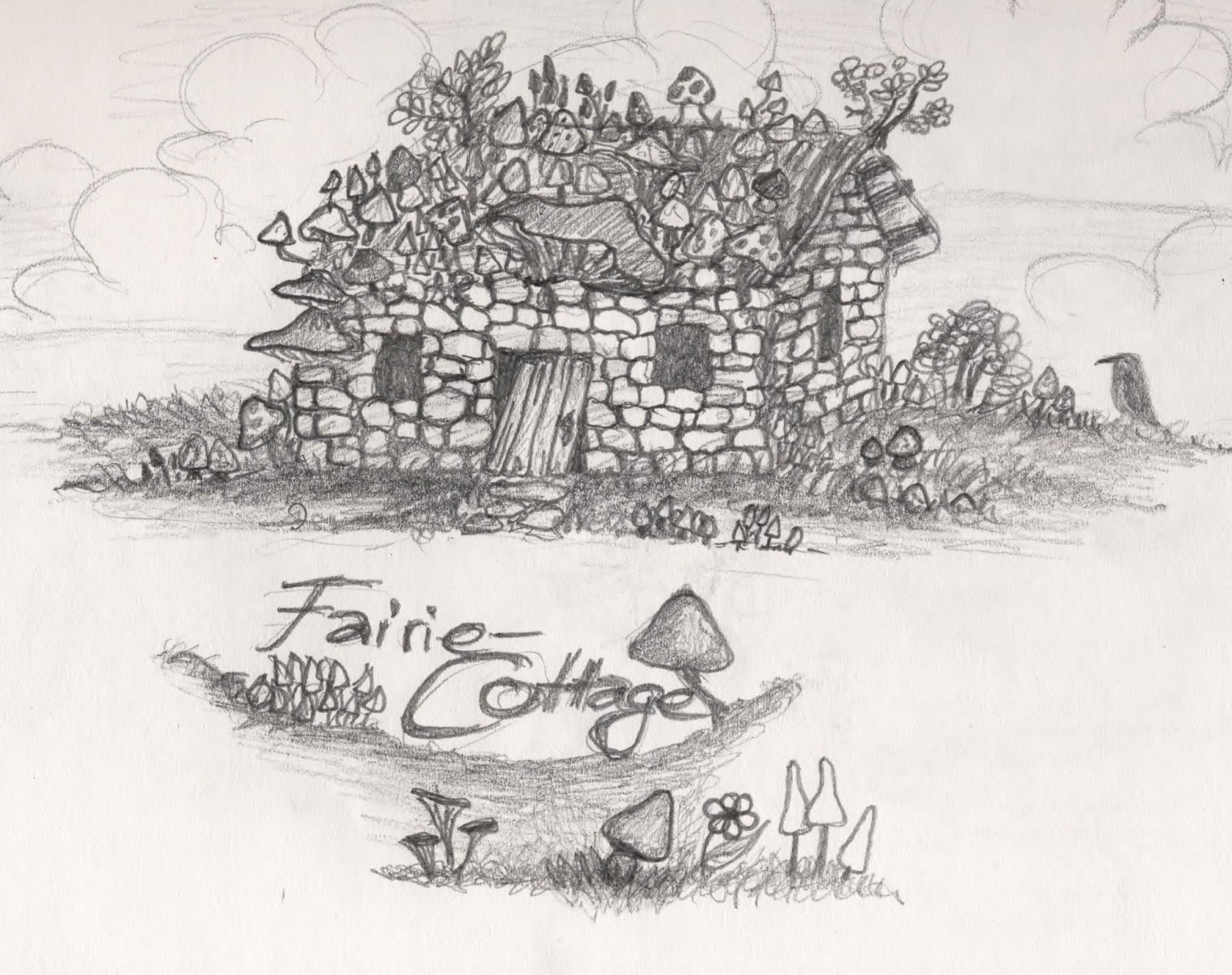
And now, a few pages from our player Lui's sketchbook (creator of the wonderful Tomb of the Iron God maps). These illustrate sights and marvels seen by the Band of Iron in connection with the faerie realms.

The mind-altering faerie fruit doesn't actually have the Goofy Grape and Loudmouth Lime faces, but it is very addictive. Lui's character has been lucky to survive this far, considering that the high-concept is "an elf who wants to taste everything."

.jpg)

Friday, 16 November 2012
One Last Harpy: Interposing Decency
Before I conclude the Naked Harpies series with a grand analysis of sociopolitical forces in conflict, I want to draw attention to one more harpy, from the 2nd edition D&D Monstrous Manual:
 Here we see a transitional form. After the raw naturalism of 1st edition, it's still clear that harpies shouldn't be wearing clothes. But ... but ... the moral panic! The D&D cartoon! Think of the children! So the artist makes use of a visual stratagem as old as prudery itself - the decorous interposition. In this case, the harpy's arm.
I guess most of us learned in Sunday School how very leafy the Garden of Eden was, and how very long Eve's hair.

For those with a more secular upbringing, you may recall that it was very important for evolving primates to put their right foot forward, or at least swing their arms a little:

Pulp magazine covers sometimes didn't even bother with the interposing object, trusting in the artistic merit of the marble-like, hairless and pigmentless female form, diaphanously clad or not. But sometimes they used it like pros:

As moral standards for newsstand entertainment tightened, the scenery became more obliging. Here is a wonderful driftwood intervention from the height of the paperback era:

You're probably more familiar with the spoof in Austin Powers, but the height of proscenic propriety was reached in the 1970 sci-fi film Colossus: The Forbin Project, where the evil computer orchestrates a naked tryst that is shown ... well, let's just say it's the only film in history where the choice to drink wine instead of martinis was the difference between an "M" and "X" rating.


I guess most of us learned in Sunday School how very leafy the Garden of Eden was, and how very long Eve's hair.

For those with a more secular upbringing, you may recall that it was very important for evolving primates to put their right foot forward, or at least swing their arms a little:
Pulp magazine covers sometimes didn't even bother with the interposing object, trusting in the artistic merit of the marble-like, hairless and pigmentless female form, diaphanously clad or not. But sometimes they used it like pros:

As moral standards for newsstand entertainment tightened, the scenery became more obliging. Here is a wonderful driftwood intervention from the height of the paperback era:

You're probably more familiar with the spoof in Austin Powers, but the height of proscenic propriety was reached in the 1970 sci-fi film Colossus: The Forbin Project, where the evil computer orchestrates a naked tryst that is shown ... well, let's just say it's the only film in history where the choice to drink wine instead of martinis was the difference between an "M" and "X" rating.

Subscribe to:
Posts (Atom)