Showing posts with label fun. Show all posts

Saturday, 20 August 2016

Waiting Out Sleep (etc.) Non-Boringly

A good game-runner, tester, designer, stays alert to the signs of boredom around the table. Like the rules that everyone forgets, the experiences that don't lead to fun or meaning need to be identified, diagnosed and dropped.

One non-fun experience in D&D and its ilk is the use of enemy powers that take a player's character effectively out of the game. Who has not succumbed to the touch of a ghoul, the tentacles of a carrion crawler, or the icy grip of a hold person spell?

All these paralytic effects, however, last longer than the typical combat does. (Actually, AD&D never gave durations for monster paralysis, but 2nd edition has ghoul touch lasting 3-8 rounds and carrion crawler paralysis lasting at least 2 turns.) This mean the affected character is warming the bench until the combat ends. Visible boredom results.

Taking paralyzation effects out of the game is not an option for me. They're an important part of the monster arsenal, much more forgiving than save-or-die, but still scary and threatening. One of my players who was concerned that his combat-machine character might be unbalanced received a healthy reminder to the contrary, when in the midst of pitched battle a hold person spell overcame his puny save against mind magic. A relentless press turned into a chaotic retreat, with the other characters having to manhandle the stiff body of the hapless warrior. The stuff of legends!

Why wait ten, twenty, thirty game minutes for the stiff to wake up can be turned into a procedure, a very simple game.

During combat, the player rolls a new saving throw against paralyzation each combat round, keeping track of successes, and also keeping track of rolls of a natural 5 or less.

  • A natural 20 means they roll again, keeping only success. 
  • A natural 1 means they roll again, keeping only failure.
  • After three successes, the paralyzation ends.
  • After three 5-or-less rolls, the paralyzation sets in and lasts for 10 minutes.

Taking the character out of danger (by ending or successfully fleeing the combat) means the character is no longer *trying* to wake up, and takes the full 10 minutes. Also, you can rule that each roll to wake up costs the character 1 hit point. This is not terribly unfair; usually attacks that paralyze don't do a lot of damage.

This rule give s a character the potential - if very lucky - to get back into the fight almost immediately. More importantly, it gives hope and something to do in what is otherwise a deadly boring situation.

Tuesday, 17 February 2015

Impulsiveness

I'm not sure if I'll get around to recounting the latest misadventure of the Muleteers, but there's a couple of posts to be had reflecting about the last session.

Huizinga, in The Waning of the Middle Ages, calls to attention "The Violent Tenor of Life"; the ease with which harsh and tender passions in alternation were unleashed, the revelling in cruelty. Although controversial as historiography, this description perhaps tells us more about what we moderns seek in the medieval, the archaic, the Renaissance or the Regency or the Wild West, when these are presented as times where life was cheap, morals were loose.


The role-playing game in its imaginative detachment allows the same vicarious pleasure in the impulsive act of grisly consequence. Vicarious? No, the direct pleasure of being able to say "I waste him with my crossbow" and having it happen as easily as saying it; of watching, horrified and grinning, in the mind's eye as a series of critical and fatal hits makes Peckinpah work of the enemy. The pleasure of being such a fearsome character and choosing to exert a brash and self-serving virtue; of hoisting sacks of coppers to urchins, the equivalent of Nino Brown serving up turkeys. The pleasure, even for mild-mannered character players, of being the monk hiding from the Vikings, the Wild West schoolmarm, the scholar who can live a little shady and still look a saint by comparison.

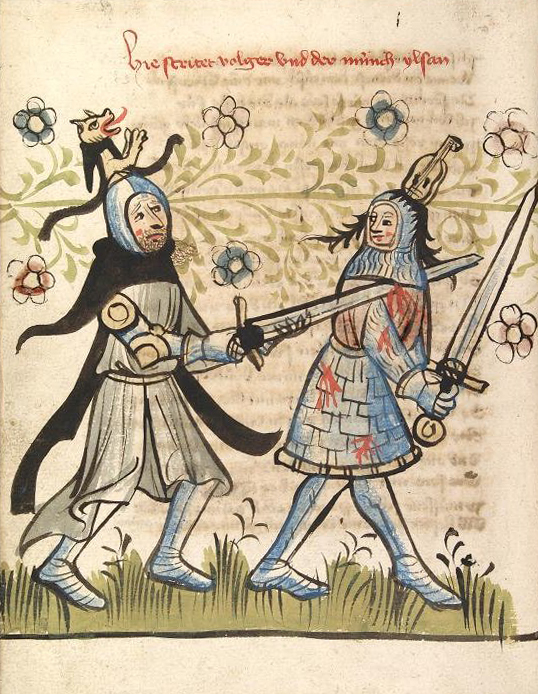
The roleplaying scenario strips away nervous inhibition and allows action as transgressive and pointless as that of the pictured fellow under the terrier crest who is spit-roasting a man for the crime of wearing a rebec on his head. Dealing out violence under these circumstances acquires a palatable irony because these are people long since dead, or better yet, who never could have lived.

One final pleasure, to the player, is finding out the boundaries of the world of action and joy. Does having a handful of hit points above the norm means that world is your arena whose inhabitants are merely bled and bowed bulls for the matador? Or rather, is it a place where crime is abhorred, vengeance is meted, and the arm of punishment is long if not swift?  Hurrah, for the scales are tipped in the favor of the latter option, the morality of the Hays Code, where we see every murder and blasphemy dealt out by the arch-hoodlum before the coppers surround him and fill him full of lead. Because to deal out the rough justice of consequences is the particular pleasure of the gamemaster. And the truly dispassionate gamemaster knows to make the delay or denial of justice, as unlikely as it may seem, a possible adventure in itself, if one of the hardest.

Tuesday, 19 March 2013

The Antisocial Nice Player

Here is one thing I have learned since turning my hand to active DMing as an adult:

Rule number one is: fun ...

and this applies to antisocial behavior, too. Many, many bytes have flown across the internet concerning the scourge of the player who backstabs and steals from the party, or the lout with poor social skills. Many suggestions have been made about how to deal with these people. But I say rule number one is fun.

We almost never see the following situation brought up. I'm not sure how common it is, but consider it as a thought experiment.

Five people and a GM get together to play a game. Four of the five players have fun playing a freewheeling, treasure-filching, underhanded bastard. The fifth wants to play cooperatively and do great and heroic things.  This causes friction at the table.

Yes, this is a conflict of fun, too. As much so as when the numbers are the other way around. The way to resolve this is the same - alert the out-of-step player that they are out of step and give them the choice to either play differently or leave the group. Or, maybe you as GM don't think you have the skills to referee a four-way intrigue hurlyburly, so the right thing to do is confess: "I can't produce fun for you guys." And not put it on the players.

But why is this situation never recognized? Even if it never happens, even as a thought experiment, it has the value of focusing you on what is really right and wrong about the situation. Thinking about it makes you realize that a lot of this "behavior advice" is actually moralization of one kind of fun over another. A lot of this advice, consciously or not, is taking the kind of behavioral modeling you might apply to a classroom of schoolchildren and trying to apply it to adults who choose to play a game together.

To give my personal odyssey: Running my first old-school campaign, I was exaggeratedly afraid of the hazards of backstabbing, even though its players were three of the nicest and most cooperative people I've seen. I required them to swear an oath of mutual support to the folk-saint of adventurers on the skull of a dragon, which was completely unnecessary. The current campaign group flies very well without such artifice. Even more so, DMing pickup sessions for the university game club has given me a renewed appreciation for the sneaky player, how to handle them and let them contribute to the fun. It may be that I put them on best behavior (I did get addressed as "sir" a few times when I first started showing up), but at the same time I've managed to have good times DMing the high-flown as well as venal, the socially skilled and the more unfortunate.

Yes, there are hard cases and horror stories. And those, as in all things, tend to circulate because they make good campfire tales. But those situations should be judged and handled the same way you would handle any other social situations. Letting go of the need to implement some kind of maturity lesson into your rules and play, I think, is the sign of true maturity.

Saturday, 16 February 2013

Preposterawesome Cockodrills

The word "preposterawesome" came to mind while watching The Man With The Iron Fists. It also applied to my experiences watching Skyfall and The Hobbit. It is when you are aware that your disbelief is not just suspended, but in freefall without a parachute, but you somehow manage to suppress your x-ty-eight year old brain and enjoy it anyway with your eight-year-old brain.

There are some role-playing games that have it, mostly by Palladium. Whether Synnibar does remains to be seen, but one of my players was a Kickstarter backer and is making noises about GMing it (or rather, taking on the mantle of whatever preposterawesome name Synnibar has for the referee).

When preposterawesome fails it becomes either preposterawful (like Turkish Star Wars) because even an eight-year-old can see through it, or spuriawesome (like Sky Captain) because it tries so hard to be awesome but is obviously playing note by note from The Complete Idiot's Guide To Being Awesome, like roleplaying games that dole out Awesome Points!!! or make you roll Just Got Real Dice!!!


Anyway, the shining example of all time is undoubtedly Clark Ashton Smith's epic poem about being a Dungeon Master, "The Hashish Eater." The medium is "bad poetry" - the nightmare you might have after downing a Milton, Coleridge and Poe milkshake just before going to bed - but he just kills it anyway.

[...] They come,
The Sabaoth of retribution, drawn
From all dread spheres that knew my trespassing,
And led by vengeful fiends and dire alastors
That owned my sway aforetime! [...]
And griffin-mounted gods, and demons throned
On-sable dragons, and the cockodrills
That bear the spleenful pygmies on their backs;
And blue-faced wizards from the worlds of Saiph,
On whom Titanic scorpions fawn; and armies
That move with fronts reverted from the foe,
And strike athwart their shoulders at the shapes
The shields reflect in crystal; and eidola
Fashioned within unfathomable caves
By hands of eyeless peoples; and the blind
Worm-shapen monsters of a sunless world,
With krakens from the ultimate abyss,
And Demogorgons of the outer dark [...]

Demogorgons I can see ... kind of like medusas or draculas ... but ... cockodrills?

COCKODRILL

Paternal line: crocodile
Maternal line: hybrid of rooster (m) and mandrill (f)
HD: 5
AC: 3[17]
Damage: d12
Move: 9" (15" in water)
It lurks in a tree or the water and then jumps out and bites. If it gets a tasty morsel on the first bite it runs, but fights if it has no escape. Its hands can fling mud in your face if it has no better mode of ranged attack. With a spleenful pygmy as a rider (halfling with berserker morale), it overcomes its sneaking nature and fights as a fierce war steed.

Tuesday, 25 September 2012

The Last Word on Game "Fans"


xkcd just nailed it to the wall.

Nailed: the worst variety of dilettante players of competitive games. Doubly so if the game involves identification with a strategy or faction. Heck, any simulationism opens the door to "I should be able to win doing this!"

What would the RPG equivalent be? Something like

"Hey, can I play? I heard this game really encourages fun!"

(backstab) (grind) (argue) (derail) (nitpick)

"This game isn't very well designed. For starters, it didn't keep me from ruining your fun."