Monday, 30 December 2013

Treasures of the Reconstituted Wunderkammer

From where we live in southeast England it's ridiculously easy to get over to Amsterdam for a long weekend and we recently did just that. Finally, we got to see the remodeled Rijksmuseum - but one of of my best memories, the wunderkammer of strange and beautiful craft objects jammed together like in a Golden Age Dutch grandee's show-off room, was gone, its inhabitants scattered to more period-appropriate settings around the museum.


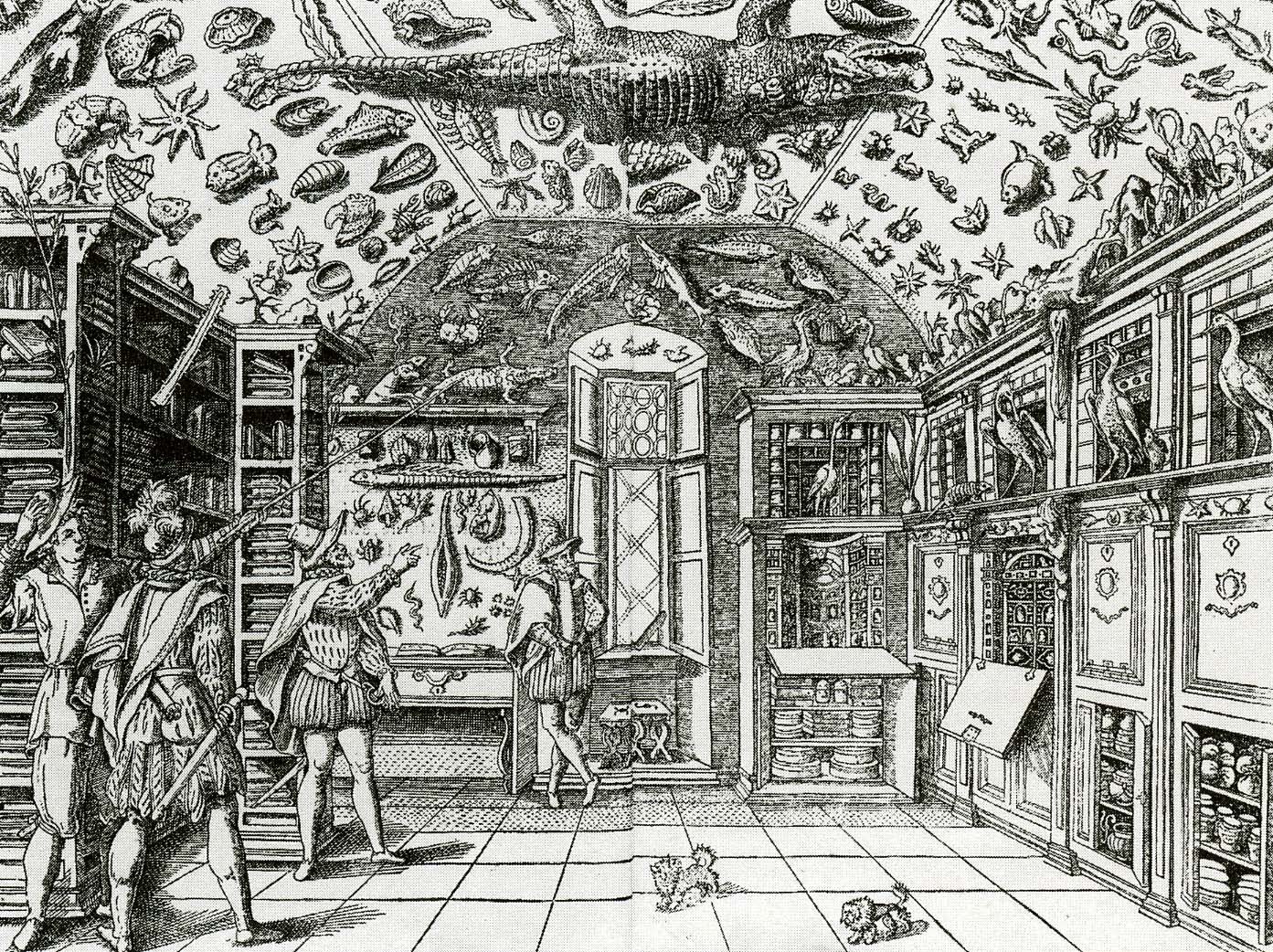
Bah, I say, the best feature of the Rijks is the way it combines arts with crafts, so in one room you'll have Rembrandts on the walls, and some inlaid tables in the middle, with equal recognition of the skill in both. For the benefit of all, through assiduous note-taking on a museum map, I have reconstituted and aggrandized the wunderkammer as a d20 table of those items of treasure most likely to excite the eye of the bounding venturer and to bear subtle enchantments.

1. Bronze figurine of a snake, eating a frog while crushing a mouse, and in turn being bitten by a lizard.
2. Painted oaken carving meant to be suspended from ceiling, of a woman holding a noble coat of arms, with two antlers jutting out behind her like legs or tails.
3. Silver chain of linked quadrangular pieces, each embossed with a civic motif, and a silver bird pendant from the whole; the prize for winning a yearly shooting contest in a company of militia.
4. A book, an illustrated genealogy of 55 noted lords and ladies of the day, each personage depicted in full color with their coat of arms and a few words about their achievements.
5. A bronze aquamanile in the form of a standing, roaring lion, ridden and bitten by a smaller dragon that forms the jug's handle.
6. A "nut" carved of boxwood, a small sphere no more than three fingers' width with a tiny Ecce Homo crowd scene carved within.
7. A ceremonial shield made from a single elk antler, a bordure carved around the edges, and the stump of the antler carved into a knotted boss.
8. A ring fitted with a mechanical flintlock, that can always make a spark without fumbling for flint and steel.
9. A piece torn form the greatcoat of a military hero, in a wooden presentation box inscribed with the hero's name and valorous means of death. Its authenticity may be ascertained by comparing it to one of the many other such pieces in circulation.
10. A silver miniature, no more than thumb's length, of a slaughtered pig splayed on a butcher's frame.
11. Cup made from a nautilus shell, with gold stem and fittings giving it the neck and legs of an ostrich.
12. A diaphanorama; that is, a series of overlaid painted glass panes mounted in a wooden case, and when light is shone through theme a scene is revealed in three dimensions; in this case, the night sack of an ancient city by barbarians, backlit by a roaring palace on fire.
13. A set of twenty painted glass roundels, intended for projection through a "magic lantern" device of candle and lenses, depicting celebrated dwarfs and dwarves of some twenty years ago.
14. A folding harpsichord, small to begin with, with two sections of keyboard and strings that close like the halves of a book.
15. Rosewood case like a miniature chest of drawers, with some twenty very flat drawers, each of which contains three or four historically significant coins, each in its own compartment.
16. Set of four terracotta caryatids, two representing Remorse with hands covering face, two representing Penance with hands tied behind back.
17. Meter-square model of a tropical marketplace, with diverse and colorful stands, entertainers and spectators, all rendered in wood, metal and dried bread dough. Very fragile to transport.
18. Military helmet, allegedly intimidating in a very different cultural context, with two gold leaf vanes like rabbit ears each one over a cubit long, protruding at 45 degree angles from the crown.
19. Stone statue of a goddess, her garment in danger of removal by a pesky monkey, her body marked here and there with nail and tooth indentations from a recent assignation. 
20. Chess set that most will consider to be in poor taste, created in ceramic by the followers of a recently overthrown and near-universally despised would-be world emperor, with pieces showing his troops advancing in triumph and the enemy nations facing them in trepidation, and the names of his enemies inlaid around the edge of the board. Of interest chiefly to covert sympathizers and collectors with a long view of history.

Wednesday, 25 December 2013

An M. R. James Christmas: Dead Man's Eyes

By chance, Michael Bukowski of Yog-Blogsoth has reached a stopping point in illustrating the creatures of H. P. Lovecraft's imagination and is now tackling the creations of an author much admired by Lovecraft - the teller of Christmas ghost stories, Montague Rhodes James (here's his very different take on the monster I statted up as the sack custodian).

I was inspired by this to read through some of James' less well known stories - all available herein the spirit of Christmas scares.

Largely, there's a reason why the stories in his first collection are better known. The later tales for the most part are still soaked in that wry humor and English antiquarian charm, but require more moving parts, more apparitions and forebodings, to deliver increasingly anticlimactic shocks. James keeps challenging himself to come up with new ideas for scares, but many of these misfire (the haunted curtain pattern in The Diary of Mr. Poynter, for one).

One of these weird ideas that does work shows up in A View From a Hill (spoilers, perforce, follow). The dark secret to be discovered is that of an amateur antiquarian, Baxter, who dabbled in sorcery the better to show up his more learned peers. Two of his artifacts bear special interest for gaming. The first is a little mask ...


Lawrence was up in the bedroom one day, and picked up a little mask covered with black velvet, and put it on in fun and went to look at himself in the glass. He hadn’t time for a proper look, for old Baxter shouted out to him from the bed: “Put it down, you fool! Do you want to look through a dead man’s eyes?” and it startled him so that he did put it down, and then he asked Baxter what he meant. And Baxter insisted on him handing it over, and said the man he bought it from was dead, or some such nonsense. But Lawrence felt it as he handed it over, and he declared he was sure it was made out of the front of a skull.

The second mystery is a strangely heavy, hand-made pair of binoculars that our protagonist borrows. Gazing through them at an opposite hill, he sees a church and a gallows that had not stood for hundreds of years. As it turns out, this artifact results from one of Baxter's more advanced spells. Their optics are filled with the gelatin of boiled bones from beneath the gallows, which allow their user to "look through a dead man's eyes" in an altogether more modern and convenient manner.

Dead Man's Eyes

Be it mask, spyglass, or a more modern contrivance, this necromantic item is created with some part of a single dead being's body, and the spells speak with the dead, monster summoning of a level appropriate to the being, wizard eye, bestow curse, and magic jar, as well as 5000 gp of materials. When complete, it has the effect of showing a scene looked upon as the dead being might have experienced it, with typical or memorable activities of the day. (This power proved very useful to Baxter, as he could rifle the countryside for finds undreamed of by his contemporaries.)

However, after the first use, there is a 1% cumulative chance that each further look through the device will bring the attention of the device's spirit, who will then attempt to possess the user and drive him or her to ruin or suicide.

Scary Christmas to all, and to all a long night!

Sunday, 22 December 2013

Tales of the Arabian Nights

Here's a game that has given me more entertainment than it really has a right to. This is Tales of the Arabian Nights, the 2009 Z-Man Games remake of a 1985 West End Games production.


It's a board game, but the real engine is a huge Book of Tales with over 2000 numbered paragraphs. You roam a map representing the Old World as seen from the caliph's Baghdad, playing one of the Arabian Nights characters (Sindbad, Ali Baba, Scheherazade, etc.) Every turn you pull a card from the encounter deck, roll a die on a table to see what you get (anything from a House Fire to a Vengeful Efreet), and choose an action to take appropriate to the type of encounter (anything from Grovel to Court).

The player on your right checks a matrix and reads out a paragraph number, which the player on your left looks up in the big book and reads out loud. This paragraph sets out the situation, and may give better or worse results according to what skills your character has. Goodies you may get include Destiny Points and Story Points (which help you win the game), fabulous treasures, or improved skills. Balancing these out are the infamous "status" cards that some paragraphs hand out. Among other things, statuses can leave you cursed, turned into an animal, sex changed, diseased, or more ambiguously married (you get point benefits but have to stick close to your family's city).

The version I have is the 2009 remake, which hugely improved the graphics and doubled the number of paragraphs in the by now enormous Book of Tales, but did little else to streamline the game design. Indeed, a number of design choices still seem odd or not well thought out, with the quirks and complexity of the 1985 design mentality. Some encounter cards have different results for the second or third time through the encounter deck, but in my experience games often end without ever having to reshuffle it. Although the 2009 version makes official the 1985 version's "quest" variant with a deck of quest cards, these take on the role of directing play across the board, so that the city encounter cards, which give bonuses on reaching a particular city, now seem like an unnecessary afterthought. And the rule for dealing with the "expert" level of skills, in which the book reader has to scan the adjacent paragraphs for uses of that skill and switch to them, is still clunky.

All the same, I think the game has to be defended against one of the major criticisms you see on Boardgamegeek and elsewhere, which is that it's a random rollercoaster ride that doesn't reward strategy. I think this is actually a psychological effect, where the game is designed so that action choices don't always lead to the logical consequence or skill opportunity, so that even though the majority of outcomes have some logic to them, the ones that don't stick out in the memory and lead to the perception of the game as meaningless. But the alternative is to have a game where the Rob action always leads to a use of Stealth and Stealing, and so on, which is also not fun.

More to the point, this game is a litmus test. If you are able to enjoy taking part in a picaresque story full of reversals and randomness, Tales will be highly rewarding, and filled with "wow" moments like gaining fabulous treasures, visiting mysterious and climactic Places of Power, and those times when the random story elements come together in a coincidental, funny way - for example, when you just can't stop having encounters with that seductive efreeteh and her jealous efreet boyfriend.

The replay value, too, is higher than I expected, having played it four times in the past few months. The sheer number of paragraphs, the random elements that interfere between an action choice and the outcome work in its favor. So does the Poisson-like distribution of events - so that many common events tend to recur, like house fires and hunchbacked beggars, but the truly special things like Places of Power are much rarer. This is the principle used in most encounter tables to balance meaning and surprise in a world, and its use in Tales means that the game is not entirely guilty of presenting a complete random carnival of events.

Finally, Tales is unique in design in the game world, in spite of the suitability of its basic concept for a more convention sword-and-sorcery picaresque. Does the requirement to have a hundreds-of-pages paragraph book scare off designers? The Dying Earth world, I think, would be particularly ripe for such treatment.

Friday, 20 December 2013

Hey, It's Metafilter

So I got aggregated. So, yeah ....

It's the home of the fantasy heartbreaker that has attained self-awareness.


D&D is fundamentally uncool. Viva Quijote!


Wednesday, 18 December 2013

Near Orientalism World

For today, I'll post this cliche setting encounter table.


Next post, I'll talk about the game that partly inspired it.

Monday, 16 December 2013

What Next?

So having just dropped the 52 Pages it's time to take stock.

First, I did an outline of the Next 52 ("Next" is intentional, my hearties), that is, the "Expert" sequel covering character levels 4-6, what I think those levels should be up to, as well as stuff for use in expert starting campaigns. A few topics might look familiar but the rest will be brand new to me. Red pages are completed (Bard and Dilettante appeared before on the blog.)
But this aside, I have a number of other projects that are about half or more finished and I really should get out the door. 

"Ultimate Wilderness": The Next 52 wilderness rules are the stripped down version of this, also colorfully graphic but aimed more at a detailed, in depth building of hexcrawls and impromptu encounter adventures. It is pretty much an account of what I do to stock a blank district the players are turning toward. It is all basically a set of instructions for using my big encounter tables with silhouettes. Readiness: 75-80%.

"36 Pages": This is my series of d20 tables for setting ideas, organized by cliche. Slowly grinding along. Readiness: 60%.

"Manden Gouge, Book 1": All right so the percentage completion of the full ambitions of this megadungeon is miniscule. Tone it down to the ambition of producing a first book, on the caves and the upper works and shallow cellars of the great castle, Karthew's Legacy (something like 120-150 encounter areas), and we can say this is about 40% done.

"The Baroque 52": A wild hair I really shouldn't start on. But you know I will. Each of these 52 pages will contain 36 table entries in a TINY font, giving a "baroque" option for that topic in the 52PP. So where the 52 has "common equipment" the B52 will have 36 weird things that you might find in a village with their uses. Where it has "henchmen" the B52 will have 36 unusual abilities and drawbacks of henchmen. The idea is to flip the script on the generic, stylized, streamlined presentation and give free reign to the other side that led to Pergamino Barocco.

So as you see, this New Year I will have no shortage of resolutions and might even make some of them come true ...

Friday, 13 December 2013

Download: 52 Pages 1.0

It's here. All 52 Pages. Download link on the right (or here if you're lazy). I even cleaned up the treasure table so it has a little more breathing room and an example.

Devil on the cover makes it Old School.
At the end, all I can say is that there are many rulebooks out there for this kind of stuff, but none like this. Enjoy.