Showing posts with label villains. Show all posts

Sunday, 23 August 2026

TSR's module A2, Secret of the Slavers' Stockade (Dungeon Level)

After a long hiatus, during which my role-playing table defeated all that A2 had to offer, I probably should wrap up with a critical review of the dungeon part of the module.

Like the fort level, the dungeon is built around two "railroad" sequences of rooms which are shaded on the TSR map. Each is similar in structure, leading the players at first through a sequence of traps, trick ambush fights, and difficult problem environments. Each sequence culminates in a boss-group fight that (like the climax of the fort level) is laid out tactically for the GM in a then-innovative detail map showing the location of each foe and furnishing.


Also like the fort level, these tricks and traps are for the most part shamelessly silly. This is D&D funhouse material with no care for naturalism. There's a magnet trap in the wall, punishing plate mail and capturing blades while hobgoblins run out and hit you with wooden clubs. There's a gauntlet of oily grille-bars through which a colony of boggles, the dimension-hopping menaces used as hound dogs in the fort, will stab and pickpocket you. There's a cave that can only be traversed by finding the sawn-off tops of stalagmites that cross an abyss filled with obscuring and sometimes scalding steam. There's a room with beehives, but no flowers; a room for cheesemaking, with nothing remotely milkable.

Indeed, if the module's dungeon were laid out just with the two railroads connected end-to-start, the whole ordeal would be a ridiculous way for the bad guys to run their operations - tortuous, snaky, running visitors and reinforcements through deadly steam, giant spiders, and bees. But in the first improvement over the fort level, the published edition of the dungeon adds sensible secret passages that both make more sense of its layout and allow more discovery and choices in play. There's a secret shortcut around the boggle grille that can be deduced by watch the scary but harmless ghost of an elf act out its last actions on Oerth. There's another that allows bypassing the steam and bee perils, leading from the first boss fight to the newly developed back area of the second boss fight -- an area that itself is laid out in a branching, not railroad, way.

Some of the other trickery works remarkably well in play. The boggles in their grille-gauntlet get to use their limb-phasing ability for good effect, not wasted as it is in the fort level. I played it like this: for each 5 x 5' wall, floor or ceiling surface a player is exposed to, they have a 1 in 6 chance of being spotted by a boggle (and can then attack its face, if they are watching and ready in that direction), once spotted, they have a similar chance of coming under attack from each surface they're close to, with an even chance of being stabbed or pickpocketed. I was able to drive the players to some truly wild levels of spell-based problem solving to get the more vulnerable members across. One even had a prized weapon stolen from him, which in the bounce-back world of 5th edition stings much more than 10 or 20 hit points damage would. The hives and their honey-bucket trap, as silly as they are, also lead into creative solutions (5th edition makes it easy to talk to the bees and that's the way my nature-loving players went.)

The end-of-railroad fights, like the one in the fort level, show off principles of a good tactical challenge that would become codified in advice to Dungeon Masters over the coming decades - variety of opponents, terrain features and obstacles (stairs, balconies, tables), and weaponized hazards (falling chandeliers, brine vats, caged monsters). By the early 80's it could no longer be taken for granted that DMs had a devious wargamer mind, so each fight comes with a detailed playbook of the foes' positioning, moves, and spells. These instructions may have been created out of a wish to standardize the running of the combat in tournament situations, but they also came to serve as examples for DMs who wanted to write and run their own memorable combats at home.

In the fort level, many of the added areas beyond the tournament gauntlet seem like dead ends or afterthoughts. In the dungeon, the added areas are much better done. They include the living quarters and operations of a varied group of slavers, led by Markessa, the boss of the final fight. As in the preceding module, there is an area of cages, as well as living quarters for the slaver NPCs. In full realism mode they include a kitchen, mess hall, and latrine. 

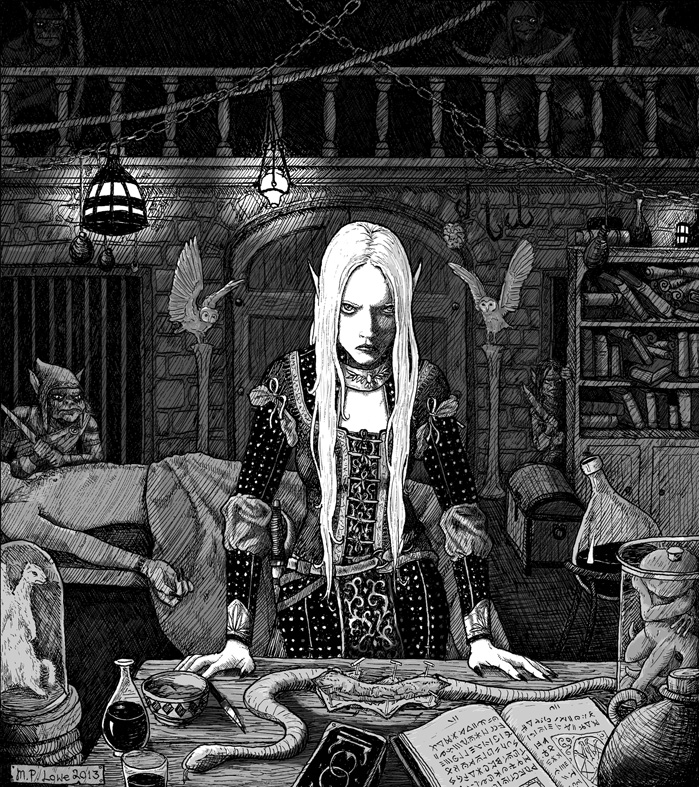
We also find the lair of Markessa and areas supporting her operations. This evil elf is already memorable as a mad scientist -- she is responsible for many of the mutant creatures in the dungeon, and the fight takes place in her lab. Her home area has the details that establish her as one of the best villains in the TSR modules. There's a cloned body double, a surgically enhanced perfect lover and bodyguard, plenty of secrets and tricks, and a whole cave complex full of mutant humanoids, the cavelings, who worship her as a goddess. 

Markessa

The caveling area is the most underdone part of all this. The map places their caves in a tightly arranged 100' square, but the description of their environment deserves a more sprawling, abstracted or procedurally generated maze of tunnels to live in. The cavelings also are meant to fuel the unruly-stronghold dynamic. Not only are they subject to various mental derangements, but they steal and eat slaves from the cells from time to time (how exactly?), and they explicitly can be turned against the slavers and even their creator Markessa. How the rabble-rousing is supposed to happen, when to get to the caveling area you will have to fight through both the slavers and, probably, Markessa, is not clear. Still, the intention is there.

When you run out of space in the corner of the graph paper

A better unruly element is the gang of slavers nominally allied with Markessa, whose leader, Blackthorn, is an ogre mage who affects a creepy-barely-human shape. Like his name-alike in James Clavell's Shogun (Japanese ogre, get it?), Blackthorn is ambitious and might work with the party to betray Markessa. In his barracks are some werewolves and a group of slavers who mostly embody the banality of evil - an architect, an accountant, an alchemist, all keeping the wicked operation running. 

 Blackthorn is a more credible early encounter, as his area can be reached through one of the secret passages early on. But Markessa has a way of spying on him -- a telepathic potted plant with hidden mutant eyes and ears which, although absurd, is memorable and perfectly in character for the mad scientist.

Overall, the dungeon level presents a fun challenge marred by implausible excess and less-than fluent strategic design. I have to also mention the obvious repetition of elements from the fort level. This is understandable if the level was designed to be run in parallel, but it creates jeopardy if the whole place is run as one adventure. These repeats include:

  • Were-creature henchmen (boars above, wolves below) 
  • A kitchen with a grumpy cook
  • A trap with a rolling danger (bear on wheels, pile of logs) and a pit behind
  • A slave gone insane (escaped in the fort, caged in the dungeon)
  • An apparition tied to the trauma of its death - represented by two different monster types, the haunt and the less dangerous phantom, both intended to be less difficult than the official high-level Ghost monster.
  • An NPC found sitting behind a desk, who pretends to chat with the PC's in good faith for a while, then flips the desk and attacks


As well, there's material that repeats well-known beats from other TSR modules of the era. There's a wholly gratuitous delegation of drow and a tunnel leading down to the underdepths. Obviously, this calls back to the culmination of the Giants series, but tends to undermine Markessa as the most evil elf-type around. The masquerading ogre mage is maybe just a good use of the monster type but recalls a similar climax at the end of one of the railroads in White Plume Mountain. 

As a whole, A2 is a more ambitious, unbalanced, and overstuffed experience than A1. The unruly elements don't quite rule out the danger of a total party kill on the fort level, while the dungeon level is both less railroaded and less amenable to a complete mobilization of the defenders. The creative and naturalistic challenges of A1 take a turn for the worse, into absurdist funhouse territory. Markessa is a much better final boss than the underwhelming Sturm Bluchholtz of A1 (who's not even named in the first printing). As proof of her appeal, in the Slavers sequel module from 2000, the idea of a self-obsessed villain who creates a line of clone henchwomen led to some righteous excess, with different color-coded Markessas roaming the Flanaess.

The Stockade can be said to outdo the Undercity, but that's not always a good thing. In any event, we are past the high-water mark of the series now, as we prepare for the least worthwhile module of the quartet, A3 - Assault on the Eyrie of the Slave Lords.

Thursday, 4 April 2024

Night's Dark Terror 13: Xitaqa 4, Curse You Golthar!

This is part of a series of posts with a scene-by-scene critique, appreciation, and improvement of the 1986 TSR module B10, Night's Dark Terror

The next deathtrap in Golthar's tower, room X11, is personally run by the evil magic-user himself. It appears to be a dead-end art gallery, but the paintings on the walls have peepholes in them. These allow Golthar to cast spells through them from a hidden passage that surrounds the place. If the adventurers try to remove or attack the paintings, electric traps zap them. Meanwhile, two pink jade statues of Hutaakans animate and attack. 

Clever mappers will already have noticed that the room's dimensions are smaller than the tower's outside, leaving room for additional secret areas. But this is only a convenient ambush point, not Golthar's last stand. At the first sign that the party has found the secret door leading out, he will flee up the stairs to his bedchamber.

Crafting the art gallery, from Battlin' Barrow

The setup is not described precisely, but it's reasonable that, Scooby-Doo style, the peepholes are concealed in the eyes of portraits. The stone wall is ancient and thick, but we can imagine a missing block about the size of a caster's head, so the whole face can fit in. Once a panel with painted eyes is pulled back, the peeper's real eyes can press right up to the holes. Sharp-sighted appreciators of the arts may notice that the eyes of each painting are set a little deeper than the canvas.

The secret door is also not described very well, because this is Old School writing, not Old School Revival. It makes sense that the door is behind a painting, the only one that's not trapped or holed, and that lifting the painting off its peg rotates the door open, while putting it back (or pushing the peg down) snaps the door back. Perhaps, cheekily, the painting can be of a Great Gate in a nearby city.

Golthar's attack moves, in the module-as-written using Basic D&D, are likely to be as follows. 

State of Play: He has already cast detect invisible and so, as a 6th level magic-user, has three level 1, one level 2, and two level 3 spells left. He holds one level 3 slot for Fly, and one level 2 slot for Mirror Image. He has memorized other spells to fit the strategy below.

Pre-battle: Casts shield on himself, to protect against counter-missile shooting and magic missiles

Round 1: Most likely, Golthar has surprise and starts at the far southeast end of one of the corridors. As the player characters are likely to be 4th level or below, they will be affected by sleep, and on average this will KO two 4th level or three 3rd level characters, no saving throw. If he's lucky, the whole party might go down! As stated, he also activates the statues to attack any characters left standing.

Round 2: Golthar moves to another eyehole - in general, he will want to decrease the distance between himself and the stairs. He uses his other level 1 spell, magic missile, to hit the weakest-looking foe, magic-users by preference.

Round 3: Any elves or other still-awake targets left, Golthar moves again and will try his luck with hold person.

Round 4: He is out of spells, so as written, he will make an escape upstairs.

As you can see, this is a brutal sequence that heavily stacks combat in favor of the jade statues and can lead easily to a total kill (or capture) of a party of five or fewer characters who've already been through some tough combats in Xitaqa. Capture is not the end of the road, though. The evil warlock (a 6th level magic-user, to use the Expert D&D title)  would simply kill Stephan to show he means business, and trade the remaining heroes of Sukiskyn for the fateful tapestry he seeks.

What recourse does the party have in this art gallery turned shooting gallery? I recommend allowing characters to cover a single painting with a readied melee attack, or all the paintings in their front field of vision with a missile or ranged spell, to hit Golthar as a held action when he starts chanting from behind the canvas. This will be at -4 to hit in Basic, or at disadvantage in 5th edition, but a hit in Basic will at least disrupt the spell, and in 5th will have a chance to disrupt any concentration spell he has up.

In 5th edition, the three conversion guides I've seen vary in their interpretation of Golthar. Based on other adaptations from that series I've seen, Jay Murphy's Classic Modules Today version is likely to be minimal and rely on minimally reskinned standard 5e creatures, so I didn't inspect it further; P. Daniel Johnson's Iconic Encounters adaptation, which I arrived at late, thoughtfully tackles the known issues with the module with copious notes and advice, and sticks close to Golthar's original spellbook; the Vaults of Pandius adaptation credited only to "G. M." is also minimal, but more creative than Classic Modules, and features a much stronger Golthar. What the Golthars have in common is a combination of control and damage spells, which can be applied in the same way as the Basic strategy I've listed above. In 5th edition, Golthar can shoot damage cantrips as long as he likes, so the encounter becomes more pressing. Still, he will likely lose nerve once he takes substantial damage in the face from a held missile.

The next encounter takes place in the next-up and final floor, X12, Golthar's bedchamber. As written, it's less of an encounter than a scene, and a pulp-serial cliché at that. In too much of a hurry to pick up the enormous amount of treasure and significant objects locked in his personal footlocker, Golthar, ever the drama queen, blows out one of the walls with high explosive. He then uses fly to escape, and covering his tracks, casts mirror image to create two additional flying Golthars. All this is set up to happen in a single round just as the first party members come charging up the stairs. 


Figures painted (mostly) by me; map by Elvis Spadoni

The module as written does consider what happens if the party kills Golthar (umm, yeah, an identical evil mastermind takes over in further encounters). But it's mute on what happens if he is given too much time to get away. It strains belief that the avaricious bastard will not salvage his most precious items, including the golden needle and thread that might show the way to an even larger treasure, if given three or four rounds unthreatened. The party might be slow to find the secret door, they might be slow to regroup, or some of the hobgoblins or Iron Ring goons might still be around to block the stairs. If Golthar gets away with the magic needle, there is no way to deduce the location of the lost Hutaakan city from the Sukiskyn tapestry, and no further adventure beyond selling off the white horses at last.

Maybe ... hear me out ... that's not such a bad thing? After the white herd is sold off, the adventure's next act becomes less compelling, as we will see. The players' time might be better occupied chasing some other lead, including the mini-adventures to the east that didn't fit the relentless pace of the planned events up until now.

Or ... hear me out ... Golthar intends to leave the needle in the chest.  He realizes it is easier for the party to put two and two together, than for him to lay hands on the tapestry. The Iron Ring has many eyes, after all, and the heroes will find it hard to keep their destination a secret ... But, let's not get too far ahead.

The description of the bedchamber, by the way, is really great, showing Golthar's twisted character through a set of furnishings in subtle bad taste. Our man leaves a huge treasure, over 10,000 gold coins as well as some more portable items. The coins will take 10 bearers to shift even at half speed, under Basic D&D encumbrance rules. 5th edition players have less weight to deal with but will still probably travel at less than ideal speed. Also, there's a (fabric?) scroll of the ancient Hutaakans that, if deciphered, will give a little more of an idea what Golthar is after.

So, exit the villain, one way or another. There's still a whole goblin village to get past, and possibly some Iron Ring underlings returning to the site on horseback. But assuming our heroes get back to Sukiskyn, and even if they find the secret map hidden in the tapestry, the next order of business is also plain: that herd of white horses, at long last, is going to market.

Next: On the road to Rifllian

Saturday, 18 June 2011

Moral Disgust III: The Perverse

There's one last feature of moral disgust that might be worth exploring. It has to do with desire.

An up-and-coming theory in moral psychology says that we can make three morally relevant judgments on any behavior: the desire of the actor, the action he or she actually took, and what the consequences are. For example, someone might want to do something that hurts someone (bad desire), nonetheless carries out an action to help them (good action), but without meaning it, that helpful action actually backfires and hurts the person (bad consequences).

What this research tends to find, with a few exceptions and glitches, is that people tend to base recommendations about punishment and reward on consequences; base judgments of the action on what the action did; and base judgments of the person's character on his or her desire.

WHH: big in Japan
I want to focus on this link between character and desires because disgust, responding to people as "things" rather than actors, seems to have a link to desire. Those who are aficionados of weird literature know of William Hope Hodgson, and maybe have read what I consider his best story, The Voice in the Night. Without giving away too much, at one point one of the characters in the story gives in to a physical need that he knows will doom his humanity. What is particularly horrifying about this is the desire with which he succumbs to this temptation - "immediately filled with an inhuman desire" in Hodgson's words - and his struggle and self-loathing.

Meanwhile, on the social science side, some colleagues and I have been running a study that, if it works out, will back up some ideas we had about they way people can be seenless than fully human based on the emotions they feel ... well, now that the corpus callosum between the gamer and psych sides of my brain has fully fused, I can present this to you guys as a fully fledged villain-ology.

There is the Misguided Villain, who has the full range of human emotions - including the ability to feel disgust, remorse, hope. This one may be doing the wrong thing, but has the right desires.

There's the Animalistic Villain, with none of the higher emotions, only the bestial ones - lust, anger, fear, pleasure.

There's the Mechanistic Villain, with no emotions at all. Perfectly rational, with cruelty only as a side effect.

Finally, and most relevant, there's the Perverse Villain. This one has all the emotions but feels them at the wrong times: joy at people's suffering, disappointment at their success. This is the classic stage villain, and the one who most forcefully reveals the wrong desires that I suspect lead to moral disgust.

Horror - fear and disgust - both these emotions compel someone to flee. The more distance you put between yourself and the scary or disgusting thing, the more the emotion subsides. The horror of desire - of sweet-smelling corruption, of the desirable body with the skeleton face - is that you willingly bring yourself closer to the vile thing. But the vile thing is not so disturbing as what your self-conscious mind reveals about you. You are perverse. Your desire is corrupt. Like Hodgson's castaway, you yourself are the monster.

Do I use this in my campaign? Well, my players may remember an amorphous thing with mouths in the cellar of the millhouse ... a thing that radiated a smell of honey and fresh meat.

Friday, 10 June 2011

Moral Disgust I: The Body

One theme of my lab's research that is smashing into print in a esoteric, university-library-only journal near you this year (4 papers out or in press, 3 more under review) is the distinction between moral anger and moral disgust.

Two of Paul Ekman's research faces.
The first thing to recognize is that anger and disgust correlate highly across moral situations. So, if someone sees something and says they're "disgusted" they're also likely to say they're "angry." A less finicky language might just call both emotions of moral condemnation something like "outrage" and leave it like that.

Except what people call "disgust" also seems different for different kinds of outrage. What our research tends to find, using carefully varied scenarios, is that moral violations that involve harm or unfairness attract high levels of anger, and a kind of "disgust" that's very highly related to anger. But when you factor out the effects of anger, disgust really stands on its own mainly as a visceral response to moral codes about the use of the body.

In other words:
  • I tell you about greedy corrupt politicians - and you may say you are disgusted, but go "grrr".
  • I tell you about someone who has cloned his or her own muscle cells in order to eat a consensual, harmless, ethically sourced human steak - now you say you're disgusted, and go "yuck" - nobody is harmed, so you only go "grrr" a little - but importantly, most people (not all) feel there's something morally wrong about this technical cannibalism.
Jack Chick's "Gay Blade"
We came up with examples like the human steak to test, even for the most liberal of our respondents, the true limit of moral tolerance. If you're liberal and you want to know how conservative people feel about sexual immodesty or same-sex marriage, think about your own reaction to the human steak. Nobody's rights are violated, but there's a sense of wrong about it.

Back to imaginative literature and gaming. There's a tendency, most pronounced in works that aspire to  "epic" or "traditional" storytelling, to stack the deck with both moral anger and moral disgust - and to help that along with liberal lashings of physical disgust. Think of Frank Herbert's Baron Harkonnen, with his boils (physical disgust), catamites (moral disgust) and underhanded cruelty (moral anger/disgust/outrage). That works, if the reader plays along with the assumptions of the work. If the reader doesn't, this all-in-one moral universe becomes a nagging flaw. I mean, I love me some Jack Vance and in particular Lyonesse, but damn if "queer = villain" doesn't get tiresome in that series.

The body is often also moralized, and overlaid with disease and deformity arguments, to feed a dehumanizing and xenophobic political agenda. Just one very obvious example: the Nazi caricature of Jews encompassed disgust at alleged physical uncleanliness, strange dietary practices, physical abnormality, and sexual licentiousness. All this came to a sharp and pointed end with the final accusation to justify the Holocaust; Jews were not just gross but dangerous and malicious. Indeed, some of our recent unpublished studies implicate fear and moral anger, as well as disgust, in the tendency to dehumanize members of other social groups.

Yeah, yeah, so fantasy heroes are little Nazis slaughtering orcs. We've all heard that before, so that even the counter-cliche itself is at risk to get worn out. In my creations, I'd prefer to keep to hand the power of bodily-moral disgust, avoiding both cliches, letting the audience draw its own conclusions. These strange customs, they are weird and gross; the high priest marries his sister, ritual scars are salted to a fine purple hue, here's a feast to which everyone contributes a slice of their own flesh. Are these marks of villainy, or of mere strangeness? Our explorers of the unknown have signed up for encounters with both, in any event, and the interpretation is up to them.