Showing posts with label medieval. Show all posts

Tuesday, 17 February 2015

Impulsiveness

I'm not sure if I'll get around to recounting the latest misadventure of the Muleteers, but there's a couple of posts to be had reflecting about the last session.

Huizinga, in The Waning of the Middle Ages, calls to attention "The Violent Tenor of Life"; the ease with which harsh and tender passions in alternation were unleashed, the revelling in cruelty. Although controversial as historiography, this description perhaps tells us more about what we moderns seek in the medieval, the archaic, the Renaissance or the Regency or the Wild West, when these are presented as times where life was cheap, morals were loose.

The role-playing game in its imaginative detachment allows the same vicarious pleasure in the impulsive act of grisly consequence. Vicarious? No, the direct pleasure of being able to say "I waste him with my crossbow" and having it happen as easily as saying it; of watching, horrified and grinning, in the mind's eye as a series of critical and fatal hits makes Peckinpah work of the enemy. The pleasure of being such a fearsome character and choosing to exert a brash and self-serving virtue; of hoisting sacks of coppers to urchins, the equivalent of Nino Brown serving up turkeys. The pleasure, even for mild-mannered character players, of being the monk hiding from the Vikings, the Wild West schoolmarm, the scholar who can live a little shady and still look a saint by comparison.

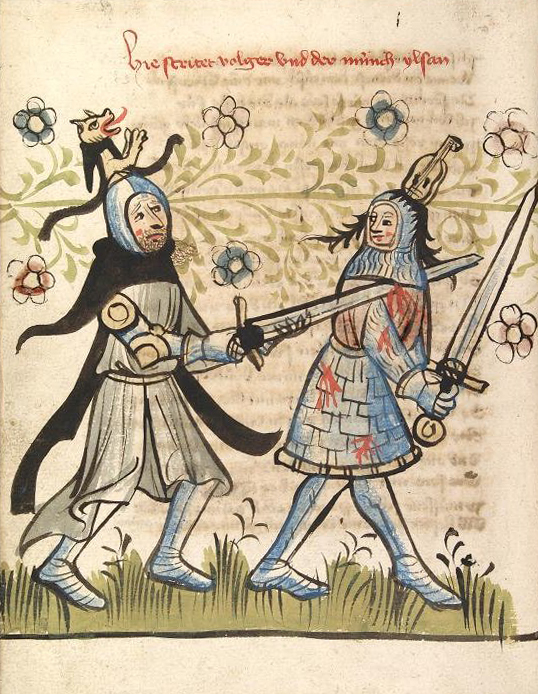
The roleplaying scenario strips away nervous inhibition and allows action as transgressive and pointless as that of the pictured fellow under the terrier crest who is spit-roasting a man for the crime of wearing a rebec on his head. Dealing out violence under these circumstances acquires a palatable irony because these are people long since dead, or better yet, who never could have lived.

One final pleasure, to the player, is finding out the boundaries of the world of action and joy. Does having a handful of hit points above the norm means that world is your arena whose inhabitants are merely bled and bowed bulls for the matador? Or rather, is it a place where crime is abhorred, vengeance is meted, and the arm of punishment is long if not swift?  Hurrah, for the scales are tipped in the favor of the latter option, the morality of the Hays Code, where we see every murder and blasphemy dealt out by the arch-hoodlum before the coppers surround him and fill him full of lead. Because to deal out the rough justice of consequences is the particular pleasure of the gamemaster. And the truly dispassionate gamemaster knows to make the delay or denial of justice, as unlikely as it may seem, a possible adventure in itself, if one of the hardest.

Tuesday, 15 April 2014

Archaic Overload

Last time, I introduced the concepts of kitsch and overload. Although kitsch-criticism was developed by members and satellites of the Frankfurt School in the mid-20th century, it's been opposed since then, for its aesthetic and economic elitism, its stand against mass production and mass preferences. I tried to separate from the loaded term "kitsch" the concept that a work of art or imagination can have effect by overloading its impact - saturating its content in the direction of commonly accepted forms, rather than perpendicular to or away from them.

I don't think there's any argument that by whatever name, kitsch or overload is the dominant form in the aesthetics of both commercial and DIY adventure gaming. In fact, it can be broken down into three elements of style that begin with an "A". The first one is the overload of Archaism.

Archaism kitsch can be seen in the way artists choose to depict that quintessential adventure setting, the dungeon. Number one earmark is the set-dressing habit of "dungeon architecture." The classic fieldstone walls and ensconced torches have a tendency to adorn even chambers deep in the earth that should be hewn out of the living rock, and where torches would quickly consume all available oxygen, even if there were minions to replace them on the hour ...


The reason for the overload: if you just have economical 5' passages hewn through stone, they could be anything - a Cold War bunker entrance, a Minoan adit, a university steam tunnel. The stone blocks and iron-reinforced doors yell "Castle!" as loudly as they can. But this is not an inevitable choice. Here's an illustration by John Bingham, from Mouth of the Shadowvein, that manages to avoid the medieval style of Archaic dungeon overload (although doubling down on Adversity with its centipede floor):


The bas-reliefs, however, remind us that another way to convey Archaism is to raid the archaeological toybox: statues, reliefs, mosaics, skull doors and demon thrones. In fact, the default overload response to "What part of antiquity?" is "All of it." So we derive the typical adventure setting with its anachronistic cohabitation of Roman, Dark Age, High Medieval, cod-Renaissance, and Nation X imitations.

Fanciful depictions of never-were civilizations and lost races also go in the mix, the costumes and scenery derived from a mix of medieval and faux-barbaric sources, with sex appeal turned way up. Compare the standard loincloths-and-bangles "Conanesque" setting with ones such as Tekumel, drawing on similar source material, but with more originality.

Focus on any one period of history, and you lose the freedom of archaic overload. If the setting is medieval, the question becomes how medieval - fairy-tale medieval, or boils-and-rats medieval? The more representational you get when it comes to history, the more you have to worry about things that make history boring - for example, a party of freebooting adventurers would almost certainly be outlawed in every jurisdiction of a feudal society. So paradoxically, even as dungeon kitsch evokes the medieval, it also avoids its hard questions.

To illustrate -- early gaming illustrations, a stone's throw away from medieval wargaming, felt  free to present fairly realistic armaments:

David C Sutherland III
But later developments in art, as producers judged audience reactions, created a glossy, "generic antiquity" overload feel (note the introduction of fanciful elements like the feathers and armor molding in the Larry Elmore Dragonlance piece):


And still later, illustrations cranked up the depiction of the next overload element: Adversity. Yes, even on a costume. More next time.

Friday, 15 November 2013

What Rough Bestiary: Agricola's De Animantibus Subterraneis

Patrick Stuart is the one to blame for invoking it, and Humza Kazmi for completing the summoning, on G+ recently. So now we have Georgius Agricola's underground monster manual for entertainment.

Basilisk vs. weasel
There is the usual medieval bestiary nonsense about how bears lick their cubs into shape because Ovid said so, foxes fish with their tails, weasels kill basilisks, and also some choice bits:

Killer hamster: "It seems angry and caustic to a degree that if an unprotected horseman were to pursue it, it is accustomed to leap up and seize on the face of the horse, and if someone were to capture it, it is accustomed to hold on by biting." [109]

Haemorrhoid snake: unfortunate name for "a snake whose bite was said to cause bleeding from all over the body" [117]

Fire toad: "On the other hand, the poisonous frog, which our miners call by their own word puriphrunos (fire toad) because of the color of fire which is on it, hides continuously among rocks as if buried and interred... In this way they appear in solid rocks, although there are no holes to be seen." [119]

Six types of demons: "In fact, Psellus, when he classified the number of demons into six types, says that this kind is worse than the others, because the material of its skin is thicker." [121] (Psellus' classification, found here, is into Igneous, Aerial, Earthly, Aqueous, Subterranean and Lucifugus - a whole topic unto itself.)

Hobgoblins: "For they passionately ridicule joy; and they seem to do many things, but do nothing completely." They appear as old men clad in the manner of miners, 3/4 as tall as a dwarf, and were enslaved by the Swedish. [121-122]

The use of these creatures is left as an exercise to the reader.